
Lieferung heute & morgen

Qualitätsgarantie

Willkommens-Angebote freischalten: KOSTENLOSE Lieferung | Bis zu 80 % RABATT | Kostenlose 30-Tage-JoyPlus-Testphase
App herunterladen
A steam cleaner for upholstery and carpets can be used in a wide range of ways around the home, in the car and when caring for mattresses. However, the appliances differ considerably. Some models mainly use hot steam, while others combine a spray function, brush and dirty-water extraction. If you only focus on wattage or a high temperature, you could end up buying a machine that is not suitable for your needs.
A high temperature can loosen dirt and help freshen up certain surfaces. However, it cannot replace a suitable brush, sufficient contact time or effective dirty-water extraction. On delicate textiles, excessive heat can also encourage discolouration, material changes or water marks.
Before using the appliance for the first time, test it on a concealed area. The care instructions from both the appliance manufacturer and the textile producer take priority.
An upholstery cleaner or carpet cleaner should ideally extract loosened dirt straight away. A sufficiently large clean-water tank and an easily accessible dirty-water tank are therefore important. A small tank may mean that you need to refill and empty the appliance frequently.
An overflow protection system is also important. If dirty water remains in the appliance for too long, performance may drop and cleaning can become less pleasant.
A comprehensive accessory set is only useful if the attachments suit your intended use. Narrow nozzles and brushes, for example, are useful for sofas, carpets and car seats. Different attachments are needed for hard floors, grout or windows.
A steam vacuum cleaner with spray, steam and suction functions is not automatically the right choice for every surface. Check whether the manufacturer has explicitly approved the relevant material for use with the appliance.
The temperature specification should always be considered in relation to the intended use. For the models featured here, the stated values range from at least 90 °C up to 145 °C. A short heat-up time can be useful when treating just a few individual stains.
Controlled use is essential for upholstery, mattresses and car seats:
Terms such as mite and bacteria removal should not automatically be understood as a guaranteed effect. Where such figures are stated, they are manufacturer claims whose conditions and measuring methods should be checked.
For individual stains, a spot cleaner with a narrow nozzle is often sufficient. For larger carpeted areas, however, a combination of spraying, brushing and extraction is useful. A high suction-power rating can provide an indication, but it is not the only criterion. Hose routing, filters, brush design and airflow also affect how easy the appliance is to use in practice.
A traditional steam cleaner often works with steam without extracting dirty water to the same extent. A carpet washer sprays cleaning solution onto the surface and then extracts it again. Combination appliances bring several functions together, but may consequently be heavier and require more maintenance.
For regular use around the home, tank capacities of around one to several litres are practical. A larger clean-water tank reduces interruptions, but usually increases the weight of the appliance. A separate dirty-water tank makes it easier to monitor the water that has been collected.
Also look for:
Steam appliances must not be directed at people, animals or electrical equipment. Before refilling or cleaning, the appliance must be switched off, unplugged from the mains and allowed to cool down.

Why this product suits the profile: Its compact design is suitable for dealing with individual areas of dirt on sofas, carpets, beds, car seats and hard floors. According to the product information, the model delivers 600 W and 18,000 Pa of suction power.
The stated suction power and focus on spot cleaning make its intended use clearer than that of a steam-only appliance without dirty-water extraction.
18,000 Pa of suction power according to the product information; designed for use on several textile and hard surfaces.

Why this product suits the profile: This model combines spraying, brushing, steam and extraction. It has a stated 1.6-litre clean-water tank, a 0.95-litre dirty-water tank and an output of 1,650 W.
The separate water tanks and stated overflow alarm help you keep an eye on liquid extraction and the tank fill level.
1.6-litre clean-water tank; according to the product description, steam of at least 90 °C and heat-up within 30 seconds.
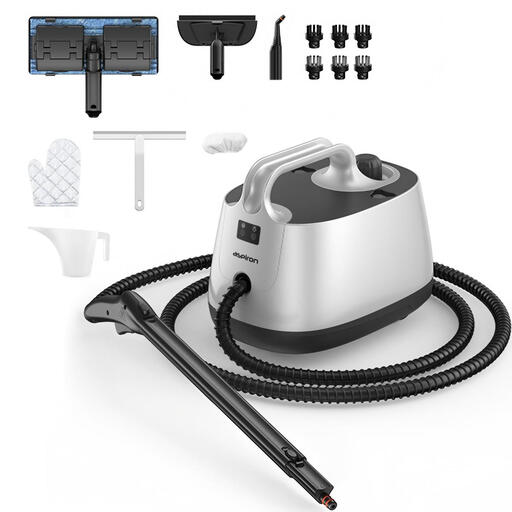
Why this product suits the profile: This steam appliance is aimed at households that want to clean not only upholstery and carpets, but also hard floors, windows, grout, curtains and the car.
The 21 stated accessories make it easier to adapt the appliance to different surfaces. A material test is still required before using it on textiles.
According to the product information: 1,500 W, 4 bar, steam temperature of up to 145 °C, a 1.5-litre water tank and 21 accessories.
We have put together a complete, regularly updated list of products that fully meet these strict selection criteria and the safety regulations applicable in the EU.
For steam cleaning in the car, compact nozzles are particularly practical. Car seats should not be excessively dampened, as moisture can penetrate the upholstery structure and interior trim. With hard floors, check whether the flooring is suitable for hot steam.
On suitable surfaces, hot steam can allow you to clean with water without additional cleaning products. However, this depends on the material and the type of dirt. Greasy or deeply embedded stains may require a cleaning solution approved by the manufacturer. Chemical-free cleaning is therefore a possible operating method, but it is not a blanket guarantee for every material and type of dirt.
This depends on the water hardness, how often the appliance is used and the manufacturer’s instructions. In areas with hard tap water, more frequent maintenance may be necessary. The manufacturer’s guidance is decisive. Descaling products should only be used if they have been expressly approved.
In addition to electricity consumption, water, cleaning products where applicable, filters and replacement brushes all contribute to running costs. A higher wattage may affect heat-up time or operating performance, but on its own says nothing about the total cost. If you only treat individual stains, you will generally use less water and time than when cleaning large carpeted areas.