
Lieferung heute & morgen

Qualitätsgarantie

Willkommens-Angebote freischalten: KOSTENLOSE Lieferung | Bis zu 80 % RABATT | Kostenlose 30-Tage-JoyPlus-Testphase
App herunterladen
STEM toys for children combine play with subjects from science, technology, computing and mathematics. However, choosing the right product is not always easy for parents, grandparents and educational settings. Many products appear versatile on the packaging, but require additional accessories or are too advanced for the stated age group.
Three typical buying patterns particularly often lead to the wrong decision:
The age rating is an important safety and usage guide, not merely a marketing statement. For children aged around 3 to 5, simple, interactive educational toys with large controls are suitable, such as a learning toy with lights, sounds and shapes. For children aged 6 and over, building kits, marble runs and age-appropriate science and technology experiments are worth considering.
For chemical experiments, growing crystals or a slime laboratory for children, you should always check whether an adult needs to be present. Heating water, mixing substances and storing small components should never be left solely to younger children.
Before buying, it is worth checking the detailed parts list:
An RC building kit with a rechargeable battery may require additional charging time and the use of an app. A Triops experiment kit, on the other hand, involves ongoing tasks such as feeding, water care and daily observation. A chemistry experiment kit should also clearly explain how materials are used and disposed of afterwards.
When buying toys for the German market, shoppers should look for clear labelling, easy-to-understand instructions and details of the responsible person in the EU. The CE mark is required for many types of toy, but it does not replace checking the specific warnings.
Small parts may present a choking hazard. Electronic components must not come into contact with water, and chemical sets should be kept out of the reach of younger children after use. A well-organised box or sealable container is practical, ensuring that no parts are lost and that experiments can be continued later.

Why this product suits this profile: The set requires no batteries and includes moulds, measuring cups, mixtures and four storage jars. It is suitable for children aged 8 and over who want a clearly defined introduction to practical experiments.
The included basic materials reduce the need for additional accessories. However, an adult should supervise the use of hot water and pouring.
Two flavours, several moulds and four customisable jars combine an experiment with storage afterwards.

Why this product suits this profile: The kit contains 604 pieces and allows children to build five models, including a robot, racing tank and tracked vehicle. App and remote-control operation appeal to children aged 6 to 12 who want to explore technology in a hands-on way.
The number of models is clearly specified. Buyers can also see in advance that they will need to allow for the rechargeable battery, app, assembly and supervision when handling small or sharp-edged parts.
604 building pieces, five construction options, a 2.4 GHz remote control and four app modes provide several technical learning and play experiences.
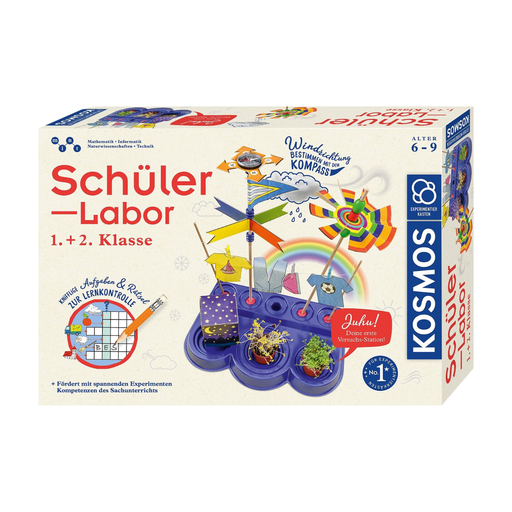
Why this product suits this profile: The set is designed for children aged 6 to 9 and contains more than 50 experiments covering light, shadows, air, water and the senses. This makes it suitable for regular activities at home or as an addition to primary-school learning.
The broad range of topics is clearly set out in the product description. The illustrated instructions and knowledge-based activities structure how the set is used, rather than offering isolated effects alone.
More than 50 activities, a format designed for the 6–9 age group and hands-on experiments without batteries support repeated use.
We have put together a complete, regularly updated list of products that fully meet these strict selection criteria and the safety regulations applicable in the EU.
For nature observation, consider a fossil excavation kit such as the Jar Melo Geological Gemstone Excavation Kit or a Triops experiment kit. Anyone interested in growing crystals for children will find sets with a process that can be observed over several days. A children’s slime laboratory, a bouncy-ball set or a kit designed to inspire children to make their own gummy sweets combines visible results with simple changes to the materials.
For younger children aged 3 to 5, interactive educational toys with cards, sounds or large controls are generally more accessible. A marble run for children aged 3 and over can also encourage spatial thinking and an understanding of cause and effect. It is still important to observe the warnings about small balls and small parts.
Many science sets are designed for ages 6 or 8 and over. The specific age rating, the materials used and the level of supervision required are the key factors. Sets containing small parts are generally unsuitable for children under 3.
The usable lifespan depends on the concept. A one-off chemistry experiment ends when the materials have been used up. A building kit, marble run or Student Lab with multiple activities, on the other hand, can be used repeatedly. Replacement parts and refill materials should be checked before purchase.
This depends on the product. Electronic models require batteries or need to be charged. Animal observation sets may require care accessories, while many hands-on experiments can be carried out using household materials. Checking the full contents list helps you estimate the total cost realistically.