Owners of passive speakers
You want to keep using the speakers you already own, so you start by checking their specifications against those of the amplifier.


First, choose an amplifier that suits your passive speakers and the connection you use to play your recordings. A traditional integrated amplifier is a good choice if you have a suitable source device; choose a streaming amplifier if it supports the network service you want to use. In an open-plan living space, speaker placement and reflections affect the sound at your listening position, as Genelec explains in its guidance on room acoustics and speaker placement. For listening at low volumes, suitable volume control or a headphone socket may matter more than a higher wattage rating.
You want to keep using the speakers you already own, so you start by checking their specifications against those of the amplifier.
You mostly play recordings through network services and want to know whether the amplifier itself supports the service and connection you need.
You want to listen to guitar recordings in a particular spot, perhaps at a low volume. Speaker placement, reflections and consideration for others all play a part in your decision.
| Criterion | What to check | Who should pay particular attention |
|---|---|---|
| Speaker compatibility | Check whether your speakers are active or passive, and whether their impedance and connections are compatible with the amplifier. | If I want to keep my passive speakers, I’ll first compare their specifications with those of the amplifier. Speaker compatibility comes first for around 31% of consumers. |
| Connections and playback method | Match your source’s output to a suitable amplifier input or a streaming service the amplifier supports. | If I play recordings through a particular connection or service, I want to know whether I’ll need an extra device. Around 25% of consumers prioritise having the right playback method. |
| Sound at your listening position | Plan where to place both speakers and your usual listening position; consider room correction as a possible extra. | If I mostly listen from one spot, I want to be able to position my speakers and listening position sensibly. For around 25% of consumers, sound at the listening position is the most important criterion. |
| Listening at low volumes | Check how easy the amplifier is to operate at low volumes and whether it has the headphone socket you need. | If I want to listen quietly or use headphones, I look for the right controls and connections. Around 19% of consumers put quiet, considerate listening first. |
Power ratings may be based on different impedances and test conditions. A higher figure on its own doesn’t prove that an amplifier will reproduce acoustic guitar recordings better.
Only compare ratings measured at the same load and on the same basis, and check speaker compatibility first. For example, Yamaha Deutschland lists a minimum RMS power rating for 8 Ω and a frequency range of 20 Hz to 20 kHz for the A-S301.
Bluetooth and built-in network services are different ways to play audio. WiiM states that the Amp Pro doesn’t support AirPlay 2; features can also vary between related models.
Make a note of the service and connection you need, then check that they’re supported by the full model name. If the amplifier doesn’t support your preferred network service itself, you may need a separate, compatible source device.
Speaker placement and reflections affect how sound travels around a room. Genelec points out that calibration doesn’t always fully resolve acoustic problems.
Start by planning where to place your speakers and listening position. Then decide whether room correction could also help with your playback setup.
The A-S301 is a traditional integrated amplifier for passive speakers and compatible analogue, optical or coaxial digital sources.
The PMA-600NE combines Bluetooth, digital inputs and an MM phono input in a traditional integrated amplifier.
The WiiM Amp and Amp Pro are amplifiers with built-in streaming features for passive speakers.
The AXA35 is an analogue-focused integrated amplifier with an MM phono stage, tone controls and a headphone socket.
According to Marantz, the MODEL M1 is a compact streaming amplifier for music and TV, with HEOS and HDMI eARC.
This selection features Bluetooth amplifiers for use with a compatible source device.
 No image available
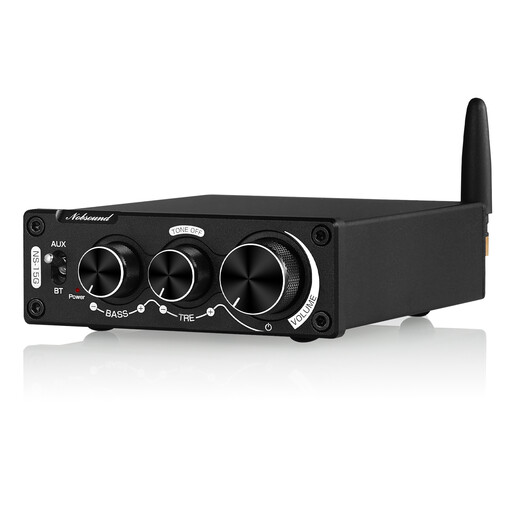
A potential option if you’re looking for a Bluetooth amplifier for passive speakers; check that your speakers’ specifications are compatible with the device before buying.
The product name states 200 W. This figure alone doesn’t prove that it will deliver better sound for acoustic guitar recordings.
The product description warns that using an incompatible power supply could cause overheating, fire or damage. Check the power supply requirements and use only a compatible one.
The speaker outputs described here are intended for passive speakers. First check whether your speakers are active or passive, then compare their connections with the instructions for the specific device. A similar-looking connector alone doesn’t mean they’re compatible.
Choose your usual listening position and try to place the two speakers as evenly as possible. Genelec explains that placement and reflections affect playback, and that calibration doesn’t always fully resolve room problems. Its guidance is about monitor placement and isn’t a measurement of your home.
It depends on how you play your recordings. Denon lists Bluetooth for the PMA-600NE; WiiM lists network features for the Amp Pro, which, according to WiiM, doesn’t support AirPlay 2. Check that the service you need is supported by the exact model variant before buying.
No. Local rules can’t automatically be applied to every home in Germany. Berlin’s environmental authorities specify quiet hours from 22:00 to 06:00 in Berlin and note that tenancy agreements or house rules may set additional requirements. Check the rules where you live.
In Germany, the statutory warranty provided by the seller is different from a voluntary guarantee. Online purchases generally come with a 14-day right to cancel from the date you receive the goods; exceptions and the terms of the specific contract should be taken into account.