Who is this guide for?

Owners of existing passive speakers

If you want to keep using your current pair of speakers, check that the connections and permitted speaker load are compatible with the amplifier in question. Yamaha Corporation and WiiM provide relevant connection and speaker information for their models.

Listeners with a varied blues collection

If you switch between physical media, connected devices and streaming, the inputs and playback options should suit your collection. Yamaha Corporation, Denon Deutschland and Marantz Deutschland list a range of connections and streaming features to consider.

People sharing control of a lounge

If several people control the music and volume, compare the controls available on the specific device, such as its buttons, remote control or app. Magnat and WiiM describe different control and streaming options for their models.

What should you consider when buying?

Buying priority What to check when buying Who will find this especially important?
Using your existing speakers Check the speaker type, connections and permitted load for the specific amplifier. Compare power ratings only when the impedance and measurement conditions are the same. If I want to keep using my existing pair of passive speakers, the connections and permitted load need to match the amplifier. Around 28% of consumers prioritise speaker compatibility.
Playing your blues collection Make a note of your existing sources and their outputs; check the analogue and digital inputs and, if applicable, the network services available on the exact model. If I switch between CD, connected devices and streaming, I want to play my collection without finding that a connection is missing. Around 22% of consumers prioritise compatible source connections and playback options.
Shared controls Consider who will control the sources and volume; compare the controls, remote and any required app or streaming options. If several people use the lounge, selecting sources and adjusting the volume should be practical for everyone. Around 22% of consumers prioritise ease of shared use.
Connecting a turntable Only if you plan to play vinyl, check the turntable’s output and whether it has a built-in preamp. If needed, use a phono input or a line input with a preamp. If records are part of my collection, I want to connect my turntable using the right signal path. Around 17% of consumers prioritise a vinyl connection.
Placement and ventilation Check the dimensions, accessibility of the connections and ventilation requirements in the chosen model’s manual against the intended location. If the amplifier needs to fit on a particular shelf or in a set position, you’ll need to be able to operate and ventilate it there. Around 11% of consumers prioritise placement.

Avoiding common misconceptions

  • Comparing power ratings without checking the measurement conditions

    Manufacturers quote power ratings at different impedances and under different measurement conditions. A higher figure alone does not prove that an amplifier is compatible with your existing speakers or offers an advantage in your listening space.

    Compare ratings only on the same basis, and check the permitted speaker load for the specific model.

  • Assuming a streaming amplifier automatically has a phono input

    WiiM does not list a built-in phono input for the Amp Pro. A turntable with a phono output needs a suitable preamp built into the turntable or an external phono preamp connected before the line input.

    Check your turntable’s output and the complete signal path before choosing a model.

  • Assuming similarly named models have the same features

    WiiM’s specifications distinguish between the Amp and the Amp Pro: AirPlay 2 is listed for the Amp, but not for the Amp Pro. Likewise, don’t assume that a CXA81 Mk II is the same as a CXA81 without checking the exact model.

    Check the full model name and verify every feature you need on the exact model.

  • Assuming shared music playback is private without checking

    Under § 15 UrhG, whether music is played publicly depends, among other things, on who the audience is and their personal relationships; calling a room a lounge does not determine this on its own. GEMA requires public music playback to be registered.

    Before assuming that registration is or isn’t required, check with the person responsible who can access the room and how the music will be used.

Key brands at a glance

Yamaha

The A-S301 combines analogue inputs with optical and coaxial digital inputs. The R-N600A adds network features and a phono input, making the models suitable for different source requirements.

  • Yamaha Corporation lists a continuously variable loudness control for the A-S301.
  • According to Yamaha Corporation, the R-N600A does not have HDMI ARC.

Denon

According to Denon Deutschland, the PMA-900HNE combines phono and digital inputs with HEOS network streaming.

  • Denon Deutschland lists 50 W per channel at 8 Ω and 85 W per channel at 4 Ω for the PMA-900HNE, along with MM/MC phono.
  • The archived DRA-800H is a different model, so its status cannot be applied to the PMA-900HNE.

WiiM

The Amp Pro is a compact streaming option for compatible passive speakers if you want network and app features.

  • WiiM lists 60 W per channel at 8 Ω and 120 W per channel at 4 Ω, as well as HDMI ARC, line and optical inputs.
  • According to WiiM, the Amp Pro has no built-in phono input and, unlike the WiiM Amp, does not support AirPlay 2.

Marantz

According to Marantz Deutschland, the MODEL 60n combines HEOS streaming with CD, MM phono and HDMI ARC connections.

  • These connections may be useful if you want to use a range of sources as well as connect a TV.
  • Manufacturer claims about sound do not independently prove that a product is particularly suited to blues.

Magnat

The MA 900 and MR 780 are different hybrid devices: the MA 900 lists MM/MC phono, while the MR 780 combines MM phono with DAB+/FM.

  • Magnat lists Bluetooth 4.0 with aptX for the MR 780, along with onboard controls and a remote control.
  • The advertised ‘warmth’ of the valve preamp is not an independently proven benefit for blues; choose based on the connections and features you need.

Suitable products on Joybuy

This selection includes a compact Bluetooth amplifier with RCA inputs and speaker outputs for compatible passive speakers.
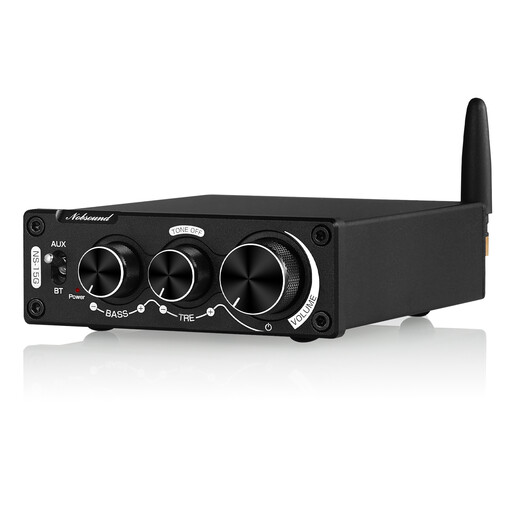
Nobsound Mini Bluetooth Digital Amplifier

Nobsound Mini Bluetooth Digital Amplifier

May suit compatible passive speakers if you want to use Bluetooth or a wired source via RCA.

Bluetooth and RCA inputs, as well as speaker outputs, are listed.

Volume, bass and treble controls, plus an input selector, are specified.

Joybuy

Frequently asked questions

Do I need a phono input for my records?

You only need a suitable phono stage if your turntable outputs a phono signal and you don’t already have a suitable preamp. WiiM describes two alternatives: a preamp built into the turntable or an external device connected before the line input.

What should I bear in mind when positioning the amplifier?

Follow the instructions for your chosen model and don’t cover the ventilation areas. The Magnat MR 780 manual, for example, specifies a gap of around 20 cm from walls; this requirement does not automatically apply to other amplifiers.

Who should I contact if there’s a fault?

For your statutory consumer rights, contact the seller; these are separate from any voluntary manufacturer’s guarantee. Verbraucherzentrale describes repair or replacement as possible remedies when a product is faulty. The rights that apply in an individual case depend on the purchase contract and the circumstances.

Do I need to register blues music played in a shared lounge with GEMA?

You can’t decide this based on the term ‘shared lounge’ alone. Under § 15 UrhG, whether music is played publicly depends on the audience and personal relationships; GEMA requires public music playback to be registered. So check who can access the room and how the music will be used before assuming that registration is or isn’t required.

Do online purchases automatically come with a 14-day cancellation period?

For consumer distance contracts, § 312g BGB generally provides a right to cancel, but there are exceptions. Where this right applies, the cancellation period is 14 days under § 355 BGB; check the information for your specific contract.