Owners of passive speakers
If you want to keep using your existing pair of speakers, first choose an amplifier that is rated for them.


If you already have passive speakers and suitable source devices, a traditional integrated amplifier is an obvious choice. If you want to access music services directly, consider a network or streaming amplifier. The key factors are whether your speakers are compatible, the signal path you actually need, and whether you have enough room for the unit, cables and ventilation. For listening at low volumes, a headphone output or adjustable loudness control may matter more than a higher wattage rating.
If you want to keep using your existing pair of speakers, first choose an amplifier that is rated for them.
If you play recordings through a music service or computer, you’ll need a source connection that works with the service and device you use.
If you need to keep the volume down at your desk or switch to headphones, consider how easy the amplifier is to use and where it will sit in the room.
Start by checking what type of speakers you have, then consider how you’ll connect your source device. Only then can you narrow down the features you need and the space required for installation.
| What matters | What to check when buying | Who is it important to? |
|---|---|---|
| Speaker compatibility | Check the speaker type and nominal impedance against the amplifier’s approved load range. | If I want to keep my passive speakers, their impedance needs to fall within the approved range. Around 36% of consumers prioritise this compatibility. |
| Source connection | Check the computer’s output, as well as your chosen music service and the supported transmission method. | If you want to play recordings from a computer or music service, choose a signal path that suits your device. Around 29% of consumers prioritise this connection. |
| Listening at low volumes | Check for a headphone output and the volume control options you want. | If I want to listen quietly in a shared home or switch to headphones, I look for suitable connections and ease of use. Around 21% of consumers put this first. |
| Available space | Compare the unit’s dimensions with the space available, allowing for cables and following the placement guidance. | If desk or shelf space is limited, check that the unit will actually fit, with room for cables and adequate ventilation. Around 14% of consumers prioritise the space it takes up. |
Power ratings can’t be used to rank sound quality if the impedance, frequency range or distortion conditions differ. Yamaha and Denon’s published specifications show why you need to check the test conditions for each model.
Compare the full power specifications and first check that the amplifier is rated for your existing pair of speakers.
Denon lists Bluetooth for the PMA-600NE, while WiiM distinguishes between its Amp and Amp Pro models. Bluetooth alone doesn’t tell you whether a particular music service or transmission method is supported.
Before buying, check the service, the protocol you need and the full model name.
If the connection you need isn’t available, you may need an additional compatible device.
The Yamaha A-S301 has a stated depth of 387 mm; you may need extra room for cables and to follow the manufacturer’s placement guidance.
Measure the space for the exact model and allow for cable runs and the ventilation requirements in the manual.
Yamaha’s A-S301 is a traditional integrated amplifier with digital inputs, while the R-N600A is a network receiver with MusicCast.
The PMA-600NE is designed for passive speakers and wired sources, with MM phono and Bluetooth also included.
According to WiiM, the Amp Pro is a streaming amplifier for passive speakers with network features.
The AXA35 is an analogue-focused integrated amplifier with MM phono and a wired headphone connection.
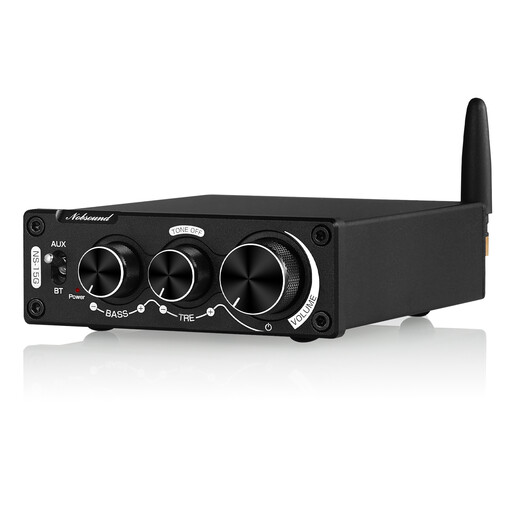
The product below is intended for passive speakers with Bluetooth or RCA input.
 No image available
For passive speakers when you need Bluetooth or RCA input.
The product specifications list speaker outputs and a load range of 4–8 Ω, as well as Bluetooth and RCA inputs.
The stated dimensions are 92 × 108 × 30 mm. Check that the relevant EU requirements apply to this specific device and, where required, that it is marked with the CE mark.
No. The speaker terminals on the amplifiers described here are designed for passive speakers. For active speakers, choose a connection that matches their input, and check that the source device’s output is compatible with it.
Position a stereo pair as symmetrically as possible in relation to your listening position, and watch out for reflections from walls and furniture. Genelec’s studio monitor placement guidance can be a useful reference, but it can’t guarantee a particular sound with other speakers.
Before placing an order, check delivery charges and any potential return costs, as well as who the seller is. According to Your Europe, when you make a qualifying distance purchase from a trader, you generally have 14 days from delivery to withdraw from the purchase. New goods bought from a trader are covered by a statutory guarantee for at least two years. This is separate from any additional manufacturer’s guarantee.
In 2017, Germany’s Federal Ministry for the Environment stated that there are no uniform federal statutory rules covering noise from people’s behaviour that affects neighbours. State and local rules, as well as building regulations, may apply; there is no general permitted time or noise level that can be assumed to apply in every home.
Germany’s Federal Network Agency explains that products covered by the relevant EU harmonisation rules must carry a CE mark. This marking does not indicate special sound quality, so check the information and documentation for the specific offer.