Who this amplifier guide is for

Chamber music listeners with a regular listening spot

If you usually listen from the same spot in an open-plan living space, consider your speaker placement and listening position together. A room measurement feature may offer another way to tailor playback to that spot.

Owners of passive stereo speakers

If you want to keep using your existing pair of speakers, check their connections and permitted load against the specifications for both devices before choosing an amplifier.

Listeners with a CD or streaming collection

Your choice depends on whether you want to connect separate sources or access music directly through supported network services. Check the connections and playback options for the full model.

What to consider when choosing

What matters What to look for Who should consider it?
Listening position and room Check where you can place your speakers and listening spot, and whether the specific model offers room measurement that will work for you. If you usually listen from one spot, placement and spatial sound are key. Around 36% of consumers put their listening position first.
Speaker compatibility Check whether your speakers are passive, then compare their impedance or permitted load with the amplifier’s manual. If you want to keep your existing passive speakers, the amplifier must match their connections and load specifications. Around 29% of consumers prioritise compatibility.
Music sources and connections Make a list of your source devices’ outputs and the services you want to use, then check the connections and playback options on the full model. If you switch between a CD player, turntable, digital sources or network services, make sure the connections and features you need are available. Around 21% of consumers put music sources first.
Listening volume at home Choose a listening volume that’s suitable for your home and check local rules and your tenancy agreement or house rules. High output power isn’t a target volume. If you live in a flat and want to be considerate of your neighbours, volume control and your listening setup matter. Around 14% of consumers prioritise being considerate at home.

Avoiding common buying mistakes

  • Comparing wattage figures without checking the test conditions

    Power ratings are based on specific impedance levels and may be measured using different frequency and distortion conditions. They don’t establish which amplifier will sound better in your living space.

    Start by checking your speakers’ specifications and the amplifier’s manual. Only compare power ratings when the test conditions match.

  • Confusing Bluetooth or digital inputs with network streaming

    Bluetooth, optical or coaxial inputs and built-in network playback are different features. Having a particular connection doesn’t automatically mean your preferred streaming service is supported.

    Check the service and playback method against the full model name. If your amplifier doesn’t offer the network playback you want, you may need an additional network player.

    An additional player means another device and another connection in your setup.

  • Relying on room measurement instead of good speaker placement

    Room reflections and speaker position affect what you hear at your listening spot. A measurement feature is set up at that spot, and it doesn’t replace suitable speaker placement or every room-acoustic adjustment.

    First, plan where to place your speakers and where you usually listen. Then use any available measurement feature to fine-tune the sound.

  • Checking only the model name on an imported product

    Power cables and included accessories can vary by country of sale. With an imported product, you may also need to check that the mains connection is suitable and find out how to make a complaint.

    Before deciding, check which version is being sold in Germany, what’s included and the seller’s details.

Key brands to consider

Yamaha

The A-S301 is a conventional integrated amplifier for connecting compatible separate sources, while the R-N600A adds network features and MusicCast.

  • Yamaha Germany lists optical and coaxial inputs for the A-S301, along with 60 W + 60 W at 8 Ω, 20 Hz–20 kHz and 0.019% THD. For the R-N600A, Yamaha lists Wi-Fi, Ethernet and 80 W + 80 W at 8 Ω, 20 Hz–20 kHz and 0.07% THD.
  • The power ratings are based on different test conditions. Yamaha Germany doesn’t list HDMI ARC for the R-N600A, so check the model’s connections if you need this feature.

Denon

The PMA-600NE is worth considering if you want to connect compatible digital sources, Bluetooth or an MM turntable.

  • Denon Germany lists 45 W per channel at 8 Ω, Bluetooth, digital inputs and MM phono for this model.
  • These connections alone don’t tell you whether the network playback you want is supported. Check the features of the specific model.

WiiM

The Amp Pro is a compact streaming amplifier for passive speakers, with network features and a room measurement function.

  • WiiM lists 60 W per channel at 8 Ω, Ethernet, network playback and RoomFit for the Amp Pro.
  • The manufacturer’s overview lists AirPlay 2 for the WiiM Amp, but not the Amp Pro. RoomFit is set up at your listening spot; it doesn’t replace suitable speaker placement or solve every room issue.

Marantz

The MODEL 60n combines HEOS network playback with connections for a CD player and an MM turntable.

  • Marantz Germany lists HEOS, HDMI ARC, CD and MM phono inputs for this model.
  • Whether it suits your setup depends on the connections you need, your speakers and their placement in the room.

Cambridge Audio

The AXA35 is a conventional integrated amplifier for compatible analogue sources, if you need a suitable phono input or a headphone socket.

  • The Cambridge Audio AXA35 manual documents a built-in phono input and a headphone socket. Connecting headphones mutes the speaker outputs.
  • Power cables and included accessories can vary by country of sale. Check the version on offer and the playback features you need.

Joybuy product selection

This selection includes a compact stereo amplifier for passive speakers, with Bluetooth and RCA inputs. Before buying, check that the connections, speaker load and compatible power supply suit your setup.
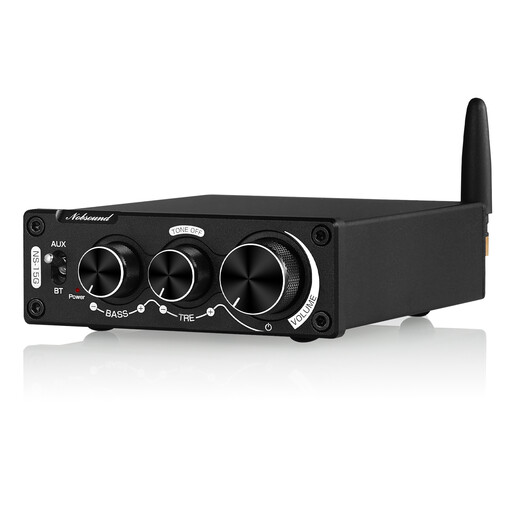
Nobsound 200 W Mini Bluetooth Digital Amplifier

Nobsound 200 W Mini Bluetooth Digital Amplifier

If you use passive speakers with compatible connections and want to connect a Bluetooth or RCA source, this compact device may be worth considering.

The product title states 200 W, but that figure alone doesn’t confirm whether it’s suitable for your speakers or how it will sound in an open-plan living space.

Only use the amplifier with a compatible power supply. According to the product description, an incompatible power supply could cause overheating, a fire risk or damage.

View at Joybuy

Frequently asked questions

Is a high wattage enough to choose an amplifier for chamber music?

No. Compare power ratings alongside impedance and test conditions, and above all check your speakers and where they can be placed in relation to your listening spot. The power ratings published by Yamaha and WiiM don’t, on their own, tell you how the music will sound in your home.

How do I set up room measurement in an open-plan living space?

On a supported WiiM model with RoomFit, take measurements at your listening spot using the WiiM Home app. The WiiM Help Center recommends a quiet environment and positioning the microphone at roughly ear height. This measurement doesn’t guarantee that every room reflection will be eliminated.

What happens if an amplifier is faulty after purchase?

For a consumer purchase in Germany, the seller is generally responsible for your statutory rights if the product is faulty. The Verbraucherzentrale gives a general time limit of two years from delivery; this is separate from any voluntary manufacturer’s guarantee. For sales contracts entered into from 31 July 2026, it describes additional information requirements and a possible extension of the time limit if you choose a repair.

Can I play music as loudly as I like in my flat at any time?

No. State law, local rules and house rules may all apply to noise from people’s activities. The Umweltbundesamt points to these different levels of regulation; the rules that apply to you depend on where you live and your house rules.

What should I check about a product’s safety when buying?

The Bundesnetzagentur lists CE marking, clear product and manufacturer details, and a German instruction manual with warnings among the points to check during market surveillance. This information doesn’t confirm that a specific offer has been checked or assessed as compliant.