Listeners with existing passive speakers
If you want to keep using your speakers, check the connections and electrical compatibility first, before comparing extra features.


First, check whether your speakers are passive and whether their connections and impedance are compatible with the specific amplifier. Next, decide whether you want to use separate source devices or built-in streaming services. In a shared room, easy-to-reach volume controls, a headphone socket or tone controls may also be important. Manufacturer specifications alone can’t predict how voices will sound in your room.
If you want to keep using your speakers, check the connections and electrical compatibility first, before comparing extra features.
If other people use the room at the same time, easy-to-reach volume controls and, where needed, a headphone socket may be important when choosing an amplifier.
If you play choir recordings from separate devices, check their connections. For music services, check whether the specific amplifier model supports them.
A good fit if: You use passive speakers and separate sources. Yamaha lists digital inputs and adjustable Loudness for the A-S301; Marantz lists analogue and digital inputs, as well as MM phono, for the PM6007.
Worth noting: Connections vary by model. According to the German Marantz product page, the PM6007 has neither HEOS nor HDMI. The manufacturer’s sound descriptions don’t establish how choir recordings will sound in your room.
A good fit if: You mainly want to use passive speakers with supported music services and reduce the number of separate source devices. Denon lists HEOS for the PMA-900HNE; WiiM lists network streaming and RoomFit for the Amp Pro.
Worth noting: Check the services, controls and connections available on the specific model. WiiM says RoomFit measures at the chosen listening position, so it doesn’t cover every seat.
A good fit if: Space is limited and your sources have compatible analogue outputs. MONACOR lists line inputs, tone controls and a headphone socket for the SA-100.
Worth noting: MONACOR specifies 2 × 20 W at 8 Ω for the SA-100. Network streaming and a phono input aren’t listed for this model.
| What matters | What to check before buying | Who this matters most to |
|---|---|---|
| Speaker compatibility | Check whether your speakers are active or passive, then compare their connections and impedance with the specifications for the complete amplifier model. | If you want to keep using your existing passive speakers, check their connections and impedance first. Around 36% of consumers prioritise speaker compatibility. |
| Listening considerately | Check the volume controls, headphone socket and what happens to the speakers when you plug in headphones, using the manual as a guide. | If other people use the room, you may want to adjust the volume easily or listen through headphones. Around 29% of consumers are particularly concerned with listening considerately. |
| Existing source devices | Compare your devices’ outputs with the inputs specifically listed for the amplifier. For turntables, check that the phono signal path is suitable. | If you want to connect existing devices to play your choir recordings, check their outputs and the compatible amplifier inputs. Around 21% of consumers prioritise using their existing music sources. |
| Streaming and listening position | Check which services are supported, how the amplifier connects to your network and, if it offers room calibration, whether this is based on your listening position. | If you want to use music services directly and reduce the number of source devices, check that the specific model supports them. Around 14% of consumers prioritise built-in streaming. |
Manufacturers may quote different figures for the same model at 4 Ω and 8 Ω. The MONACOR SA-100 product page also distinguishes between total and per-channel figures.
Compare only clearly defined figures, and first check that the speakers are compatible with the amplifier.
Denon lists Bluetooth for the PMA-600NE, while HEOS is specifically listed for the PMA-900HNE.
Check the supported services and connection method against the full model number. If a service you want isn’t supported directly, you may need an additional source device.
WiiM describes RoomFit as measuring and correcting sound at the listening position. This doesn’t automatically account for other seats in a shared room.
Choose the most important listening position, then assess the sound from the other seats people actually use as well.
The A-S301 is a traditional stereo integrated amplifier for separate analogue or digital sources.
The PMA-600NE and PMA-900HNE offer different options for connecting sources and streaming.
The PM6007 is designed for listeners with several analogue and digital sources, or a compatible MM turntable.
The Amp Pro combines amplification for passive speakers with network streaming, HDMI ARC and RoomFit.
The compact SA-100 is an option for analogue line-level sources and use in a shared room.
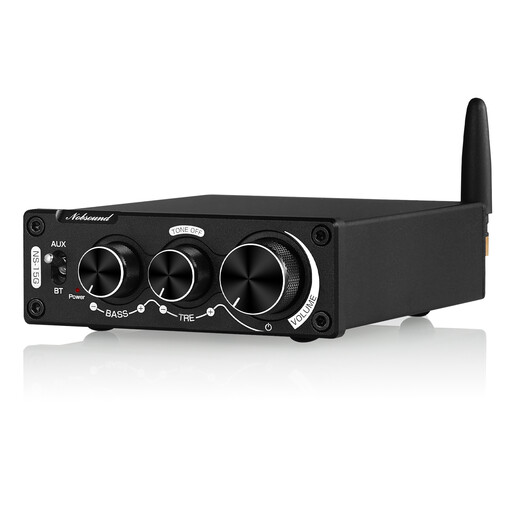
This selection includes a compact stereo amplifier for passive speakers, with Bluetooth and RCA inputs.
 No image available
A compact option if you want to use passive stereo speakers with Bluetooth or RCA sources.
The product description lists Bluetooth and stereo RCA inputs, speaker outputs, and volume, bass and treble controls. The 200 W figure in the product name can’t be directly compared with other amplifiers without a matching power specification and reference impedance.
First, check that the connections and the speaker load supported by the amplifier are compatible with your devices. Switch everything off before connecting cables, following the relevant manual. MONACOR specifically warns against inserting objects into the SA-100’s ventilation openings or opening the unit yourself.
Make sure the ventilation openings are clear; MONACOR specifically requires this for the SA-100. If you use WiiM RoomFit, the manufacturer says measurements are taken at the listening position, ideally in a quiet room. This advice applies to the models mentioned and isn’t a guarantee for all amplifiers.
Your statutory rights for faulty goods are against the seller and are separate from any voluntary guarantee. If there’s a fault, the first step may be to ask for a repair or replacement. The Verbraucherzentrale says the seller must cover the costs of transport, labour and materials. For distance purchases, you also generally have a 14-day right to cancel, which must be explained to you.
For electrical and electronic products within its remit, the Bundesnetzagentur checks matters including CE marking, whether the product can be identified, manufacturer details and a German-language manual with the necessary warnings. According to the Bundesnetzagentur, the manufacturer affixes the CE mark on its own responsibility; it isn’t proof of an independent sound test. Check the details for the specific product.
Old electrical equipment mustn’t go in household waste. The Federal Ministry for the Environment lists local collection points, as well as return options through manufacturers and, in certain circumstances, retailers. Retailers’ obligations depend on factors including their size and whether you’re buying a corresponding new appliance.