Listeners with passive speakers
If you want to keep using your existing passive speakers, check their connections and impedance requirements against the amplifier before choosing a model.


Choose an amplifier that suits your speakers and how you’ll play your recordings. A traditional integrated amplifier is a good choice for separate sources, a streaming amplifier for supported network services, and a compact model if space is limited. Compare power ratings only when the load and measurement conditions are the same. Check the connections, controls and any extra equipment you’ll need, rather than assuming that a higher wattage means better sound for brass band music.
If you want to keep using your existing passive speakers, check their connections and impedance requirements against the amplifier before choosing a model.
If your music comes from a computer or music service, check the actual output on your source and whether the amplifier has a suitable input or supports the streaming service you need.
Allow space for cables and speakers as well as the amplifier. If you often adjust the volume while working, make sure the relevant control is easy to reach.
First, make sure your speakers and signal path are compatible. Then decide whether streaming features or a particularly compact design matter more for your workspace.
| What to look for | What to check before buying | Who it matters most to |
|---|---|---|
| Matching your speakers | Check the speaker type and impedance requirements; compare rated power only when the load and measurement conditions are the same. | If I’m keeping my passive speakers, I want to make sure the amplifier and speakers are compatible. This is the top priority for around 36% of consumers. |
| Connecting your source | Match your source’s output to a suitable amplifier input; for streaming, check the service and the exact model version. | If my recordings come from a computer, CD player or music service, I need a signal path that suits my source. Having the right connection for their source is the main concern for around 29% of consumers. |
| Space and controls | Check the dimensions and allow room for connections; make sure the controls you want are available on the unit or in the app. | At a small desk, I want to fit the amplifier and cables in and be able to adjust the volume easily. Space and controls are the priority for around 21% of consumers. |
| Your overall set-up | List your existing components and any extra sources you’ll need; check the seller’s information and terms for the specific offer. | If I don’t want to buy additional equipment, I’ll take any missing components into account when choosing. Around 14% of consumers put their overall set-up first. |
A maximum power rating can’t be directly compared with rated power unless the load, measurement conditions and power supply are also specified. For the Nobsound NS-15G, the seller lists 2 × 100 W at 4 Ω under conditions involving more than 24 V/8 A, while the set is listed with a 19 V power supply.
Compare power only when the load and measurement conditions match, and check which power supply is included with the offer.
Bluetooth and playback through a supported network service are different ways to connect and control your music. A Denon PMA-600NE with Bluetooth isn’t automatically a Wi-Fi streamer.
Before buying, decide whether you want to listen via Bluetooth, through a wired source or directly through a supported network service.
According to WiiM’s model overview, the WiiM Amp supports AirPlay 2, but the WiiM Amp Pro does not.
Check each service and connection you need against the full model name.
The A-S301 integrated amplifier may suit passive speakers and separate digital sources.
The PMA-600NE combines analogue and digital sources with Bluetooth and MM phono on a traditional integrated amplifier.
The WiiM Amp and Amp Pro are streaming amplifiers for passive speakers. They may suit you if you want to listen through supported network services.
The PM6007 is an integrated amplifier with MM phono, digital inputs, and subwoofer and headphone outputs.
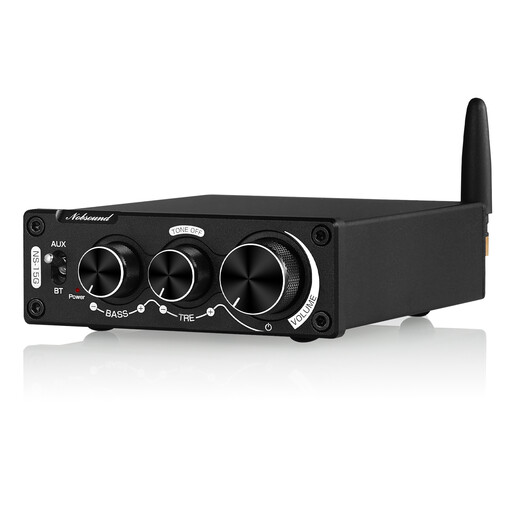
The compact NS-15G may suit passive speakers and a separate Bluetooth or stereo RCA source.
A compact stereo amplifier for passive speakers and a separate Bluetooth or RCA source.
 No image available
May suit you if you want to connect passive speakers to a separate Bluetooth or stereo RCA source and have limited space.
The product description lists dimensions of 92 × 108 × 30 mm, Bluetooth and stereo RCA inputs, and a speaker output for 4–8 Ω speakers.
According to the product description, the advertised maximum of 2 × 100 W applies only at more than 24 V/8 A into 4 Ω; a 19 V power supply is listed for the set. Check the relevant conformity information for the specific offer, too.
No. Choose a connection that suits your speaker type. The speaker outputs on the amplifiers discussed here are designed for passive speakers; active speakers have their own amplifier and need a suitable signal output. Check the connections on both devices.
First, check which audio output your computer actually has. An optical input on an amplifier won’t automatically accept USB audio. Depending on your equipment, you may need a suitable analogue output or a compatible separate source device.
Keep the volume at a sensible level. The German Environment Agency points out that both sound level and exposure time matter for your hearing. The amplifier’s wattage doesn’t tell you the sound level at your listening position.
If goods are faulty, you can generally exercise your statutory rights against the seller within two years of delivery or receipt. The Verbraucherzentrale distinguishes these rights from a voluntary manufacturer’s guarantee. For a typical online distance purchase from a trader, you generally have a 14-day right to cancel from the date of delivery, as explained by the European Union. Exceptions and conditions, such as return postage costs, should be taken into account.
No. According to the Bundesnetzagentur, products covered by the relevant EU harmonisation legislation must carry the CE mark; it indicates that the manufacturer declares the product to be compliant. It isn’t an independent judgement of sound quality and doesn’t replace checking the details of the specific offer.