Listeners with existing passive speakers
If you want to keep your speakers, their impedance needs to be compatible with the amplifier’s stated speaker requirements.


First, check that the amplifier is compatible with your passive speakers, then position the speakers to face your usual listening spot. Next, choose according to your sources: a traditional integrated amplifier may suit your existing audio equipment, while a streaming model can include network services and, in some cases, room correction. A higher rated power output or room calibration feature alone does not guarantee better jazz sound in your living space.
If you want to keep your speakers, their impedance needs to be compatible with the amplifier’s stated speaker requirements.
If you want to listen attentively in an open-plan living space, consider speaker placement and the effect of the room before letting extra amplifier features sway your decision.
If you mostly listen to jazz through network services or a digital collection, check that the supported sources and controls suit the way you listen.
Start with speaker compatibility and your listening spot. Then decide which features you really need, based on your music sources and connected devices.
| What to consider | What to look for | Who will find this most important? |
|---|---|---|
| Speakers and power output | Check your passive speakers’ impedance and guidance against the specific amplifier’s stated speaker compatibility. Compare wattage figures only when the impedance and measurement basis are comparable. | If I want to keep using my passive speakers, their electrical compatibility comes first. Around 33% of consumers are likely to consider speaker compatibility their top priority. |
| Room sound at your listening spot | Choose your listening spot and speaker positions, then check whether any room calibration or EQ feature meets your needs. | If you listen to jazz from a set spot in an open-plan room, you’ll want to assess speaker placement and bass there. Around 27% of consumers are likely to prioritise sound at their listening spot. |
| Music sources and controls | Check that the services and audio equipment you use are supported by the specific model; Bluetooth is not the same as network streaming. | If I listen to jazz through particular network services or a digital collection, the source and controls need to suit them. Around 20% of consumers are likely to prioritise built-in access to their music sources. |
| Connections and expansion | Check the TV outputs and amplifier inputs, cartridge type and phono input, and whether there is a suitable subwoofer output. | If you want to connect a TV, turntable or subwoofer in the future, you’ll need the right connections for each. Around 20% of consumers are likely to put connecting additional devices first. |
A power figure at 4 ohms is not directly comparable with one at 8 ohms. The amplifier’s stated speaker compatibility also needs to match your existing speakers.
Compare power figures only at the same impedance and under similar measurement conditions. According to the manufacturer, the Cambridge Audio AXA35 is specifically designed for 8-ohm speakers.
Speaker position and reflections in the room affect what you hear from your listening spot. Genelec notes that calibration alone does not always resolve acoustic problems.
First position your speakers and listening spot sensibly, then assess whether room calibration would help.
Repositioning speakers or adding acoustic treatments can take time and effort.
Amplifiers vary in the music sources and TV connections they support. Yamaha says the R-N600A does not have HDMI ARC, while the NAD C 3030 lists Bluetooth and HDMI eARC.
Make a note of your music sources and TV connections, then check each feature you want against the specific model.
The R-N600A is a network stereo receiver with streaming and both analogue and digital sources.
The PMA-900HNE combines stereo amplification and HEOS streaming with phono and digital audio inputs.
The Amp Ultra combines streaming with RoomFit, HDMI ARC and a subwoofer output.
The AXA35 and CXA81 Mk II are different types of integrated amplifier; the right choice depends, among other things, on your speakers and sources.
The C 3030 combines classic hi-fi controls with HDMI eARC, Bluetooth, phono and a subwoofer output.
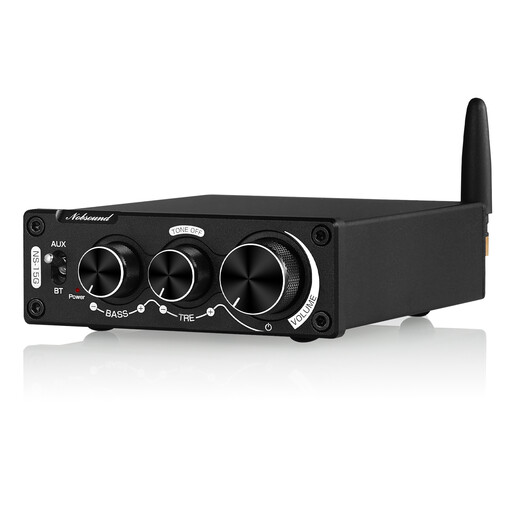
The Joybuy products below are compact stereo amplifiers for straightforward Bluetooth playback. Before buying, check that they’re compatible with your speakers and have the connections you need.
 No image available
A compact option if Bluetooth playback and bass and treble controls suit the way you listen. Before buying, check the specific unit’s speaker compatibility and power supply requirements.
The product name specifies 200 W. A power figure alone does not tell you whether it is compatible with your speakers or how it will sound from your listening spot.
Not as your only selection criterion. First check speaker compatibility, and compare power figures only when impedance and measurement conditions match. Speaker placement and room reflections also affect the sound at your listening spot.
Start with a set listening spot and arrange the left and right speakers as symmetrically as possible around it. Then assess reflections and bass. Genelec’s placement advice is intended for studio environments. It can be a useful guide, but it does not guarantee a particular result in your living room.
No. Check your TV’s outputs and make sure the amplifier has a matching input. For HDMI ARC, both devices must support the connection; WiiM also says HDMI-CEC must be enabled on the TV for the ARC control features described. Yamaha states that the R-N600A does not have HDMI ARC.
Products covered by relevant EU harmonisation legislation must carry the CE marking; Germany’s Federal Network Agency explains this requirement for products within its scope. The marking is not an independent sound or quality certification. Check the details and documentation for the specific product on offer.
For a consumer purchase from a business seller, European Union guidance states that there is a legal guarantee of at least two years from receipt of the goods. The seller is responsible for these claims; a voluntary manufacturer’s warranty is separate.