Owners of passive speakers
If you want to keep using your existing speakers, make sure the amplifier, connections and setup all work together. Yamaha Deutschland and Genelec explain the relevant technical specifications and placement considerations.


Start by choosing an amplifier to suit your existing passive speakers and the sources you actually use. A conventional integrated amplifier works well with wired sources, while a streaming amplifier is a better fit if you mainly listen to digital music and want fewer separate components. Then check speaker compatibility, connections and available space. A higher wattage alone doesn’t guarantee better jazz sound in your room.
If you want to keep using your existing speakers, make sure the amplifier, connections and setup all work together. Yamaha Deutschland and Genelec explain the relevant technical specifications and placement considerations.
If you listen to records, check whether your turntable has a built-in phono stage and whether the amplifier has a compatible phono input. Cambridge Audio EU and NAD Electronics explain the connection options available.
If you mainly listen through streaming services and want to cut down on separate components, compare the streaming features, controls and footprint of the specific model. WiiM describes the Amp Pro’s features.
Start by checking how your speakers and sources connect. Then make sure the amplifier’s casing and placement will work in your living room.
| What matters | What to check before buying | Who it matters most to |
|---|---|---|
| Speaker compatibility | Check whether your speakers are passive and whether their impedance and permitted speaker load are compatible with the specific amplifier. | If I want to keep my existing passive speakers, I’ll first check that they’re compatible with the amplifier. Around 36% of consumers prioritise finding the right amplification for their speakers. |
| Available space and listening position | Measure the available space and check whether you can position both speakers effectively in relation to your listening position. | If space is limited, I want to know whether the amplifier and speakers will fit sensibly into my living room. Around 29% of consumers prioritise room layout, available space and listening position. |
| Streaming and digital sources | Make a note of the services and devices you use, then check that their connections match the inputs on the model you’re considering. | If I mainly listen to jazz digitally, I want to connect my sources without unnecessary extra equipment. Around 21% of consumers prioritise streaming and digital sources. |
| Turntable and phono | Check whether your turntable has a built-in phono stage and whether the cartridge is compatible with the phono input. | If you listen to jazz records, check before buying whether your turntable needs a phono stage. Around 14% of consumers prioritise vinyl connectivity. |
Power ratings are only useful to compare when the impedance and measurement conditions are the same. On their own, they don’t tell you how the system will sound from your listening position.
Compare ratings on a like-for-like basis and check your speakers’ requirements first. Yamaha Deutschland lists the measurement conditions for the A-S301, while Genelec explains how the room and speaker placement affect the sound.
A turntable without its own phono stage needs a suitable phono signal path. A standard line input alone won’t provide the necessary pre-amplification.
Check whether your turntable already has a built-in phono stage and which type of cartridge it uses. Cambridge Audio EU describes the AXA35’s integrated MM phono stage; NAD Electronics explains when you might need a separate phono preamplifier.
If you don’t have a suitable phono stage, you may need an additional phono preamplifier.
Room reflections and speaker positioning affect playback. The presence of a room correction feature doesn’t tell you what results it will achieve from your listening position.
Plan your speaker positions and listening spot first, and treat adjustment features as an extra option. Genelec covers speaker placement, while WiiM describes the Amp Pro’s room correction as a device feature.
According to Yamaha Deutschland, the A-S301 is an example of an integrated amplifier with analogue, optical and coaxial inputs.
The AXA35 is an option for an analogue-focused system with a compatible turntable.
The C 316BEE V2 is an example of an analogue-focused amplifier with MM phono for a straightforward stereo system.
According to WiiM, the Amp Pro combines amplification for passive speakers with streaming and adjustment features.
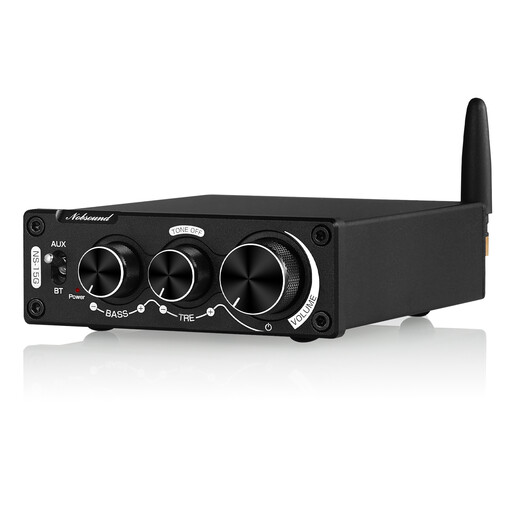
This selection is suited to a space-saving stereo setup with a Bluetooth or RCA source.
 No product image available
For a compact stereo setup with a Bluetooth or RCA source. Before buying, check that your speakers and the required power supply are compatible with the unit.
The product specifications list Bluetooth 5.0, an RCA input, 2.0 channels and dimensions of 92 × 108 × 30 mm.
Use only a compatible power supply. According to the product description, an incompatible one could cause overheating, a fire hazard or damage.
Not necessarily. Compare power ratings alongside impedance and measurement conditions, and check your speakers’ requirements. Speaker placement in the room also affects the listening experience.
Start by positioning both speakers as symmetrically as possible in relation to your listening spot, and angle them towards it. Genelec’s guidance is intended for studio environments, so its specific distances aren’t universal recommendations for every living room.
Yes, if the signal has already been suitably pre-amplified, for example by a built-in or separate phono stage. Otherwise, you’ll need a phono input or phono preamplifier that’s compatible with your cartridge.
Your statutory rights against the seller are separate from any voluntary guarantee. Distance-selling contracts generally come with a right to cancel; § 355 BGB sets out a 14-day period, but you should check when it starts and whether any exceptions apply to your specific contract. According to the German Environment Agency, old electrical appliances can be returned free of charge to local collection points and, subject to certain conditions, to retailers.