Owners of passive speakers
You want to keep using your existing speakers and first check whether the amplifier, connections and available space are a good fit.


If you use CDs or other existing sources, first check their connections and your passive speakers’ requirements; a traditional integrated amplifier could be a good fit. If you mainly listen to live albums through network sources and want fewer separate devices, a compact streaming amplifier may be worth considering. Check that it supports your music service, has the inputs you need and leaves enough room for your speakers and cables. Wattage alone won’t determine whether the combination is right or how it will sound in your room.
You want to keep using your existing speakers and first check whether the amplifier, connections and available space are a good fit.
You listen to full concerts through a music service or digital collection, and care about the transitions between tracks and changes in volume throughout an album.
You want to connect separate audio sources. For a turntable, the right phono connection also depends on its cartridge and whether you already have a phono preamp.
A good fit if: You want to use a CD player or other separate sources with passive speakers.
Things to weigh up: Check that the inputs match your sources, and allow enough room for the unit, cables and ventilation.
A good fit if: You mainly use network sources with passive speakers and want to reduce the number of separate devices.
Things to weigh up: Playback and volume features vary by model, app and music service. Also check that it has the connections you need for your existing sources.
| What you need | What to look for | Who will find this important? |
|---|---|---|
| Connecting speakers correctly | Check that the amplifier meets the requirements of your passive speakers. Compare power ratings only alongside impedance and measurement conditions; for example, Yamaha Germany lists a minimum RMS output of 2 × 60 W into 8 Ω at 20 Hz–20 kHz for the A-S301. | If I want to keep using my passive speakers, the amplifier needs to meet their requirements. Around 33% of consumers focus above all on getting the right match for their speakers. |
| Listening to live albums as a continuous performance | Check playback with your specific source and music service. The WiiM Help Center describes Album Gain as a way to preserve volume differences between tracks; for Qobuz, it lists only Track Gain in the WiiM app. | When I listen to a concert album, I want to hear the transitions and volume differences as part of a continuous album. Around 27% of consumers focus primarily on album playback. |
| Space in a small living room | Measure the unit, connections and space needed for cables. Yamaha Germany gives the A-S301’s dimensions as 435 × 151 × 387 mm; remember to plan where your speakers will go, too. KEF recommends trying out the distances from your listening position and the rear wall in your own room. | If space on my furniture is limited, I want to fit in as few devices as possible while still positioning the speakers sensibly. Around 20% of consumers prioritise space-saving design and built-in streaming. |
| Connecting existing sources | Check that your sources’ outputs match the inputs on the specific model. For a compatible MM turntable without a built-in phono preamp, look for an MM phono input; Denon Germany lists one on the PMA-600NE, as does NAD Germany on the C 316BEE V2. | If I want to connect a CD player, turntable or other existing sources, I need the right inputs rather than unnecessary extra devices. Around 20% of consumers focus mainly on the connections for their existing sources. |
Manufacturers quote power at different impedances and under different measurement conditions. So a single figure won’t tell you whether an amplifier is right for your speakers.
Compare the full manufacturer specifications with your speakers’ requirements rather than focusing on the highest wattage.
Playback and volume features depend on the device, app and source. WiiM, for example, documents different ReplayGain options depending on the service.
Check your specific playback setup with a full concert album and see which album settings are available.
Cables and speaker placement also take up space. The distance from the wall can affect bass response.
Plan for the entire setup and try out different speaker positions before replacing your amplifier based solely on a perceived lack of power.
Line inputs and MM phono inputs serve different purposes.
Before choosing, check your turntable’s cartridge and whether you have a phono preamp.
If there’s no suitable phono input and your turntable doesn’t have a built-in preamp, you may need to budget for a separate, compatible phono solution.
The A-S301 is a traditional integrated amplifier for separate analogue and digital sources.
The PMA-600NE combines separate sources with Bluetooth, digital inputs and MM phono.
The WiiM Amp is a streaming amplifier for passive speakers and network sources.
The C 316BEE V2 is designed for separate analogue sources, including compatible MM turntables.
The MODEL M1 combines streaming and TV sound in a single unit for passive speakers.
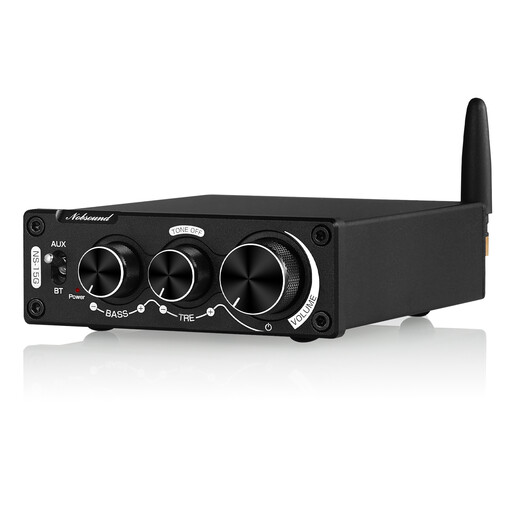
A compact mini Bluetooth amplifier for a space-saving stereo setup. Before you buy, check that its connections and speaker requirements are compatible with your existing system.
 No image available
Described as a mini Bluetooth amplifier; before choosing, check the connections on your sources and your speakers’ requirements against the product specifications.
The product title mentions Bluetooth and 200 W. Compare the power rating only alongside the full measurement conditions and your speakers’ requirements.
Passive speakers need a compatible amplifier. If your speakers already have built-in amplification, check their inputs to see whether you need an additional integrated amplifier.
Start by following the guidance for your speakers, then try different distances from your listening position and the rear wall. KEF recommends testing these distances in your own room; its guidance isn’t a universal minimum requirement for every model.
No, not automatically. If your turntable has an MM cartridge and no built-in phono preamp, look for a compatible MM phono input, such as the one on the Denon PMA-600NE or NAD C 316BEE V2, or plan for a separate phono solution.
If a product develops a fault, the seller is generally your point of contact for your statutory rights, not the manufacturer. The Verbraucherzentrale explains the two-year statutory warranty period and how it differs from a voluntary guarantee; how the rules apply in your case depends on your purchase contract and the fault.