For live albums in an open-plan living space, the amplifier should first and foremost suit your existing passive speakers and the source you actually use. Network streaming makes sense if you listen directly through a supported service or music library, while a traditional integrated amplifier may be all you need when paired with a suitable source component. Speaker placement and reflections also affect what you hear; a higher wattage rating alone proves neither that an amplifier will recreate a better live atmosphere nor that it is right for your room.
Who is this selection for?
Listeners with existing passive speakers
If you want to keep your speakers, compare their requirements with the specifications of the specific amplifier you’re considering. Yamaha Germany and WiiM publish technical specifications for individual models.
Live album streamers
If you listen to concert recordings through a network service or a local music library, check the specific service and playback method. WiiM lists gapless playback for the Amp and Amp Pro, but that alone doesn’t guarantee seamless playback for every version of an album.
Listeners in open-plan living spaces
If you can adjust your speakers and listening position, remember to take room reflections into account too. Genelec’s speaker placement advice is intended for studio monitors, so use it as a guide rather than a fixed rule for every home.
What should you look for when buying?
First, check that the amplifier is a good match for your speakers and album source. In an open-plan living space, you should also factor in speaker placement and the connections you need.
| Buying consideration |
What to check before buying |
Who is this important for? |
| Matching your speakers |
Compare your speakers’ nominal impedance and manufacturer guidance with the manual for the specific amplifier. Only compare power ratings when the impedance and measurement basis are the same. |
If I want to keep my passive speakers, I’ll first check that the amplifier and speakers are compatible. Around 33% of consumers put compatibility first. |
| Album source and track transitions |
Check the music service or file source, supported connection method and, if needed, playback with the version of the album you want to listen to. |
If you want to stream concert albums directly and care about transitions between tracks, you’ll need a suitable playback method. Around 25% of consumers prioritise access to live albums and the transitions between tracks. |
| Placement in an open-plan space |
Check whether you can position both speakers sensibly towards your preferred listening spot and create similar conditions on the left and right. |
If I listen in an open-plan living space, I want to position my speakers and listening spot so that the stereo image isn’t affected simply by differences in reflections. Around 25% of consumers prioritise speaker placement. |
| Connections for other sources |
Check the outputs on your CD player, TV or turntable against the inputs on the full amplifier model, one by one. For turntables, also check whether you need a phono stage. |
If you want to keep using several devices you already own, you need the right inputs rather than extra features you won’t use. Around 17% of consumers look first for connections for other sources. |
Common buying misconceptions
-
Using wattage figures as a ranking without checking the measurement conditions
Manufacturers quote power ratings at different impedances and under different measurement conditions. You can’t use them to create a reliable ranking of sound quality or room suitability.
Only compare power ratings on the same basis, and check your speakers’ requirements first.
-
Assuming Bluetooth is the same as network streaming
Bluetooth and built-in network streaming are different ways to play music. Denon lists Bluetooth for the PMA-600NE, while the PMA-900HNE has HEOS network streaming.
Before you buy, decide which device will play your music service or album library.
If the amplifier doesn’t offer the network access you need, you may need a separate network streamer.
-
Expecting a new amplifier alone to improve an open-plan space
Speaker placement and reflections affect what you hear. Genelec points out that even calibration can’t solve every room-acoustics problem.
Check your speakers and listening position before assuming that more amplifier power or room-correction features will solve the problem.
-
Counting the connections you need only after buying
Models differ in features such as HDMI ARC, phono and XLR inputs, and network functions. If a required input is missing, you may need extra equipment.
Make a list of the sources you already own and check their outputs against the connections on the full amplifier model.
Depending on your source, you may need an extra streamer, adapter or phono stage.
Key brands to consider
Yamaha
The A-S701 is a traditional integrated amplifier for separate sources, while the R-N600A combines network functions with additional inputs.
- Yamaha Germany lists the A-S701 at 2 × 100 W into 8 Ω at 20 Hz–20 kHz and 0.019 % THD, and the R-N600A at 2 × 80 W into 8 Ω at 20 Hz–20 kHz and 0.07 % THD.
- The different distortion figures don’t allow for a direct comparison of sound quality. HDMI ARC isn’t listed for the R-N600A.
Denon
The PMA-900HNE combines HEOS network streaming with analogue, digital and phono sources.
- Denon lists the PMA-900HNE at 50 W per channel into 8 Ω and 85 W per channel into 4 Ω, as well as including a phono input.
- These power ratings can’t be used to compare sound quality without the same measurement basis. Denon says the PMA-600NE offers Bluetooth, but not the HEOS features listed here for the PMA-900HNE.
WiiM
The Amp Pro combines network streaming with HDMI ARC and adjustment options.
- WiiM lists gapless playback for the Amp and Amp Pro.
- WiiM lists AirPlay 2 for the Amp, but not the Amp Pro. For TV audio, WiiM lists stereo PCM or Dolby Digital for the Amp Pro, but not DTS or Dolby Atmos.
Cambridge Audio
The CXA81 Mk II is aimed at listeners who need connections including XLR, digital and Bluetooth.
- Cambridge Audio lists XLR inputs, digital inputs and Bluetooth among the model’s features.
- Bluetooth won’t replace built-in network streaming if you want to listen directly through a network service.
Joybuy products
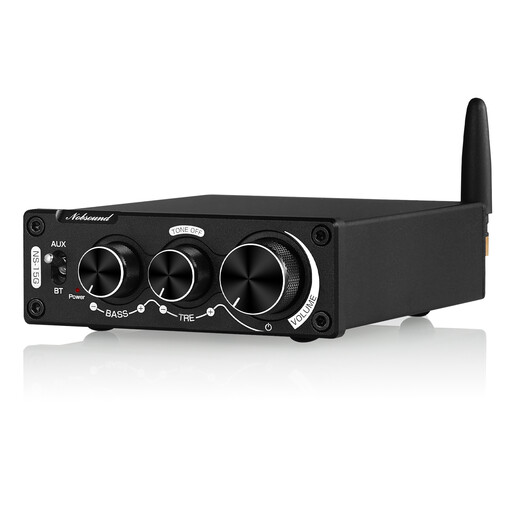
The following Joybuy products are stereo amplifiers for passive speakers, with Bluetooth or stereo RCA as the source connection.
 No image available
Nobsound 200 W Mini Bluetooth Digital Amplifier
Worth considering if your passive speakers fall within the stated impedance range of 4–8 Ω and you want to use Bluetooth or stereo RCA as your source connection.
View at Joybuy
Frequently asked questions
Can any network amplifier play my live albums without pauses between tracks?
No, you can’t tell that from the type of device alone. WiiM lists gapless playback for the Amp and Amp Pro; still, check the album version, service and playback method you’ll actually use.
What should I try first when setting up in an open-plan living space?
Position both speakers towards your preferred listening spot, and aim for similar conditions on the left and right. Reflections and room surfaces affect what you hear. Genelec’s advice for studio monitors can be a useful guide, but it isn’t a set measurement rule for every home.


