Who is this guide for?

Quiet listeners with passive speakers

You want to listen to your soul playlist through your existing speakers at low volume, and use the tone controls or loudness deliberately. Germany’s National Metrology Institute notes that our perception of loudness also depends on pitch.

Playlist streamers

You want to play your playlist through a supported network service without connecting a separate network player. The services and playback methods available depend on the specific model.

Listeners with several music sources

You want to connect other devices as well as your playlist source, such as an analogue player or a compatible turntable. The key considerations are the connections available and compatibility with your existing source.

What should you look for when buying?

Integrated amplifier with adjustable loudness

A good fit if: You already have a suitable player and want to adjust the sound directly on the amplifier when listening at low volume. Yamaha lists this feature for the A-S301 and A-S701.

Bear in mind: The ability to adjust the sound does not prove it will be better with your speakers. You’ll also need to make sure the playlist playback method is right for you.

Streaming amplifier with EQ

A good fit if: You want to connect passive speakers and use a streaming service supported by the model, without a separate network player. WiiM describes the Amp Pro as offering streaming and EQ.

Bear in mind: EQ and room correction are different features. WiiM does not list the Amp Pro as an AirPlay 2 receiver.

Analogue-focused integrated amplifier

A good fit if: An existing player outputs your playlist in analogue, or you also want to connect a compatible turntable. The Cambridge Audio AXA35 has bass and treble controls, as well as an MM phono stage.

Bear in mind: Bass and treble controls are not the same as adjustable loudness. You may also need an additional player for your playlist.

Priority What to check when buying Who it matters to
Sound at low volume Check whether the model offers adjustable loudness or separate bass and treble controls. If I listen at low volume, I want to adjust the sound to suit my listening level. Around 36% of consumers prioritise tone controls for quiet listening.
Playing a playlist Check that your streaming service and playback method are supported by the exact model. If I want to play a playlist without an additional network player, the amplifier needs to support my service. Around 29% of consumers prioritise having a suitable playback method.
Connecting speakers Check whether your speakers are passive, then compare their impedance and connections with the amplifier’s manual. If I already have passive speakers, I want to be sure they’ll work with the amplifier. Around 21% of consumers focus primarily on this compatibility check.
Other analogue sources Check which inputs you need. For a turntable, the phono stage and cartridge type also matter. If I want to use other analogue devices as well as my playlist, I need the right connections. Around 14% of consumers prioritise additional analogue sources.

Common misconceptions to avoid

  • A high wattage proves that an amplifier sounds good at low volume

    A power rating alone can’t predict how an amplifier and your speakers will sound at normal room volume.

    Check speaker compatibility, ease of use and tone controls separately from the power rating.

  • Bluetooth, AirPlay 2 and network streaming are interchangeable

    Supported playback methods vary by model. WiiM lists the Amp, but not the Amp Pro, as an AirPlay 2 receiver.

    Check that the service and playback method you want are supported by looking up the specifications for the exact model.

  • A phono input takes care of playlist playback

    A phono input is for a compatible turntable; it doesn’t replace a network player or another device for playing playlists.

    Make a list of your existing sources, then choose the inputs you need for the devices you actually plan to connect.

Key brands at a glance

Yamaha

According to Yamaha Germany, the A-S301 and A-S701 are traditional integrated amplifiers with continuously adjustable loudness.

  • The adjustable feature may appeal if you want to fine-tune the sound yourself when listening at low volume.
  • For network playlists, check the playback method supported by the specific model and allow for a separate player if needed.

WiiM

WiiM describes the Amp Pro as an amplifier for passive speakers with network streaming and EQ.

  • WiiM lists Spotify and Tidal Connect as supported services for the Amp Pro.
  • WiiM’s compatibility list does not include the Amp Pro as an AirPlay 2 receiver. Features available on other models cannot be assumed to apply.

Cambridge Audio

According to Cambridge Audio, the AXA35 is an analogue-focused integrated amplifier with bass and treble controls and an MM phono stage.

  • The tone controls let you adjust the sound manually, while the MM phono input is designed for a compatible turntable.
  • You’ll need a suitable player for network playlists. Tone controls do not prove that the amplifier automatically adjusts loudness.

Denon

Denon’s EU product sheet lists HEOS network streaming, digital inputs and MM/MC phono for the PMA-900HNE.

  • The inputs may be useful if you want to connect several compatible sources as well as your playlist player.
  • The manufacturer’s claims about sound quality are not independent evidence of how your system will sound at low volume.

Marantz

According to Marantz, the MODEL 60n combines HEOS streaming, HDMI ARC and MM phono.

  • The additional connections are useful if you actually need them for your existing sources.
  • Advertised sound characteristics are the manufacturer’s claims, not independent evidence of a particular result when listening at low volume.

Joybuy products

This selection includes a compact amplifier for playing playlists over Bluetooth or RCA, with manual tone controls.
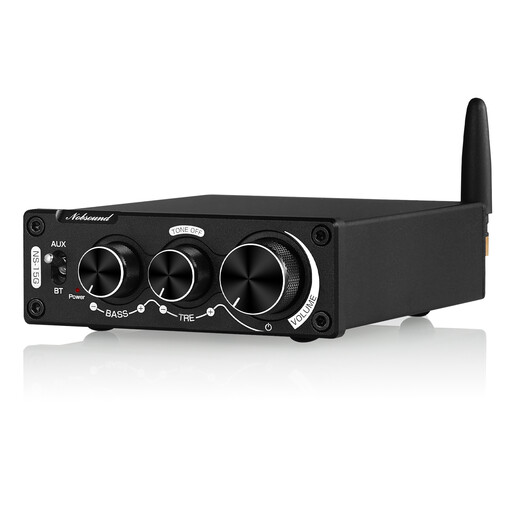
Nobsound 200 W Mini Bluetooth digital amplifier

Nobsound 200 W Mini Bluetooth digital amplifier

An option if you want to play your playlist via Bluetooth or RCA and adjust the tone controls manually.

The product description lists Bluetooth and RCA inputs, a volume control, tone bypass, speaker outputs, and bass and treble controls.

Use only a compatible power supply. The product description warns that incompatible power supplies may cause overheating, fire and damage.

View at Joybuy

Frequently asked questions

Is loudness the same as an equaliser?

No. Loudness and EQ are different features. Yamaha describes the A-S301 as having an adjustable loudness function, while WiiM describes EQ as a way to adjust frequency ranges manually and room correction as a separate feature. The right choice depends on how you want to adjust the sound at your usual listening volume.

How do I set up playlist playback?

First, decide whether you want to listen through a supported network service, AirPlay 2 or an external player. Check that your chosen method is supported by the exact model: WiiM lists the Amp, but not the Amp Pro, as an AirPlay 2 receiver.

What should I bear in mind when connecting my speakers?

Check that your passive speakers and their specifications are compatible with the manual for your chosen amplifier. Try the tone controls at your usual listening volume; a power rating or room correction does not replace this compatibility check.

What costs and rights should I know about after buying?

You may incur extra costs if you need a separate player for your playlist. For a typical online purchase by a consumer in Germany, there is generally a 14-day right to cancel. According to the Verbraucherzentrale, the period usually starts when the contract is concluded or the goods are received. Your statutory rights against the seller are separate from any voluntary guarantee.

Does CE marking matter for electrical equipment?

Yes, if the equipment falls under the relevant EU harmonisation rules. Germany’s Federal Network Agency states that products covered by these rules and placed on the EU market must carry CE marking. For the Low Voltage Directive, the European Commission specifies a scope of 50 to 1,000 V AC or 75 to 1,500 V DC. CE marking is not an independent award for sound or quality.