Classical music fans who listen quietly
You usually listen at a low volume and want to adjust the tonal balance yourself using an available Loudness or EQ control.


For listening to orchestral recordings quietly, an amplifier with adjustable Loudness or suitable tone controls is a more sensible choice than choosing on wattage alone. Yamaha describes the A-S501 as having adjustable Loudness, but this does not prove that it will sound a particular way with every recording. You should also check that it suits your passive speakers and has the connections you need for your sources.
You usually listen at a low volume and want to adjust the tonal balance yourself using an available Loudness or EQ control.
You want to keep using your existing speakers and are checking the connections and suitability of a specific amplifier.
You listen via streaming, your own files or digital devices, and need a way to connect that suits your sources.
First check that the amplifier suits your speakers and offers the tone controls you want. Then consider which inputs and room-correction features you actually need.
| Consideration | What to check before buying | Who it matters most to |
|---|---|---|
| Tonal balance at low volume | Check whether the model offers Loudness or EQ. Yamaha documents adjustable Loudness on the A-S501. | If I want to adjust the treble and bass at my usual low listening volume, I look specifically for suitable tone controls. Tonal balance is the top priority for around 33 % of consumers. |
| Compatibility with existing speakers | Compare the connections and documented requirements of your passive speakers with the specifications for the exact amplifier model. | If I want to keep using my existing passive speakers, the amplifier needs to suit their connections and requirements. Speaker compatibility is the priority for around 27 % of consumers. |
| Playback connection for your recordings | Check that your sources match the inputs and streaming features. Yamaha lists optical and coaxial digital inputs for the R-N800A, but no HDMI ARC; Denon lists Bluetooth, digital inputs and MM phono for the PMA-600NE. | If I use CDs, a turntable, files or music services, I need connections or streaming features that suit my source. The playback connection is the top consideration for around 20 % of consumers. |
| Adjusting the sound at your listening position | Check whether you want to run room calibration and whether you need any additional equipment. Yamaha lists YPAO for the R-N800A; BluOS and Dirac Live on the NAD C 389 require the optional MDC2-BluOS-D module. | If I want to tailor the sound to my listening position, I check whether the model requires room calibration, manual tone controls or an optional module. Adjusting the sound at the listening position is the main priority for around 20 % of consumers. |
Power ratings can be based on different impedances and test conditions. They do not tell you directly whether you will like the tonal balance at a low volume.
Compare wattage figures only when they use the same test conditions, and check speaker compatibility and tone controls separately.
Adjustable Loudness, EQ and room calibration differ in how they work and what they require. Yamaha describes the A-S501’s Loudness control, WiiM lists EQ features for the Amp Pro, and NAD offers optional room correction for the C 389.
First decide which type of adjustment you want, then check which features are available on the specific model without an additional purchase.
The BluOS and Dirac Live features described for the NAD C 389 require the optional MDC2-BluOS-D module.
According to Yamaha, the R-N800A does not have HDMI ARC; WiiM does not list AirPlay 2 for the Amp Pro. The product category alone therefore does not tell you whether it supports your preferred playback connection.
Compare your source’s outputs and your preferred playback method with the specifications for the complete model.
If the connection you need is missing, you may need to use a different connection or add another source device.
The A-S501 is a traditional integrated amplifier with adjustable Loudness, while the R-N800A combines network features with YPAO.
The PMA-600NE is worth considering if you want to use Bluetooth, digital or MM phono sources.
The Amp Pro combines amplification for passive speakers with streaming and EQ features.
The C 389 has expansion slots for buyers who may want to add streaming and room-correction features later.
This selection is for consumers who want to connect passive speakers via Bluetooth or RCA and adjust the tonal balance manually.
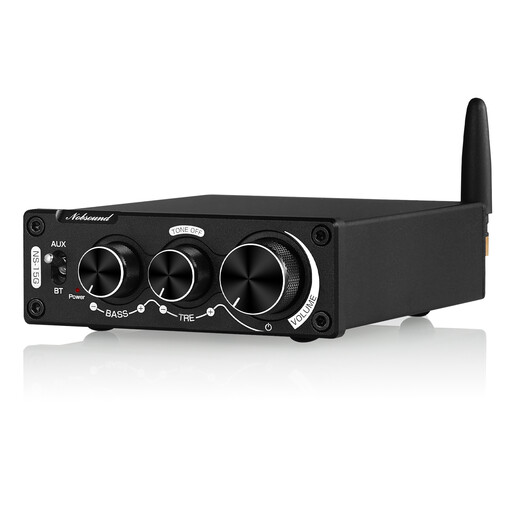 No image available
A suitable choice if you want to connect passive speakers via Bluetooth or stereo RCA and adjust the bass and treble manually.
The product description lists Bluetooth 5.0, a stereo RCA input, speaker outputs and 4–8 Ω; according to the description, Bypass switches the tone controls.
Use only the compatible power adapter supplied. The product description warns that an incompatible adapter may cause overheating, a fire hazard or damage to the device.
No. A wattage figure describes power under the stated test conditions; it does not automatically tell you about the tonal balance at your low listening volume. Yamaha Germany lists the test conditions for the A-S501 separately, so check speaker compatibility and tone controls too.
Start at your usual low listening volume and compare the available setting with playback without tone adjustment. Yamaha describes a separately adjustable Loudness control on the A-S501; WiiM lists EQ features for the Amp Pro. A setting may not suit every recording.
No. The BluOS and Dirac Live features NAD describes for the C 389 require the optional MDC2-BluOS-D module. Before buying, check whether the module is included with the specific offer.
When you enter into a distance contract as a consumer, you generally have the right to cancel. The statutory cancellation period is 14 days, provided the legal requirements are met and no exception applies (§§ 312g and 355 BGB). The Federal Ministry of Justice and the Federal Office of Justice list the relevant statutory provisions. Your statutory rights relating to faulty goods are separate from any voluntary guarantee.