Streaming music through speakers
If you want to listen to music services through passive speakers, check whether the amplifier supports the service you want or whether you’ll need a separate source device.


Start with your speakers and the music source you’ll actually use. A streaming amplifier suits you if you want to stream through supported network services, while a traditional integrated amplifier may be all you need for a CD player or other existing source. If you also want to play your TV’s audio through it, the TV output and supported audio format must match. Wattage figures alone won’t tell you whether the connections or speaker compatibility are right.
If you want to listen to music services through passive speakers, check whether the amplifier supports the service you want or whether you’ll need a separate source device.
If you want to keep using your existing passive speakers, check their connections and impedance ratings against the amplifier’s specifications.
If you want your TV to provide the audio, its output and the signal format supported by the amplifier must be compatible.
First decide how you’ll connect your source, then check that the amplifier and speakers are compatible. If you’ll use the TV for audio too, check the connection and audio format as well.
| What matters when buying | What to check | Who is it important to? |
|---|---|---|
| Source and streaming | Check your source’s output and whether the specific model supports the service or connection method you want. | If I want to use music services without a separate source device, the amplifier must genuinely support the streaming method I want. Around 36% of consumers put source and streaming compatibility first. |
| Speaker compatibility | Check whether the speakers are active or passive, which connections they have and whether their impedance matches the amplifier’s permitted load. For example, Denon specifies 4 to 16 Ω for the PMA-600NE. | If I want to keep my passive speakers, their connections and impedance ratings must be compatible with the amplifier. Around 29% of consumers prioritise speaker compatibility. |
| TV sound | Match the TV output to the amplifier input. If you’re using HDMI ARC, also check which audio formats are supported. | If I also want to play TV sound through my stereo system, I need a compatible connection and a supported format. Around 21% of consumers say TV sound is their main buying consideration. |
| Space and ease of use | Check the unit’s dimensions, allowing for space for cables, and make sure the inputs you need are easy to reach. | If space is tight in my living room, I want a unit that fits comfortably and has the inputs I need. Around 14% of consumers prioritise a compact setup. |
A traditional amplifier can play music from a connected device without offering network services of its own.
Decide how you’ll actually connect your source and check the features of the specific model rather than relying on the word ‘digital’ alone.
For the Nobsound NS-15G, the 100 W per channel maximum quoted by Douk Audio requires more than 24 V/8 A at 4 Ω. The listing in question specifies a 19 V power supply.
Compare output figures only when you’ve taken the load, power supply and test conditions into account. Don’t use a power supply that isn’t explicitly intended for the device.
A different power supply could mean extra costs and compatibility issues.
For TV sound through the Amp Pro, WiiM specifies Stereo PCM or Dolby Digital, and excludes DTS and Dolby Atmos in its connection instructions.
Check whether your TV has an ARC or eARC connection, and choose an audio format supported by the amplifier.
The Amp Pro combines network streaming with an amplifier for passive speakers.
The A-S301 is a traditional integrated amplifier for separate music sources and passive speakers.
The PMA-600NE is designed for sources connected via Bluetooth, digital input or MM phono.
The PM6007 is a traditional integrated amplifier for analogue and digital sources.
The NS-15G is an especially compact amplifier for passive speakers, with Bluetooth or stereo RCA as source options.
This selection is for small living rooms where you want to connect a Bluetooth or stereo RCA source to passive speakers.
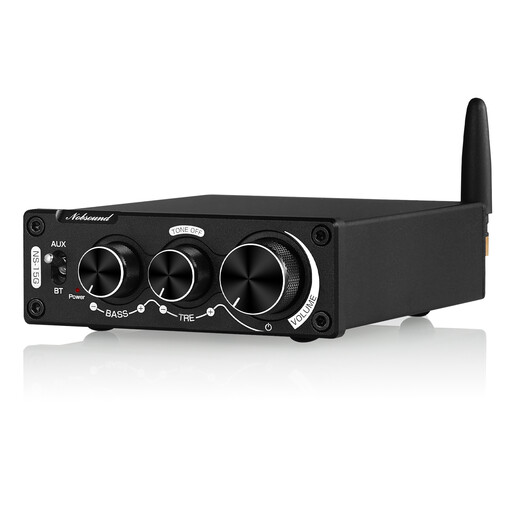 No image available
A good option if your music source uses Bluetooth or stereo RCA and you’re short on space.
The product details list Bluetooth and stereo L/R RCA inputs, and dimensions of 92 × 108 × 30 mm.
The amplifiers covered here have speaker outputs, so you’ll need passive speakers; active speakers already have amplification built in. If you have speakers already, compare their specifications with the manual for the amplifier you’re considering.
For the Denon PMA-600NE, disconnect the power supply before connecting the speakers. Keep loose wires away from the terminals, and make sure left and right, and positive and negative, are connected correctly. These are model-specific instructions from Denon; for other devices, follow the relevant manual.
No. WiiM lists the WiiM Amp as AirPlay 2 compatible and explicitly states that the WiiM Amp Pro isn’t compatible. Check the full model name before you buy.
No. HDMI ARC alone doesn’t mean every format is supported. For the WiiM Amp Pro, WiiM specifies Stereo PCM or Dolby Digital and excludes DTS and Dolby Atmos in its connection instructions. So check your TV’s audio output too.