Playlist listeners with passive speakers
You want to start playlists without a separate source device and keep using your passive speakers. Check that the exact amplifier model supports your preferred streaming service.


A compact streaming amplifier may be all you need for passive speakers, provided it supports your preferred service and is compatible with your speakers’ specifications. A network receiver is a better choice if you need extra sources or connections, while a traditional integrated amplifier needs a separate streaming source for network playlists. A subwoofer output alone won’t fine-tune the bass: features vary by model, as WiiM and Yamaha explain in their product information.
You want to start playlists without a separate source device and keep using your passive speakers. Check that the exact amplifier model supports your preferred streaming service.
You need to fit your amplifier and speakers into a small living room. Consider the unit’s dimensions, connections and planned position together when choosing.
You want to tailor the bass for dance music or add an active subwoofer later. The output and adjustment options on the specific model need to suit your setup.
First, decide how you want your playlists to reach the amplifier. Then check that it suits your speakers and available space, before deciding whether you need extra bass options or additional connections.
| What matters to you | What to check before buying | Who it matters most to |
|---|---|---|
| Playlist access | Services and connection methods supported by the exact model, plus any required account and controls. | If I want to start playlists without a separate source device, the right streaming option matters most. Around 33% of consumers put playlist access first. |
| Speakers and available space | Check your speaker type and specifications against the amplifier’s details, and measure the unit in advance. | If you want to connect and fit existing passive speakers in a small living room, this compatibility is especially important. Around 27% of consumers prioritise speaker compatibility and space. |
| Getting the bass right | Check whether the specific model has a subwoofer output and an adjustable crossover frequency. | If you want the bass to suit your room when playing dance music, the connection and adjustment options matter. Around 27% of consumers put bass control first. |
| Other audio sources | Compare the outputs on your existing devices with the amplifier’s inputs, and check TV connections carefully. | If you want to connect existing devices as well as play playlists, you’ll need the right inputs. Around 13% of consumers prioritise additional audio sources. |
That isn’t necessarily the case for streaming: according to WiiM, the WiiM Amp supports AirPlay 2, while the Amp Pro does not.
Check the full model name against your preferred streaming option.
Power ratings may be based on different speaker impedances and test conditions. A single figure therefore won’t tell you whether an amplifier is right for your speakers.
Only compare figures measured under comparable conditions, and check speaker compatibility separately.
The output lets you connect a subwoofer, but it doesn’t replace an active subwoofer or the right adjustments. Your speakers and their positioning also affect how the bass sounds where you sit.
Check your current setup first, then look at the connections and adjustment options on the specific model.
A suitable active subwoofer is an extra piece of equipment to factor into your plans.
Compact amplifiers for passive speakers, with built-in streaming features.
The R-N600A is a network stereo receiver with MusicCast, phono, digital and headphone connections.
The PMA-900HNE combines HEOS streaming with phono and digital inputs.
The MODEL M1 combines HEOS streaming with HDMI eARC in a compact amplifier.
The Sonos Amp is designed for passive speakers and combines streaming with potential multi-room and TV use.
This amplifier could suit a compact stereo setup with Bluetooth playback and passive speakers, provided its connections are compatible with your speakers.
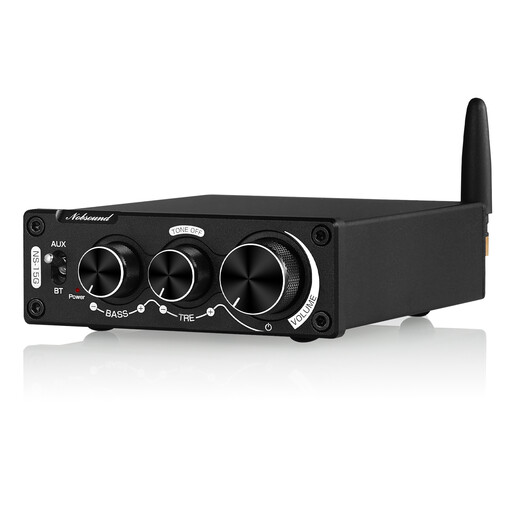 No image available
Could work with passive speakers and Bluetooth playlists, provided the connections and speaker specifications are compatible.
The product description lists bass and treble controls. Before buying, check that the specific listing has the correct CE marking.
Not without checking the connections first: the documented speaker connections on the WiiM Amp and Amp Pro are intended for passive speakers. With active speakers, you’ll need to match a suitable signal output on the amplifier to their inputs.
The TV output must match the amplifier input. The WiiM Amp Pro has HDMI ARC; WiiM specifies stereo PCM or Dolby Digital, but not DTS or Dolby Atmos. According to Yamaha Germany, the R-N600A has no HDMI ARC connection, but it does have optical inputs.
Check whether you can connect a suitable active subwoofer and how you can adjust the crossover to your main speakers. According to Yamaha’s FAQ, the subwoofer output crossover frequency on the R-N600A is fixed at 90 Hz.
Your statutory rights are against the seller and are separate from any voluntary guarantee. If a product is faulty, the first step is usually to ask for it to be repaired or replaced. The Verbraucherzentrale states that, in general, purchased goods are covered by statutory rights for two years.
Electrical and radio equipment covered by the relevant EU rules must carry the correct CE marking. For affected devices, the Bundesnetzagentur lists the marking, manufacturer details, declaration of conformity and German-language instructions among the points to check.