Listeners with existing passive speakers
If you want to keep using your speakers, first check that their impedance and connections are compatible with the amplifier.


Choose an amplifier whose supported speaker load and connections suit your existing speakers and playback devices; wattage alone isn’t the deciding factor. A traditional integrated amplifier is a good choice for connecting several sources, while a streaming amplifier suits compatible network services. A compact analogue amplifier can work well if it has enough inputs for your needs. For stereo imaging, it also matters whether you can position the speakers and listening position symmetrically in the room.
If you want to keep using your speakers, first check that their impedance and connections are compatible with the amplifier.
If you play string quartet recordings from several devices, you’ll need inputs that match their respective analogue or digital outputs.
If you want to listen to music from your home network or streaming services, check that the specific model supports the services you need and is easy to set up.
A good fit if: You want to connect a CD player and other analogue or digital sources. The Denon PMA-600NE and Yamaha A-S301 have the corresponding inputs listed in their specifications.
Bear in mind: These inputs don’t provide built-in network streaming, and the unit needs space.
A good fit if: Space is limited and your source has a compatible analogue output. According to the manufacturer, the Fosi Audio V1.0G is a model with RCA inputs for passive speakers.
Bear in mind: The V1.0G isn’t listed as having an optical input or built-in network streaming. Check the power supply and version supplied for the German market, too.
A good fit if: You mainly use compatible streaming services or music from your home network and want to keep your passive speakers. According to the manufacturer, the WiiM Amp combines an amplifier with network features.
Bear in mind: Check service compatibility, set-up and the analogue connections you need. Room correction doesn’t replace suitable speaker placement.
| Buying criterion | What to look for | Who should consider it? |
|---|---|---|
| Speaker compatibility | Check the nominal impedance of your passive speakers against the supported range in the amplifier manual. Compare power ratings only when they’re measured under the same conditions. | If you want to keep using your existing passive speakers, first check that the combination is supported. Around 36% of consumers say speaker compatibility is their top concern. |
| Connections for playback devices | Note the outputs on your CD player and other sources, then check that they match the amplifier’s analogue, optical or coaxial inputs. Check network streaming separately. | If you have several playback devices, you’ll want to use your recordings without running into incompatible connections. Around 29% put suitable source connections first. |
| Space and stereo set-up | Allow for the unit’s dimensions, space for cables and room for both speakers. Aim for a symmetrical layout around your listening position, where possible. | If you have limited living room space, you’ll need to fit the unit, cables and speakers together. Around 21% prioritise space and stereo imaging. |
| Overall set-up and ease of use | Check whether your source connects directly to the amplifier or whether you’ll need another device. Consider how easy it is to use and which streaming features you need. | If you want to keep your set-up simple, think about which devices you’ll actually need and how you’ll select your sources. Around 14% put an all-in-one solution and ease of use first. |
Power ratings may be quoted for different speaker impedances and under different test conditions, so they aren’t always directly comparable.
Read the full power rating and check that the supported speaker load matches the specifications for your speakers.
Bluetooth, optical or coaxial inputs and network features are different ways of connecting. A compatible digital input doesn’t automatically mean that streaming services are built in.
Decide which sources and services you use, then check whether the amplifier supports them directly or whether you’ll need another source device.
A compact casing is useful when space is tight, but the amplifier may not have the right connections for your playback devices.
Before buying, compare your source outputs with the amplifier inputs, check the power supply version and make sure you have room for all the cables.
The A-S301 is a traditional integrated amplifier with analogue, optical and coaxial digital inputs.
The PMA-600NE combines analogue and digital inputs with Bluetooth and an MM phono input.
The AXA35 is an analogue option for listeners who want to connect compatible sources directly.
According to the manufacturer, the WiiM Amp combines an amplifier for passive speakers with network features.
The V1.0G is an example of a space-saving analogue amplifier for passive speakers.
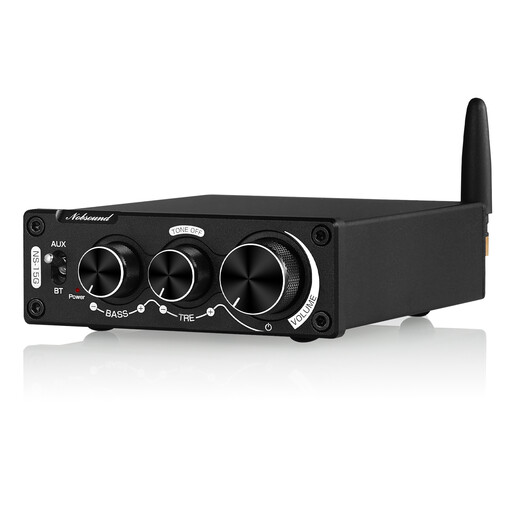
This selection includes compact stereo amplifiers for limited spaces and sources with Bluetooth or stereo RCA connections.
 No image available
A compact option if space is limited and your source offers Bluetooth or stereo RCA connections. Check beforehand that the connections suit your set-up.
No. First check the supported speaker impedance in the relevant manual, and compare power ratings only when they’re based on the same test conditions. Denon lists 4–16 Ω for the PMA-600NE; the ratings given for 8 Ω and 4 Ω are based on different test conditions.
Start by positioning both speakers at roughly the same distance from your listening position, with a symmetrical left-right layout. Genelec recommends an equilateral triangle as a guide for stereo monitoring. Adapt the arrangement to your furniture and listening position rather than assuming it will create a particular effect in the room.
No. Bluetooth playback is listed for the Denon PMA-600NE, while the WiiM Amp offers network and service interfaces according to the manufacturer. Check that your preferred service works with the specific model version.
A new device offered for sale in Germany must comply with the applicable EU conformity rules. CE marking is only required if the relevant harmonised legislation requires it for that particular product. The German Environment Agency advises that electrical appliances must not be put in household waste and need to be collected separately.
According to Your Europe, if you buy as a consumer from a business seller, you have at least two years of legal protection against goods that don’t conform to the contract. A voluntary manufacturer’s guarantee may also apply, but it doesn’t replace this legal protection.