What should you look for when buying?
Traditional stereo integrated amplifier
A good fit if: you use separate source components and the amplifier has the analogue or digital inputs you need.
Bear in mind: you may need an additional source device for network streaming; connections vary by model.
Stereo amplifier with streaming
A good fit if: you want to use supported network services directly and keep the number of separate devices to a minimum.
Bear in mind: check the services, set-up requirements and, for TV sound, the audio formats supported by the specific model.
Start by checking your speakers’ load and your sources before deciding between traditional amplification and built-in streaming.
| What matters to you |
What to check before buying |
Who is it especially relevant to? |
| Speaker compatibility |
Check whether your speakers are active or passive, and match their impedance and permitted configuration to the amplifier. Cambridge Audio highlights the importance of choosing a suitable speaker load. |
If I want to keep using my passive speakers, I need to make sure their load and connections are compatible; around 33% of consumers put speaker compatibility first. |
| Listening position and placement |
Allow space for a left and right speaker, as well as a preferred listening position. Genelec explains how the room and speaker placement affect listening. |
In an open-plan living space, I want to find a suitable listening position and arrange the speakers accordingly; around 27% of consumers prioritise listening position and room layout. |
| Connections for music sources |
Check that each source has a suitable input, for example a CD player, TV sound or turntable. Yamaha Germany lists optical and coaxial inputs for the A-S301. |
If I use several source devices or services, I want to connect them without running into unsuitable inputs; around 27% of consumers prioritise sources and connections. |
| Listening considerately |
If needed, check for a headphone socket and a suitable plug; when using speakers, follow the relevant household and local rules. |
If other residents might be disturbed by speakers, I want a quieter alternative; around 13% of consumers prioritise considerate listening. |
Notable brands and models to help you choose
The examples below show a range of features. The technical specifications come from the manufacturers and apply to the models named.
Yamaha
The A-S301 is a traditional integrated amplifier with digital inputs and adjustable loudness.
- Yamaha Germany lists 2 × 60 W RMS at 8 Ω over 20 Hz–20 kHz for the A-S301, along with optical and coaxial inputs.
- If you need network streaming, check whether a separate source device would suit your set-up.
Denon
The PMA-900HNE combines a stereo integrated amplifier with HEOS streaming and analogue and digital connections.
- For this model, Denon lists 50 W per channel at 8 Ω and 85 W per channel at 4 Ω, as well as phono and TV audio connections.
- Check that your services, set-up and speakers are compatible with the specific model.
WiiM
The Amp Pro is a compact streaming amplifier for passive speakers, with HDMI ARC and measurement-based room adjustment.
- WiiM lists 60 W per channel at 8 Ω and 120 W at 4 Ω. According to WiiM, RoomFit takes measurements at your listening position and corrects the frequency response.
- For the HDMI ARC input, WiiM lists stereo PCM or Dolby Digital, but not DTS or Dolby Atmos. Room adjustment is no substitute for proper speaker placement.
Cambridge Audio
The AXA35 is an analogue-focused integrated amplifier with an MM phono stage and headphone socket.
- Cambridge Audio lists 35 W per channel, four RCA inputs, tone controls and a headphone socket.
- To connect digital sources directly, you’ll need a different device or an additional source component.
Marantz
The PM6007 is a traditional integrated stereo amplifier.
- Marantz lists 45 W per channel for the PM6007.
- The power rating alone won’t tell you whether the model is right for your speakers and room layout.
Joybuy products
This selection is designed for stereo playback through speakers, using Bluetooth or RCA as the source connection. Before buying, check your speakers’ specifications against the amplifier’s requirements.
 No image available
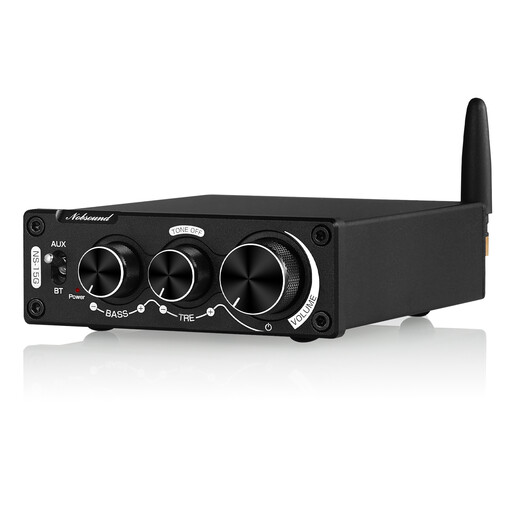
Nobsound 200 W Mini Bluetooth Digital Amplifier
For stereo playback through compatible speakers, when you want to use Bluetooth or RCA as your source connection.
- Described as a 2.0 amplifier with speaker outputs.
- Bluetooth and RCA inputs; bass and treble controls and a tone bypass function are also listed.
- The product description lists an output impedance range of 4–8 Ω and compatibility with 20–200 W speakers. Check your speakers’ specifications against those of the device.
- Dimensions: 92 × 108 × 30 mm; weight: 320 g.
View at Joybuy
Frequently asked questions
Can I compare the wattage of different amplifiers directly?
Only if you also take the load and measurement conditions into account. For example, Yamaha lists 60 W RMS per channel at 8 Ω over 20 Hz–20 kHz for the A-S301; Denon gives separate figures for 8 and 4 Ω for the PMA-900HNE. You should also check your speakers’ impedance.
How should I set up my system in an open-plan room?
First, choose a preferred listening position and point your left and right speakers towards it. Genelec notes that room reflections and speaker placement affect playback; room adjustment on the amplifier is no substitute for considering these factors.
What should I check before connecting my speakers?
Check the speaker load and connections against the instructions for both devices. Cambridge Audio warns that impedance that is too low can overload an amplifier and potentially cause damage; also follow the guidance for your specific model.
Can I return an amplifier ordered online?
Online purchases in Germany generally come with a 14-day cancellation period, starting from the conclusion of the contract or receipt of the goods. The Verbraucherzentrale recommends notifying the seller that you wish to cancel; check the terms of your specific purchase and any legal exceptions that may apply.
Is there a standard time for playing music through speakers across Germany?
Don’t assume that one specific time applies to every home. For neighbour noise caused by people’s activities, the Umweltbundesamt refers to state laws, local rules and house rules; check the requirements that apply where you live.


