Choose your amplifier based first on your speakers and the source you’ll actually use, not just its wattage. If your turntable doesn’t have a built-in preamp, you’ll need a suitable phono input. For a CD player, make sure its output matches an input on the amplifier. If you mainly listen to blues through streaming services, a streaming amplifier could replace a separate source device. However, an unamplified turntable signal will still need a suitable phono preamp.
Which amplifier is right for you?
Vinyl listeners with a turntable
If you want to listen to blues records, check that your cartridge and any existing phono preamp are compatible with the amplifier’s input. Denon Germany and Cambridge Audio list an MM phono input for the PMA-600NE and AXA35 respectively.
Listeners with a CD collection
If you want to connect an existing CD player, check that its output matches the amplifier’s inputs. Yamaha Germany lists optical and coaxial digital inputs for the A-S301.
Network and streaming listeners
If you listen to your collection through supported services or over your network, an amplifier with built-in streaming could be a good match for passive speakers. With the WiiM Amp Ultra, the services and features available depend on factors including the service, subscription and region.
What should you look for when buying?
Traditional stereo integrated amplifier
A good fit if: you own a CD player or turntable and its output is compatible with the inputs on the specific model.
The trade-off: Built-in network streaming is not listed for the traditional models mentioned here, so you may need a suitable external source device.
Streaming amplifier
A good fit if: your blues collection is available through supported network services and you want to connect passive speakers.
The trade-off: With the WiiM Amp Ultra, service availability depends on factors including region and subscription. An unamplified phono signal requires a suitable external phono preamp.
The figures below show which considerations consumers prioritise when choosing an amplifier for this listening set-up.
| Consideration |
What to check before buying |
Who should pay particular attention? |
| Speaker compatibility |
Check whether your speakers are passive and whether their connection and load specifications match the amplifier’s requirements. Only compare power ratings when the impedance and measurement basis are the same. |
If you want to keep using your existing speakers, their connections and permitted load must be compatible with the amplifier. Around 36% of consumers put speaker compatibility first. |
| Connecting your collection |
Check that your turntable or CD player’s outputs match the amplifier’s inputs. With vinyl, the cartridge and phono preamp are key. |
If you want to play your blues records or CDs on an existing player, its output must match the amplifier’s input. Around 29% of consumers prioritise the right connection for their source. |
| Built-in streaming |
Check which service and playback method you actually use. Bluetooth reception is not the same as built-in network streaming. |
If you want to listen to your collection over a network or through supported services, check whether the amplifier supports that playback method. Around 21% of consumers prioritise built-in streaming. |
| Space and controls |
Measure the space available and allow room for cables. Consider whether direct tone controls, a headphone socket or app control matter to you. |
If space is limited in your small living room, the unit’s size and controls need to suit your set-up. Around 14% of consumers put space requirements and ease of use first. |
Common misconceptions when buying an amplifier
-
Assuming Bluetooth means built-in network streaming
Bluetooth and network services are different ways to play audio. Denon lists Bluetooth for the PMA-600NE, while the WiiM Amp Ultra is listed by its manufacturer as having network features.
First, think about where your collection is stored and which service or output you want to use to play it.
If you want to use network services with a traditional amplifier, you may need an additional network source device.
-
Mistaking a line-in for a phono input
WiiM describes the Amp Ultra’s line-in as suitable for a turntable with a built-in preamp. An unamplified phono signal does not meet this requirement.
Check your turntable’s preamp and cartridge, as well as the exact type of input on the amplifier.
An unamplified phono signal may require a suitable external phono preamp.
-
Comparing wattage without checking the test conditions
Yamaha Germany lists the A-S301 at 2 × 60 W RMS into 8 Ω and also gives a maximum rating of 2 × 95 W. These figures are not directly comparable.
Only compare power ratings when the impedance and measurement basis are the same, and also check your speakers’ requirements.
-
Treating manufacturers’ sound claims as independent comparisons
A sound description on a product page does not, by itself, prove that an amplifier is independently better suited to blues music.
Base your choice on the listed connections and whether the equipment is compatible with your set-up.
Notable brands and model ranges
Yamaha
The A-S301 is a traditional integrated amplifier with analogue, optical and coaxial digital inputs. Check that its inputs are compatible with your source devices.
- Yamaha Germany lists the A-S301 at 2 × 60 W RMS into 8 Ω, with dimensions of 435 × 151 × 387 mm.
- These specifications do not prove a sound advantage over other equipment or confirm suitability for speakers whose specifications are unknown.
Denon
According to Denon, the PMA-600NE combines MM phono, digital inputs and Bluetooth. The PMA-900HNE is a separate model with HEOS network features.
- An MM phono input and Bluetooth are listed features of the PMA-600NE.
- The PMA-900HNE’s HEOS features are not available on the PMA-600NE; Bluetooth alone does not mean it has built-in network streaming.
Cambridge Audio
The AXA35 is an analogue-focused stereo integrated amplifier with an MM phono stage and direct tone controls.
- According to the EU product page, the AXA35 offers 35 W per channel, RCA inputs and a headphone socket.
- Don’t assume it has an optical digital input or built-in network streaming based on the features listed.
WiiM
According to the manufacturer, the Amp Ultra combines amplification for passive speakers with network streaming, HDMI ARC and app control.
- These features could suit a collection played through supported network services.
- Service availability depends on factors including region and subscription. The line-in is not a substitute for a phono preamp when connecting an unamplified turntable signal.
Marantz
The PM6007 is a traditional integrated amplifier with MM phono, plus analogue and digital inputs.
- According to the German product page, the model delivers 45 W per channel into 8 Ω; HEOS is listed as “No”.
- Any description of the sound on the product page is the manufacturer’s claim, not an independent comparison.
Related products at Joybuy
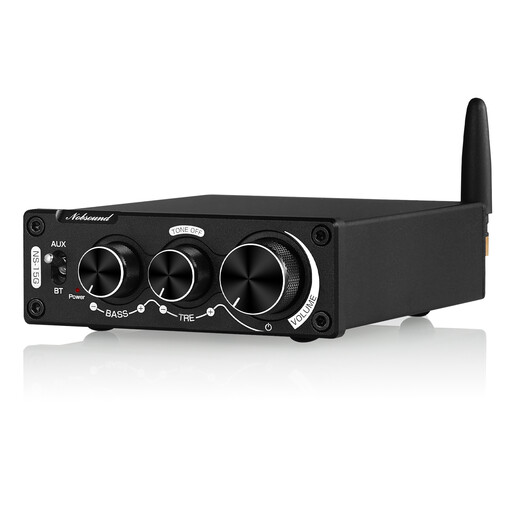
This selection is for people with passive speakers looking for a compact amplifier with Bluetooth playback.
 No image available
Nobsound 200 W mini Bluetooth digital amplifier with bass and treble controls
A good choice if you’re looking for a compact amplifier for home speakers and Bluetooth suits the way you listen.
The product name lists Bluetooth and bass and treble controls. According to the product information, use only the compatible power supply provided.
Joybuy
Frequently asked questions
Do I need a separate phono preamp for my blues records?
It depends on your turntable and the amplifier you choose. Denon and Cambridge Audio list an MM phono input for the PMA-600NE and AXA35 respectively. WiiM describes the Amp Ultra’s line-in as suitable for a turntable with a built-in preamp. Check your cartridge and any existing preamp before planning to buy additional equipment.
How do I connect a CD player?
Check the CD player’s actual output against the amplifier’s input. WiiM describes the Amp Ultra as connecting to a CD player with a line-out via its analogue line-in; Yamaha also lists optical and coaxial digital inputs for the A-S301.
What should I consider when setting up and using the amplifier?
Check the dimensions and set-up guidance in the manual for the model you choose. Cambridge Audio says the AXA35 automatically switches to standby after 20 minutes of inactivity; you can change this setting.
What should I look for when it comes to product safety?
For relevant electrical and radio equipment, the Federal Network Agency’s market surveillance checks include CE marking, an identifiable product, manufacturer details, German-language instructions with warnings and a declaration of conformity. A CE mark alone does not prove that the product has been independently safety-tested by the authority.
What should I do with an old amplifier?
The German Environment Agency advises that waste electrical equipment must not be put in household rubbish. Check with your local authority or a suitable take-back point to find out where to dispose of it.


