What should you consider when choosing?
Traditional stereo integrated amplifier
A good fit if: You want to connect passive speakers and existing source devices, such as a CD player or a turntable with a compatible MM cartridge.
The trade-off: Digital inputs or Bluetooth don’t automatically mean that network music services are built in. Depending on the model and source, you may need an additional device.
Stereo streaming amplifier
A good fit if: You mainly want to use passive speakers with network music services and reduce the number of separate source devices. WiiM lists network features for the Amp Pro, while Yamaha lists MusicCast for the R-N600A.
The trade-off: According to the manufacturer, the WiiM Amp Pro has no built-in phono input. If your turntable has a phono-level output only, you’ll need a phono stage before the amplifier.
When choosing a stereo amplifier for rock albums in a small living room, you can organise the checks around what matters most to you.
| Buying priority |
What to check before buying |
Who is this especially important to? |
| Connecting compatible speakers |
Note the speaker type and impedance; check that the amplifier’s permitted load and connection configuration are suitable in its manual. |
If I want to keep using my passive speakers, I first need to know whether the load and connections are compatible. Around 36% of consumers might put speaker compatibility first. |
| Connecting a turntable |
Check the turntable’s output, built-in preamp and cartridge type; don’t assume an MM input is also an MC input. |
With my turntable, I want to check whether its signal can go straight to the amplifier or whether I need a phono stage. Around 29% of consumers might prioritise connecting vinyl. |
| Using your preferred source |
Match each source’s output to a suitable input; don’t treat network streaming, Bluetooth and HDMI ARC as interchangeable. |
If I listen to rock albums through music services or existing source devices, I want to find the features I need on the specific model. Around 21% of consumers might prioritise streaming and source choice. |
| Placement and controls |
Check the device’s dimensions and leave room for cables; choose only the volume and sound features you need. |
If space is limited or I listen at moderate volume, I want to place the device comfortably and have the controls I need. Around 14% of consumers might prioritise placement and quiet listening. |
Amplifiers at Joybuy
The Joybuy products below are compact stereo amplifiers for passive speakers, with Bluetooth or RCA connectivity. Before buying, check that the connections and speaker specifications are compatible with your set-up.
 No image available
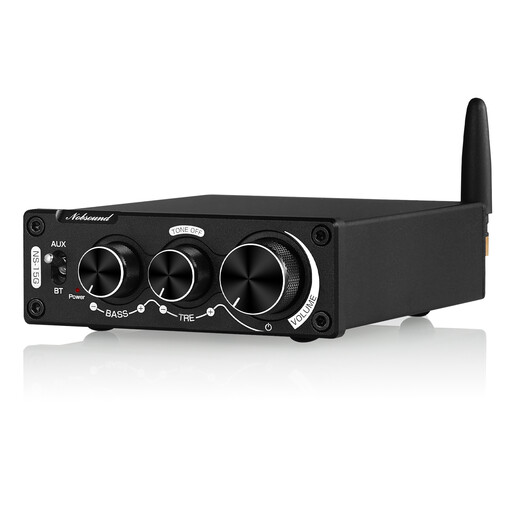
Nobsound 200 W mini Bluetooth stereo amplifier
Designed for a space-saving set-up with passive speakers and Bluetooth or RCA connectivity; check that the stated speaker range is suitable for your speakers before connecting them.
The description lists 2.0-channel operation, speaker outputs and a speaker range of 4–8 Ω.
Features include Bluetooth, an RCA input, and bass and treble controls. The stated dimensions are 92 × 108 × 30 mm.
Joybuy
Frequently asked questions
Do I always need a phono input for a turntable?
No. If your turntable has a built-in phono preamp that’s switched on, you can connect its line-level signal to a suitable line input. If it outputs a phono-level signal only, you’ll need a compatible phono input or a phono stage before the amplifier; WiiM describes this set-up for the Amp Pro.
How can I avoid connection problems with my existing speakers?
Before connecting them, compare your speakers’ specifications with the permitted load and connection configuration in the manual for the amplifier you’ve chosen. Compare power ratings only when they use the same stated Ohm load and test conditions. Model figures alone don’t prove that an unfamiliar speaker combination is compatible.
Does Bluetooth on an amplifier also provide network streaming?
Not automatically. Denon lists Bluetooth for the PMA-600NE, while Yamaha lists MusicCast for the R-N600A. Check the services and connections explicitly listed for the specific model.
What rights apply when buying online in Germany?
When you buy from a trader, you’re generally entitled to a minimum two-year statutory guarantee from the date you receive the goods; this is separate from a voluntary manufacturer’s warranty. Your Europe sets out the two-year guarantee for goods in the EU. Online purchases generally come with a 14-day right to cancel, subject to legal exceptions; the Council of the European Union describes this right for distance purchases.
What should I check if an amplifier may have been imported?
Check that the specific version of the device is suitable for the German market, and look at its power supply details, product labelling and German-language safety information. The Federal Network Agency lists the CE marking, correct manufacturer details and a German instruction manual among the checks to make.


