Which buying criteria matter when listening to blues at low volume?
First decide which feature matters most in your day-to-day listening. Then check the connections and speaker specifications against your existing system.
| Criterion |
What to check before buying |
Who is this especially important to? |
| Sound and controls at low volume |
Check the adjustment range and controls from where you listen. Try the settings at your usual volume with familiar recordings. |
If I mostly listen to blues quietly, I want to be able to adjust the volume and tonal balance directly. Around 36% of consumers put ease of use at low volume first. |
| Connections for your collection |
Make a note of the outputs on your source components. For a record player, check the cartridge type and whether you already have a phono preamplifier; Bluetooth isn’t the same as network streaming. |
If I switch between CDs, records and digital tracks, the inputs need to suit my equipment. Around 29% of consumers prioritise having the right source connections. |
| Compatibility with your existing speakers |
Check the impedance and the number of speaker pairs you’ll use at the same time against the manual for the specific amplifier. Yamaha specifies at least 8 Ω per speaker for the R-N600A when speaker pairs A and B are both switched on. |
If I want to keep my passive speakers, I check their impedance against the amplifier’s specifications. Around 21% of consumers put this compatibility first. |
| Listening in private |
Check the headphone socket and plug type on the specific model, and whether the speaker outputs are muted when you plug in headphones. |
If I prefer listening through headphones, the right connection and what happens when I plug them in matter to me. Around 14% of consumers prioritise private listening. |
Joybuy products for this listening setup
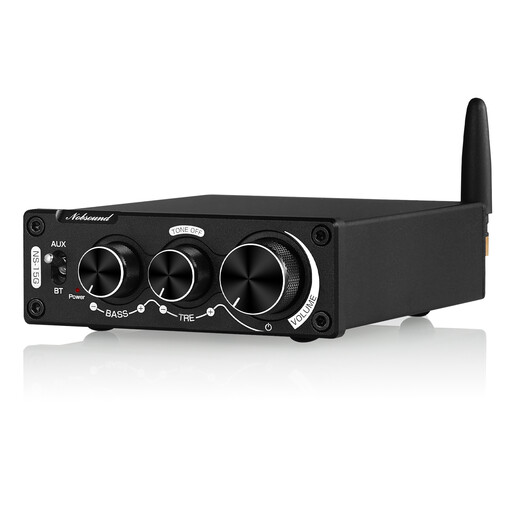
A compact stereo amplifier option with Bluetooth, RCA inputs and tone controls for a setup with passive speakers.
 No image available
Nobsound 200 W Mini Bluetooth Digital Amplifier
The product description specifies 4–8 Ω for passive speakers, with Bluetooth and RCA listed as inputs.
Described as a two-channel amplifier, it has volume, bass and treble controls, as well as a tone-bypass function.
Use only the supplied 19-V power adapter that’s compatible with the unit.
View at Joybuy
Frequently asked questions about amplifiers for listening at low volume
Do I need a phono input for my blues records?
If your record player doesn’t have a built-in phono preamplifier, you’ll need a suitable phono input or a separate preamplifier. Also check the cartridge type: Denon lists MM and MC support for the PMA-900HNE, while NAD lists an MM input for the C 316BEE V2.
Can I use two speaker pairs at the same time with the Yamaha R-N600A?
According to Yamaha’s manual, each speaker must have an impedance of at least 8 Ω when speaker pairs A and B are both switched on. For a single pair with an impedance of 4 Ω to less than 8 Ω, Yamaha describes a separate impedance setting. These conditions apply to the R-N600A and shouldn’t be assumed to apply to other amplifiers.
What ongoing costs and connections should I factor in?
For network playback, you’ll need suitable network access. Depending on what you choose, separately paid streaming services may also cost extra. Check whether your source needs an additional phono preamplifier or suitable cables.
Are a manufacturer’s guarantee and the statutory warranty in Germany the same thing?
No. When you buy as a consumer, the statutory warranty is a claim against the seller; a manufacturer’s guarantee is an additional voluntary promise with its own terms. The EU consumer information site Your Europe states that purchased goods generally have a statutory period of two years.
What do CE marking and proper disposal mean for an amplifier?
Germany’s Federal Network Agency explains that CE marking is the manufacturer’s declaration that the product meets the relevant EU requirements. It isn’t an independent sound award or quality mark. Electrical equipment that has reached the end of its life shouldn’t go in household waste: the German Federal Government lists municipal recycling centres as a disposal option. This general guidance doesn’t confirm that a specific product listing complies with the requirements.


