Owners of passive speakers
If you want to keep using your existing speakers, check their impedance and connections against the amplifier’s specifications. TUPower notes that the speaker impedance must be compatible with the amplifier.


First, make sure the amplifier is compatible with the impedance and connections of your passive speakers. Then decide whether you’ll mainly use wired sources or supported network streaming. A streaming amplifier can replace a separate source device if it supports your service and signal path. Speaker placement also matters in a small living room: a higher wattage alone doesn’t make an amplifier better suited to chamber music.
If you want to keep using your existing speakers, check their impedance and connections against the amplifier’s specifications. TUPower notes that the speaker impedance must be compatible with the amplifier.
For your existing source devices, you’ll need the right inputs. With a turntable, also check that its cartridge and the available phono signal path are compatible with the amplifier. Denon, Marantz and Cambridge Audio list MM phono inputs on the models covered here.
If you listen to music through network services and want to keep the number of devices to a minimum, check which services and playback methods the exact model supports. WiiM highlights differences between its models.
A good fit if: You mainly want to connect a CD player, other wired sources or a turntable with a compatible MM signal path.
The trade-off: You may need an additional suitable source device for network streaming.
A good fit if: Most of your music comes from supported network services and you want to have fewer separate devices.
The trade-off: Services and playback methods vary by model. According to WiiM, the Amp supports AirPlay 2, but the Amp Pro does not.
| Buying priority | What to check | Who it matters to |
|---|---|---|
| Existing speakers | Check that the speaker type, impedance and connections match the specifications of the exact amplifier. Only compare power ratings when the load and measurement conditions are the same. | If I want to keep using my passive speakers, I mainly want to know whether the combination is compatible according to the manufacturer’s specifications. Around 33% of consumers put speaker load compatibility first. |
| Existing music sources | Check the outputs on your source devices and the corresponding inputs; for a turntable, take the cartridge and any existing phono preamp into account. | If I’m keeping my CD player, digital source or turntable, I need the right signal path for each device. Around 27% of consumers prioritise connecting their existing sources. |
| Stereo set-up | Check whether you can position the speakers and listening seat appropriately, and follow the speaker placement guidance. | If I listen to chamber music in a small room, I want to make good use of the space for my speakers and listening position. Around 20% of consumers put stereo set-up first. |
| Streaming and space | Check the supported services, your preferred playback method and the dimensions of the exact model. | If I want to listen to music over a network and keep the number of devices down, the streaming features on the model I choose need to suit me. Around 20% of consumers prioritise built-in streaming in a compact set-up. |
Power ratings are only meaningfully comparable when the speaker load and measurement conditions match. Yamaha Deutschland specifies at least 2 × 60 W RMS into 8 Ω from 20 Hz–20 kHz for the A-S301; other power ratings may be measured under different conditions.
First, check your speakers’ requirements against the amplifier manufacturer’s specifications. Then compare only ratings that state the load and measurement conditions.
Bluetooth is not the same as built-in network streaming. An unamplified phono signal also needs a suitable signal path. Depending on your set-up, you may need a separate network source device or phono preamp.
Make a note of your sources and how they connect, then check each one against the inputs on the exact model.
WiiM’s model-specific compatibility list includes AirPlay 2 for the WiiM Amp, but not for the WiiM Amp Pro.
Before buying, check the full model name and confirm that your preferred playback method is listed for that exact model.
Traditional stereo integrated amplifiers for separately connected sources.
The PMA-600NE combines traditional connections with Bluetooth and an MM phono input.
The PM6007 offers analogue and digital connections, plus an MM phono input for separately connected sources.
According to WiiM, the Amp Pro combines streaming and amplification for passive speakers.
The AXA35 is a traditional integrated amplifier with analogue source connections and an MM phono input.
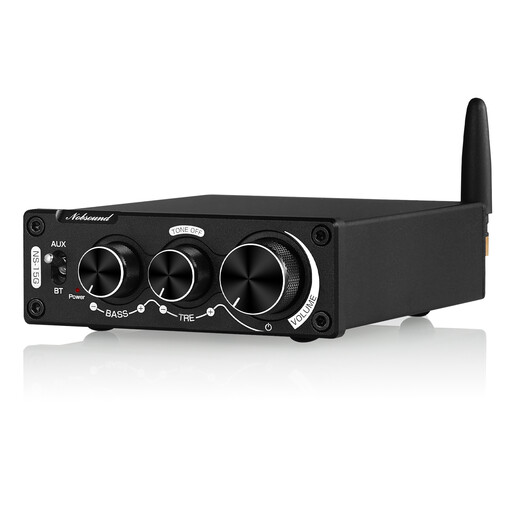
The following Joybuy products are compact stereo amplifiers for passive speakers, with Bluetooth and RCA inputs.
 No image available
May suit passive speakers with a stated impedance range of 4–8 Ω, provided the connections and requirements of your speakers match the amplifier.
According to the product description, it offers two-channel operation, speaker connections, Bluetooth and stereo RCA inputs. Its stated dimensions are 92 × 108 × 30 mm.
As stated in the product guidance, use only the correct power supply: an incompatible one may cause overheating, a fire risk or damage.
Start by positioning the two speakers as symmetrically as possible in relation to your listening seat, and connect them according to the amplifier instructions. ELAC recommends starting with the speakers and listening position arranged in roughly an equilateral triangle; follow your speaker manufacturer’s guidance first and foremost.
Not without checking the signal path. For an unamplified MM cartridge, for example, Denon lists a suitable MM phono input on the PMA-600NE, Marantz on the PM6007 and Cambridge Audio on the AXA35. If there’s no suitable phono input, you’ll need an appropriate external preamp for an unamplified phono signal.
You may need a separate streamer or phono preamp if the amplifier doesn’t provide the signal path you want. If a consumer purchase is faulty, your statutory rights against the seller are separate from any voluntary guarantee; remedies generally include repair or replacement. This is explained by the Verbraucherzentrale.
A CE marking is required when the EU harmonisation rules applicable to the specific device call for one. Your Europe explains this requirement; as part of market surveillance, the Bundesnetzagentur checks details such as markings and manufacturer information. The CE mark is not an independent test certificate and, by itself, does not prove that a specific product listing complies.