Families with passive living-room speakers
If you want to keep using your existing passive speakers, consider the speaker connections, amplifier and placement together.


For passive speakers, choose an amplifier with connections and a playback setup that suit your existing speakers and preferred music source. A streaming amplifier can replace a separate streamer for app-based playback, while a traditional integrated amplifier may be a good choice if you already have suitable wired sources. In an open-plan living space, easy-to-reach controls and a carefully set volume matter too – not just the wattage.
If you want to keep using your existing passive speakers, consider the speaker connections, amplifier and placement together.
If you often play music from your mobile phone, check that the music service or playback method you want to use works with the specific model and is easy to operate.
If you want to connect wired devices as well as play playlists, check the inputs, network features and available space for the unit.
A good fit if: You play children’s songs through a supported service or playback method and want to connect passive speakers.
Bear in mind: The app and network need to be compatible with the model. WiiM lists AirPlay 2 for the Amp; the German product page explicitly states that the Amp Pro does not support AirPlay.
A good fit if: You have passive speakers and a suitable wired music source.
Bear in mind: The Yamaha A-S301 has documented analogue, optical and coaxial inputs; you may need a separate streamer for app-based playback.
A good fit if: You want to combine streaming with other wired sources. Yamaha lists MusicCast and additional inputs among the features of the R-N600A.
Bear in mind: Allow space for the specific unit and check that its connections suit the rest of your setup.
A good fit if: Your speakers have built-in amplification and a suitable input for your chosen music source.
Bear in mind: You normally won’t need an additional power amplifier; the key things are the playback method and ease of use.
| Priority | What to check before buying | Who will find this especially important? |
|---|---|---|
| Compatible music source | Supported service or playback method, and the exact model variant. A built-in streamer can replace a separate one, but may require app and network setup. | If I often play songs from my mobile phone, I want to know whether my service or playback method will actually work. Around 36 % of consumers say finding the right music source is their top buying priority. |
| Connecting your speakers | Check whether your speakers are passive or active, which connections they have, and whether the amplifier and speakers are compatible according to their specifications. | If you want to keep using your existing speakers, you’ll want to be sure they’ll work with your planned setup. Around 29 % of consumers put speaker compatibility first. |
| Controlling the volume | Look for easy-to-reach volume controls and keep playback at a considerate level. The WHO identifies volume, listening time and how often you’re exposed to loud sound as factors that can affect hearing. | If children play in an open-plan living space, I want to be able to turn the volume down easily as part of everyday life. Around 21 % of consumers prioritise volume control. |
| Space and ease of use | Compare the unit’s dimensions and allow space for the speakers and cables, as well as a convenient, easy-to-reach position for the controls. | If you’re putting the amplifier in a shared room, you’ll need enough space and a practical position for the controls. Around 14 % of consumers put this first. |
The German product page lists AirPlay 2 for the WiiM Amp; it explicitly states that the Amp Pro does not support AirPlay.
If you want to play songs using AirPlay, check that the feature is available on the exact model you’re considering.
If your preferred playback method isn’t supported, you may need to use a different method or add another device.
An amplifier for passive speakers doesn’t include a pair of speakers. And a traditional integrated amplifier won’t necessarily play music directly from an app.
Before choosing, make a note of the speakers you have and how you want to play children’s songs through the unit.
Depending on your existing setup, you may need suitable speakers or a separate streamer.
Power ratings can be measured under different conditions. For hearing, the actual volume, listening time and frequency of listening all matter.
Only compare power ratings measured on the same basis, and keep playback at a considerate level where the children are spending time.
WiiM offers compact streaming amplifiers for passive speakers, including options for app-based playback.
The A-S301 is a traditional integrated amplifier for wired sources, while the R-N600A adds network features and MusicCast.
The DRA-900H is a network stereo receiver for passive speakers and other audio or TV sources.
The MODEL M1 combines streaming and stereo amplification with HDMI eARC, making it an option if your setup also includes a TV.
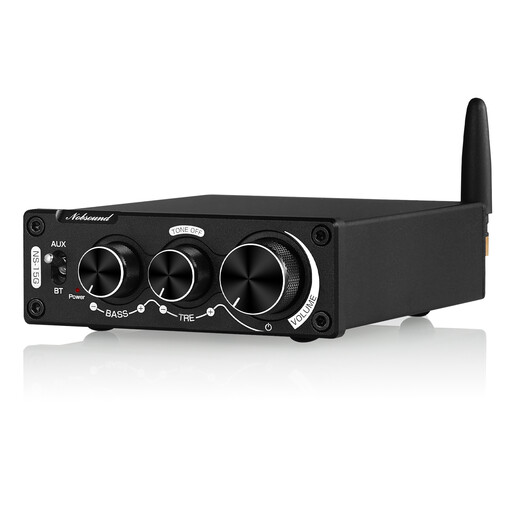
This selection is for anyone who wants to play children’s songs through Bluetooth or an RCA input, using a compact setup.
 No image available
A compact option if you want to play music via Bluetooth or RCA and adjust the volume directly on the unit.
Features listed include Bluetooth 5.0, an RCA input, volume and tone controls, and a bypass function. The dimensions are 92 × 108 × 30 mm.
Use only the appropriate power supply and make sure the unit is well ventilated while in use. The product description warns against placing it within reach of children.
An amplifier for passive speakers won’t produce sound through a pair of speakers on its own: you’ll need suitable speakers too. If you already have active speakers with built-in amplification, check their inputs first rather than automatically planning to add a separate power amplifier.
Keep the volume at a considerate level, and pay attention to listening time and how often the music is played. The WHO advises staying away from loudspeakers; the position of a volume control doesn’t directly show the sound level where your child is.
Your statutory rights under the legal guarantee are separate from any voluntary manufacturer’s guarantee; if a product is faulty, contact the seller first. The EU generally provides for a minimum two-year legal guarantee from the date you receive the goods. The consumer advice centre also explains the difference between a legal guarantee and a manufacturer’s guarantee.
A CE marking is required if a product is covered by harmonised EU rules that require it. It is not an individual approval from a government authority. Whether the requirement applies to a particular device depends on the relevant rules; the EU’s information page on CE markings explains this too.
In Germany, an old amplifier shouldn’t go in household waste; it must be taken to a separate collection point for electrical and electronic waste. The German Environment Agency provides guidance on disposing of old electrical equipment correctly.