Listeners with existing passive speakers
If you want to keep using your pair of speakers at your desk, check that their connections and permitted load are compatible with the specific amplifier.


Start by choosing an amplifier that suits your speakers and the source of your choral recordings. A traditional integrated amplifier is suitable for compatible passive speakers and separate source devices, while a streaming amplifier gives you access to supported network services without a separate streaming device. Then check the connections, space available and headphone requirements against your desk setup. Manufacturer specifications are not a listening comparison specifically for choral recordings.
If you want to keep using your pair of speakers at your desk, check that their connections and permitted load are compatible with the specific amplifier.
If you choose recordings through a network service or app, check that the specific model supports the service and playback method you want to use.
If you use a separate source device, turntable or wired headphones, for example, check that the amplifier has the inputs and connections you need.
| Priority | What to check before buying | Who it matters to |
|---|---|---|
| Speakers and sources | Check the type of speakers and their permitted load, as well as the actual outputs on your source devices and the inputs on the amplifier. | If I want to keep using my existing pair of speakers and source devices, the load and signal connections need to be compatible. For around 36% of consumers, compatibility with their speakers and sources comes first. |
| Playback method | Check that the specific model supports your preferred service and controls. Bluetooth is not the same as network streaming. | If you mainly play choral recordings via an app, network service or Bluetooth, you should be able to choose that exact playback method. Around 29% of consumers prioritise the right streaming and source options. |
| Listening position and setup | Check whether you can position the speakers on either side of your listening position, and whether tone controls or model-specific room correction would be useful to you. | If I regularly listen from the same spot at my desk, I want to be able to position both speakers to suit it. Around 21% of consumers prioritise their listening position and speaker placement. |
| Headphones and space | Check the headphone socket and what happens to the speakers when you plug in headphones, as well as the dimensions, cables and power supply of the specific version. | Connections and device dimensions matter particularly if space is limited or you regularly listen through wired headphones. For around 14% of consumers, headphone use or space requirements are their top buying priority. |
A maximum power rating cannot be directly compared with an RMS rating if the load, power supply and measurement conditions differ. For the Nobsound NS-15G, the manufacturer’s 2 × 100 W rating is based on 24 V/8 A and 4 Ω; the Joybuy product description lists a 19 V power supply.
Compare power ratings only alongside their respective conditions, and check which power supply is included with the version on offer.
Bluetooth and direct playback through network services are different ways of connecting a source. Denon lists Bluetooth for the PMA-600NE, while WiiM describes network features for the Amp.
Before buying, decide which device or service you want to use to play your choral recordings, then check that the specific model supports that playback method.
Speaker placement and reflections in the room affect what you hear from your seat; amplifier specifications alone cannot tell you what the result will be in that position.
Allow space for both speakers, the amplifier, cables and, if needed, the power supply.
The A-S301 is a traditional integrated amplifier for separate source devices and compatible passive speakers.
With compatible passive speakers, the WiiM Amp combines amplification with network playback.
The PMA-600NE is an integrated amplifier with Bluetooth and a range of separate analogue and digital sources.
The AXA35 is designed for compatible analogue sources and wired headphones.
The PM6007 is a traditional integrated amplifier for several separate analogue and digital sources.
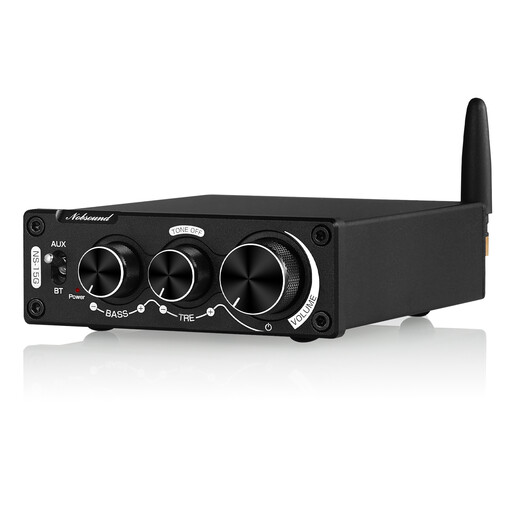
The NS-15G is a compact amplifier for Bluetooth or stereo RCA, provided your speakers and signal path are compatible.
This selection includes a compact Bluetooth and stereo RCA amplifier for compatible speakers and smaller spaces.
 No image available
A compact option if you want to use Bluetooth or a compatible stereo RCA signal at your desk.
The manufacturer lists dimensions of 92 × 108 × 30 mm. The Joybuy product description specifies Bluetooth, an RCA input and a 19 V power supply included in the box.
According to the manufacturer, the advertised maximum output of 2 × 100 W requires 24 V/8 A and 4 Ω; this is not the rated output with the 19 V power supply described.
No. Check your computer’s audio output against the inputs on the specific amplifier model. Yamaha Germany lists optical and coaxial digital inputs for the A-S301, while Cambridge Audio lists analogue inputs for the AXA35. Neither of these details automatically means that the amplifier has a USB audio input.
Position both speakers as symmetrically as possible in relation to your seat, and take reflective surfaces into account. Genelec recommends a 60° angle at the listening position for studio monitors; this guidance does not guarantee a particular result in your room or with a specific amplifier.
According to the Cambridge Audio AXA35 manual, plugging in headphones mutes the speaker outputs. The manual also says that automatic standby is enabled by default after 20 minutes of inactivity; check the setting if you often pause your recordings.
For qualifying distance purchases, the EU explains that you generally have a 14-day right to cancel from the date of delivery; exceptions and rules on return costs apply. For faulty goods, EU rules generally give you a minimum two-year legal guarantee from the seller. This is separate from a voluntary manufacturer’s warranty.
The Federal Network Agency lists CE marking, traceability, manufacturer details and German-language instructions among the points it checks when monitoring the market. The Federal Environment Agency explains that waste electrical equipment must be collected separately and that municipal collection points generally take it free of charge. CE marking is not independent proof of sound quality.