Owners of passive speakers
If you want to keep using your existing speakers, check that their connections and impedance match the amplifier’s specifications.


First, check whether your speakers are passive and whether their connections and impedance are compatible with the amplifier. Your music source will then help you decide whether built-in network streaming or a traditional integrated amplifier for your existing sources makes more sense. Speaker placement and room acoustics also affect how your system sounds in an open-plan living space. A higher wattage rating alone won’t resolve these issues.
If you want to keep using your existing speakers, check that their connections and impedance match the amplifier’s specifications.
If you want to listen to country music directly through a network service, check whether the specific model supports your chosen service and how to use it.
If you listen from a fixed spot, factor in where you’ll place the speakers and consider what volume will be reasonable for your neighbours.
A good fit if: You mainly want to connect existing equipment, such as a CD player or a compatible turntable.
Bear in mind: Streaming and TV features vary by model; the manufacturer lists neither HEOS nor HDMI for the Marantz PM6007.
A good fit if: You want to play music through supported network services and use as few separate sources as possible.
Bear in mind: Connections vary by model: according to the manufacturer, the Yamaha R-N600A has no HDMI ARC, while the WiiM Amp Pro has no built-in phono preamp.
| What you need | What to check | Who should consider this? |
|---|---|---|
| Compatible speakers | Check whether your speakers are active or passive, and match their connections and permitted impedance; compare wattage ratings only at equivalent loads. | If I want to keep my passive speakers, I’ll check the connections and impedance first rather than just looking at wattage. For around 33% of consumers, compatibility with existing speakers is the top priority. |
| Streaming and music source | Check that the exact model supports your chosen service and network connection, and that it’s compatible with the output from your existing music source. | If I want to play country music directly from my network service, the exact service needs to be supported. For around 27% of consumers, built-in streaming is the top priority. |
| Listening position and room | Make space for two suitably positioned speakers and the amplifier; treat room correction as a feature that varies by model. | In an open-plan living space, I want to consider where I’ll listen and position the speakers, while being considerate of my neighbours. Around 20% of consumers prioritise the room, listening position and a considerate volume. |
| Connections for other equipment | For turntables, check the cartridge and phono preamp; for TV use, check the output, input and supported audio format. | If I want to connect a turntable, CD player or TV, I need the right signal path for each device. For around 20% of consumers, connections for existing equipment are the top priority. |
Manufacturers state power ratings at different impedances and under different test conditions. These figures alone won’t tell you whether an amplifier will suit your speakers or how it will sound in your room.
Compare power ratings only at the same load, then check your speaker specifications and listening position.
Bluetooth reception, an optical input and built-in network streaming are different ways of getting music to your amplifier.
Before you buy, decide whether you want to play music directly from a supported network service or from an existing source.
If a model doesn’t have the right built-in features, you may need a separate network streamer for network streaming.
A standard line input can’t replace a phono preamp. According to the manufacturer, the WiiM Amp Pro has no built-in phono preamp; Marantz says the PM6007 has an MM phono input.
Check that the cartridge and any preamp already built into your turntable are compatible with the amplifier input.
If your turntable doesn’t have a suitable preamp, you may need a separate phono unit to connect it.
The PMA-900HNE connects passive stereo speakers to HEOS streaming and analogue and digital sources.
The R-N600A is a network-enabled stereo receiver with MusicCast, phono and several digital inputs.
The Amp Pro is designed for people with passive speakers who want network streaming, HDMI ARC and adjustment features in a compact unit.
The PM6007 is a traditional stereo integrated amplifier for compatible analogue and digital sources, including turntables with an MM cartridge.
This selection features a compact stereo amplifier for passive speakers, with Bluetooth or RCA inputs. Bluetooth is not the same as built-in network streaming.
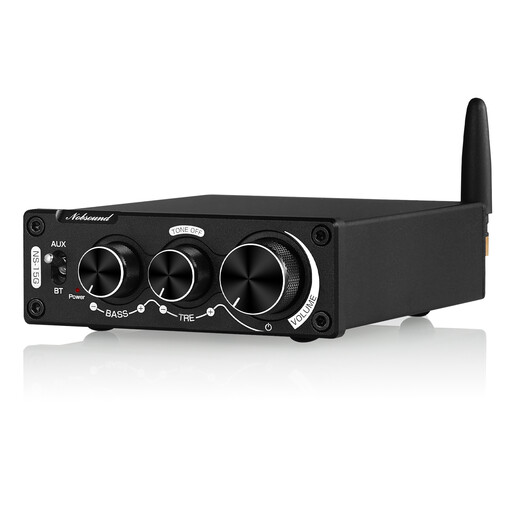 No image available
For passive speakers rated at 4–8 Ω, when you want to play music via Bluetooth or through a stereo RCA input.
2.0 channels, Bluetooth 5.0 and stereo RCA input.
Dimensions: 92 × 108 × 30 mm.
The documented setup for the WiiM Amp Pro uses passive speakers connected to its speaker outputs. For active speakers, check whether your chosen signal path provides a suitable output; speaker terminals are not a substitute.
First, plan your listening position and where to put the two speakers. Genelec explains that room reflections and symmetrical placement can affect listening; its guidance on monitor placement is not an assessment of the amplifiers mentioned here.
No, not with every amplifier. According to the EU manual, the Marantz PM6007 has an MM phono input. The manufacturer says the WiiM Amp Pro has no built-in phono preamp; a turntable without its own preamp will need an external one connected to the line input.
The European Commission explains that under EU rules on the sale of goods, the seller is liable for defects that exist at the time of delivery and become apparent within two years. These statutory rights are separate from any additional manufacturer’s guarantee; the applicable terms will depend on the specific purchase and fault.
No. Under § 117 OWiG, significant disturbance to neighbours may constitute unlawful noise. Quiet hours and other rules vary by location: Berlin’s environmental portal lists, among other things, quiet hours from 22 to 6 in Berlin and notes that you may also need to keep the volume down to room level during the day if the noise causes an unreasonable disturbance. These Berlin hours are not evidence of a uniform rule across Germany.