First, choose an amplifier whose speaker load and connections are compatible with your speakers and music sources. Only compare power ratings when the impedance and measurement conditions are the same. For a convincing orchestral soundstage, your listening position and speaker placement also matter. A streaming amplifier with room correction can give you more ways to fine-tune the sound, but it can’t replace suitable speaker placement.
Who should consider these options?
Listeners with existing passive speakers
If you want to keep using your current speakers, check their impedance and connections against the specifications of the amplifier you’re considering. Power ratings are only meaningfully comparable when the load and measurement conditions match.
Listeners with a challenging room layout
If you can’t position your speakers and listening seat symmetrically in an open-plan living space, check the possible speaker positions before choosing your equipment. Genelec notes that room acoustics and speaker placement affect sound reproduction.
Listeners with digital music sources
If you use a CD player or digital source, or want to listen to music through network services, check that the amplifier has the inputs you need and supports the services you want to use.
What should you look for when buying?
Traditional stereo integrated amplifier
A good fit if: You have passive speakers and mainly want to connect separate sources such as a CD player.
Consider: Check whether the specific model offers built-in network streaming or automatic room correction. Depending on what you need, you may also need an additional source device.
Stereo amplifier with network streaming
A good fit if: You mainly use supported network services and want to keep the number of separate source devices to a minimum.
Consider: Check that it’s compatible with your services and devices. Room correction gives you another way to adjust the sound, but it can’t replace suitable speaker placement.
| Buying priority |
What to check |
Who it matters most to |
| Speaker compatibility |
Speaker impedance and connection type; compare amplifier power ratings at the same impedance and under the same measurement conditions. |
If I want to keep using my existing passive speakers, I’ll first check that the load and connections are compatible. Around 33% of consumers put speaker compatibility first. |
| Stereo speaker placement |
Check whether two speakers and a suitable listening position can be arranged sensibly in your open-plan space. |
If I can’t position my speakers and listening seat symmetrically, practical placement is especially important. Around 27% of consumers prioritise stereo speaker placement. |
| Inputs and sources |
Check that the outputs on your existing source devices match the amplifier’s inputs; also check support for your preferred streaming services. |
If I use existing CD or digital devices, or want to use network services, I’ll check that the available connections meet my needs. Around 20% of consumers consider connecting their sources their top buying priority. |
| Room correction |
Check whether the specific model offers room correction and how to set it up; consider possible speaker positions first. |
If my open-plan living space makes speaker placement difficult, extra adjustment options may be useful. Around 20% of consumers prioritise adapting their system to their room. |
Avoiding buying mistakes
-
Comparing wattage without checking impedance and measurement conditions
Manufacturers may specify power at 4 or 8 Ohms, for example. These figures aren’t automatically directly comparable, and they don’t tell you on their own how loud your speakers will play.
Check that the impedance and measurement conditions for the amplifier ratings match, and look at the specifications for your existing speakers.
-
Expecting the amplifier to fix a poor listening position
Reflections and asymmetrical speaker placement can affect the soundstage. An extra amplifier feature won’t automatically change where your speakers or listening seat are positioned.
First, check how you can position your speakers in the room, then consider room correction as an additional tool. Trying different positions may take extra time and effort to rearrange your space.
-
Assuming Bluetooth, network streaming and AirPlay 2 are interchangeable
These connection options aren’t interchangeable, and features can vary between models from the same brand.
Check that the specific model supports the service you want and offers the right way to connect. For example, AirPlay 2 isn’t listed in the WiiM Amp Pro’s technical specifications.
Key brands at a glance
The information below relates to the model ranges mentioned and can help you compare inputs, streaming features and published power ratings.
Yamaha
The A-S701 is an option for passive speakers and separately connected sources.
- Yamaha Germany lists optical and coaxial digital inputs, as well as a subwoofer output. The A-S701 is rated at 2 × 100 W into 8 Ohms across 20 Hz–20 kHz at 0.019% THD.
- This power rating doesn’t confirm that the amplifier is suitable for speakers with unknown specifications or for a particular room size. Network streaming isn’t among the listed features.
Denon
PMA models vary in their streaming features and specifications, so check the features of the exact model variant.
- Denon Germany lists Bluetooth, digital inputs and a built-in phono preamplifier for the PMA-600NE. The PMA-900HNE offers HEOS streaming, as well as analogue and digital inputs.
- Denon rates the PMA-900HNE at 50 W per channel into 8 Ohms and 85 W per channel into 4 Ohms. These figures aren’t directly comparable with ratings measured at a different impedance.
Marantz
The PM6007 is aimed at listeners using analogue and separately connected digital sources, including MM turntables.
- The German Marantz specifications list five analogue inputs, one coaxial input and two optical inputs, as well as 60 W RMS per channel into 4 Ohms.
- These inputs and power ratings don’t indicate that the amplifier has built-in network streaming or is particularly suitable for orchestral recordings.
WiiM
The Amp Pro is a compact streaming option for passive speakers, with HDMI ARC and the manufacturer’s RoomFit feature.
- WiiM rates the Amp Pro at 60 W per channel into 8 Ohms and 120 W into 4 Ohms. RoomFit gives you another way to adjust the sound.
- AirPlay 2 isn’t listed in WiiM’s technical specifications for the Amp Pro. RoomFit doesn’t replace checking the position of your speakers and listening seat.
Joybuy products
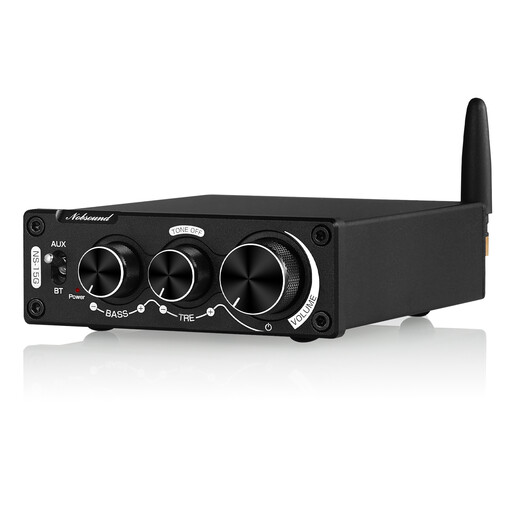
This product is described as suitable for passive speakers with Bluetooth or RCA connections. Before buying, check that its impedance, connections and power rating conditions are compatible with your system.
 No image available
Nobsound 200 W Mini Bluetooth digital stereo amplifier
For passive speakers, if the stated impedance of 4–8 Ω and Bluetooth or RCA connection suit your system.
The product description gives a maximum output of 100 W + 100 W and specifies that this requires more than 24 V/8 A at 4 Ω; it also lists a 19 V power supply. So don’t assume the maximum rating is achievable with the supplied power supply.
The warning says to use only the correct power supply: an incompatible adapter could cause overheating, a fire risk or damage.
View at Joybuy
Frequently asked questions
Is a high wattage enough for dynamic orchestral recordings?
No. A high wattage alone doesn’t answer the question. First, check the speaker load and only compare power ratings at a similar impedance and under the same measurement conditions. Your listening position and room acoustics matter too. Manufacturer ratings don’t tell you how loud your particular speakers will play.
How should I position speakers in an open-plan living space?
Start by choosing a listening position and check whether you can arrange both speakers sensibly around it. Genelec’s speaker placement guidance explains that positioning and room acoustics affect sound reproduction. Specific studio distances aren’t a universal recommendation for every home.
Can room correction replace better speaker placement?
No. WiiM lists RoomFit as a feature of the Amp Pro, while Genelec’s acoustics guidance points out that calibration can’t fix every room problem. First, check the possible speaker positions, then see whether the adjustment features of the model you’re considering meet your needs.
Who should I contact in Germany if something is faulty after purchase?
Your statutory rights for faulty goods are generally against the seller and are separate from any voluntary guarantee. The Verbraucherzentrale generally specifies a two-year period for goods that don’t conform to the contract. For relevant purchases made from 31 July 2026, it describes a one-off extension of 12 months if you choose repair when a fault arises.
What are the rules on labelling and disposing of electrical appliances?
For electrical and electronic products, the Bundesnetzagentur checks matters including CE marking, product identification, and required German-language instructions and warnings. A visible mark alone doesn’t prove that a specific product listing is compliant. In Germany, old electrical appliances mustn’t be put in household rubbish. The Umweltbundesamt lists local collection points and retailers as free drop-off options, subject to certain conditions.


