First, choose an amplifier that’s compatible with your passive speakers and the outputs on your music source, then check how much space you have for it. Traditional integrated amplifiers are well suited to several wired sources, while a streaming amplifier could be a good fit if you mainly listen to piano music through apps or want to connect your TV. Neither type of amplifier can make up for speakers that aren’t positioned properly in a small living room.
Who is this selection for?
Owners of passive speakers
If you want to use your existing passive speakers for piano recordings, make sure your speakers, amplifier and music source are connected appropriately. Yamaha, Denon and WiiM provide information on different connection options.
Streaming listeners short on space
If you mainly play music through apps and want to avoid extra source devices, check whether a streaming amplifier is compatible with your speakers and the space available. WiiM lists the network services available on the WiiM Amp.
Listeners with several traditional sources
If you want to connect a CD player, digital source devices or a turntable, check that the amplifier has each input you need. Yamaha, Denon, Cambridge Audio and Marantz list different combinations of analogue and digital connections.
What should you look for when buying?
Start by checking your speakers and source, then consider the space available and how you want to use the amplifier. This lets you compare connections and power ratings in context, rather than judging individual features in isolation.
| What matters when buying |
What to check |
Who it matters most to |
| Speakers and source |
Check the type of speaker and the manufacturer’s guidance on impedance against the amplifier; also check the output on your music source and make sure it matches an input. Yamaha lists optical and coaxial inputs on the A-S301, while Cambridge Audio lists four RCA inputs on the AXA35. |
If I want to keep using my existing speakers and source devices, their connections need to be compatible. Around 33% of consumers put this check first. |
| Space and positioning |
Check the unit’s dimensions and allow room for cables and ventilation. Yamaha lists the A-S301 at 435 × 151 × 387 mm; Genelec notes that the room and speaker positioning affect what you hear. |
In a small living room, it’s not just the width of the unit that matters to me; I also need a practical position for both speakers. Around 27% of consumers prioritise space and positioning. |
| Streaming and TV |
Check that the specific model’s listed features match the app you actually use, your Wi-Fi requirements and, if needed, Bluetooth or HDMI ARC. WiiM lists HDMI ARC on the Amp; for TV audio, the TV needs an ARC connection and must be set to Stereo-PCM. |
If I listen to piano recordings through apps or want to connect my TV, compatible playback options are essential. Around 20% of consumers prioritise streaming or a TV connection. |
| Listening at low volume and features |
Check for a headphone socket and the right plug type, as well as which sources you already have and whether you’ll need any extra devices. Cambridge Audio lists a headphone socket on the AXA35; the manual says the speaker outputs are muted when headphones are connected. |
If I want to listen quietly in the evening and avoid unnecessary extra devices, I check the features I need in advance. Around 20% of consumers prioritise headphone listening and suitable features. |
Common mistakes when choosing
-
Assuming the highest wattage means better piano sound
Manufacturers quote power ratings using different impedance and measurement conditions. The room and speaker positioning also affect the sound you hear.
Only compare power ratings measured on the same basis, and check your speakers, listening position and connections first.
-
Pairing an amplifier for passive speakers with active speakers
Amplifiers such as the WiiM Amp are designed for passive speakers. With active speakers, you need to use their own signal input.
Check the model name and connection instructions for your speakers before choosing a device.
-
Confusing Bluetooth, network streaming and HDMI ARC
These features serve different purposes: the Denon PMA-600NE lists Bluetooth, while the WiiM Amp offers network services and HDMI ARC.
Make a note of the sources you actually use, then check each one against the inputs and services available on the specific amplifier.
Key brands at a glance
Yamaha
The A-S301 is a traditional integrated amplifier with analogue and digital inputs, as well as a subwoofer output.
- Yamaha lists 2 × 60 W RMS at 8 Ohm, along with optical and coaxial inputs.
- Check the listed dimensions of 435 × 151 × 387 mm against the space you have available. Built-in network streaming isn’t listed.
Denon
The PMA-600NE combines traditional amplifier connections with Bluetooth and an MM phono input.
- Denon lists 45 W per channel at 8 Ohm, along with digital inputs.
- Check that the listed connections suit your sources; Bluetooth isn’t the same as network streaming.
WiiM
The WiiM Amp combines streaming and TV connectivity with an amplifier for passive speakers.
- WiiM lists HDMI ARC, network services, EQ and 60 W per channel at 8 Ohm.
- For your intended use, check Wi-Fi requirements, app setup and supported services. For TV audio via HDMI ARC, WiiM specifies an ARC connection on the TV and the Stereo-PCM setting.
Cambridge Audio
The AXA35 is designed for analogue sources, including a turntable with an MM cartridge.
- Cambridge Audio lists 35 W per channel at 8 Ohm, four RCA inputs, a phono input and a headphone socket.
- The listed features don’t include built-in network or HDMI inputs. At 430 mm wide, the unit isn’t necessarily a mini solution.
Marantz
The PM6007 is a traditional option for analogue and optical digital sources, with the option to connect an active subwoofer.
- Marantz’s European specifications list 2 × 45 W RMS at 8 Ohm, MM phono, two optical inputs and a subwoofer output.
- Check that these inputs and outputs match the source devices you actually use; manufacturers’ claims about sound quality aren’t an independent comparison.
Joybuy products for this topic
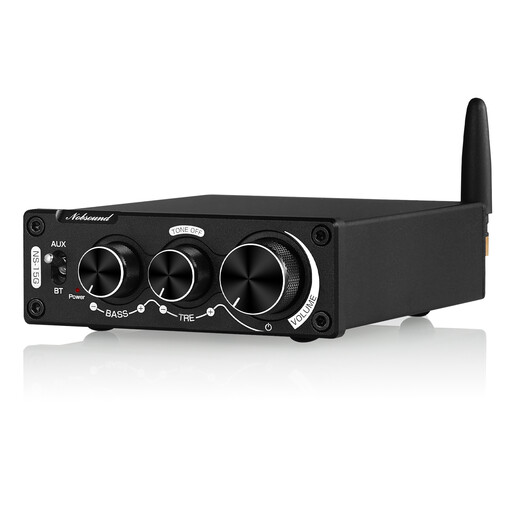
This selection includes a compact Bluetooth stereo amplifier for use with speakers.
 No image available
Nobsound 200 W Mini Bluetooth Digital Amplifier
A compact option for playing audio through passive speakers from an RCA source or via Bluetooth.
With bass and treble controls. Use only the supplied power adapter, ensure adequate ventilation and don’t open the casing.
View at Joybuy
Frequently asked questions
Do I need a separate stereo integrated amplifier for active speakers?
Start by checking the type of speaker: the speaker outputs described here and the WiiM Amp are designed for passive speakers. With active speakers, you need to use their signal input and a compatible source.
Can I use a stereo amplifier to amplify a digital piano?
It depends on the digital piano’s audio output and whether the amplifier has a compatible input. The specifications reviewed here don’t confirm universal compatibility with every digital piano, so check the instrument’s manual before connecting it.
How can I check speaker positioning in a small living room?
Where possible, position the two speakers symmetrically around your listening position, and try other positions if needed. Genelec explains how room reflections and symmetry affect sound, but studio recommendations aren’t fixed minimum spacing requirements for every living room.
What should I know about faulty products and online purchases in Germany?
Your statutory rights are generally against the seller and are separate from any voluntary guarantee. According to the Verbraucherzentrale, online purchases usually come with a 14-day right to cancel; the relevant terms and conditions apply.
What should I look for when it comes to product safety?
For the specific product, look for appropriate markings, clear manufacturer information and instructions in German. The Bundesnetzagentur lists these points as part of its market surveillance; the European Commission notes that CE marking is a manufacturer’s declaration, not an independent quality mark.


