Listeners with existing passive speakers
You want to choose an amplifier to suit your pair of speakers, rather than relying on wattage alone. HIFI.DE and Yamaha Deutschland both treat power and matching speakers as important factors in your choice.


Choose an amplifier for piano sonatas in a small living room based on your passive speakers, the music sources you have and the space available – not the highest wattage. A traditional integrated amplifier is better suited to separately connected sources, while a compact streaming amplifier can do away with extra devices but needs a suitable connection and controls to use its network features. Manufacturers’ specifications alone do not prove an audible advantage for piano music.
You want to choose an amplifier to suit your pair of speakers, rather than relying on wattage alone. HIFI.DE and Yamaha Deutschland both treat power and matching speakers as important factors in your choice.
You might switch between a CD player, a digital source and a turntable, so you need the right inputs for each. Model specifications from Yamaha Deutschland, Denon Deutschland and Marantz Deutschland show that connection options vary.
You want to stream piano sonatas through passive speakers without having to set up lots of separate devices. WiiM explains how to set up its amplifiers with passive speakers, a smartphone or tablet and a Wi-Fi connection.
A good fit if: You have passive speakers and mainly use separately connected sources. The Yamaha A-S301 and Denon PMA-600NE offer different analogue and digital connections; Denon also lists Bluetooth and an MM phono input.
Things to consider: You may need a separate source device for network streaming. Also check the amplifier’s dimensions and leave enough room for the cables.
A good fit if: You mainly want to stream to passive speakers and keep the number of separate devices to a minimum. WiiM lists built-in network features and RoomFit for the Amp Pro.
Things to consider: Setup and streaming features require the relevant app and network connection. WiiM says RoomFit settings depend, among other things, on measurements, the microphone and your chosen settings.
| Priority | What to check before buying | Who it matters to |
|---|---|---|
| Matching your speakers | Compare your speakers’ impedance and the manufacturer’s guidance with the specifications of the specific amplifier. Only compare wattage figures when the load and measurement conditions are the same. | If I already own passive speakers, I want to know whether they’re compatible with the amplifier rather than focusing on a high wattage figure. Around 33% of consumers put speaker compatibility first. |
| Connecting music sources | Check the output of each source and the matching amplifier input; for a turntable, make sure the cartridge is compatible with the phono stage. | If you want to connect a CD player, digital source or turntable, make sure the amplifier has all the inputs you actually need. Around 27% of consumers prioritise suitable source connections. |
| Space and streaming | Check the amplifier’s dimensions and allow room for the connections; make sure its streaming services, inputs and controls meet your needs. | If I want to stream most of my music and keep the number of devices in my small living room down, a compact design with easy-to-use controls matters to me. Around 20% of consumers focus mainly on saving space and built-in streaming. |
| Listening at low volume | Check how easy it is to use at your usual listening volume. Only factor in loudness or room correction if the specific model offers those features. | If you mostly listen to piano sonatas quietly, adjustable playback may matter more than extra power reserves. Around 20% of consumers prioritise listening at low volume. |
Power ratings relate to specific impedances and measurement conditions. A higher wattage figure alone doesn’t tell you which amplifier will work better with your speakers or piano recordings.
Check the load, frequency range and measurement conditions, then compare them with your speakers’ specifications. HIFI.DE treats speaker matching as a separate point to consider.
Cambridge Audio notes that the USB port on the rear of the AXA35 is not an audio input.
Check the manual for the exact model to find out what each connection does. Depending on your sources, you may need a different connection or an additional source device.
Inputs and built-in streaming features vary between models. Not every device will necessarily have a connection for a particular source or a network feature.
List the sources you have and plan to use, then check that each one is supported by the connections and controls on the specific amplifier.
The A-S301 is a traditional integrated amplifier for passive speakers, with analogue, optical and coaxial digital inputs.
The PMA-600NE combines traditional stereo connections with Bluetooth and an MM phono input.
The PM6007 is a stereo integrated amplifier for analogue and digital sources, including an MM turntable.
The Amp Pro is designed for people who want to power passive speakers and stream over a network with a single compact device.
The AXA35 is an alternative if you mainly use analogue sources and an MM turntable.
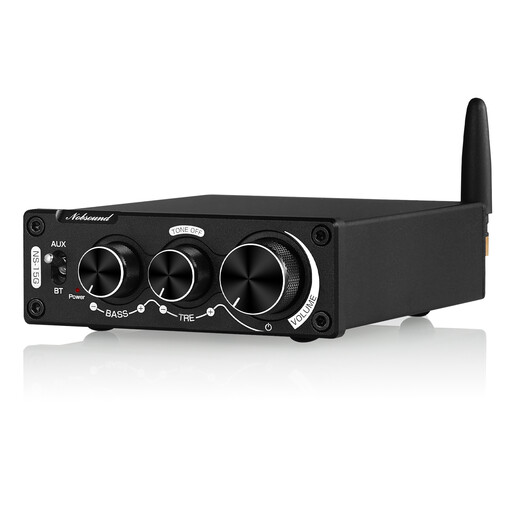
The Joybuy listing below is for compact stereo amplifiers for passive speakers with Bluetooth or analogue input.
 No image available
Could be a good fit if you want to connect passive speakers in a small space using Bluetooth or an analogue source.
The product title states 200 W; without details of the measurement conditions, this figure is not a reliable way to compare performance for piano playback. Before buying, check that the stated impedance range matches your speakers, make sure you have the right power supply and confirm the compliance information required for the specific German version.
No. Only compare power ratings when the speaker impedance and measurement conditions are the same, and start by checking your speakers and sources. For example, Yamaha Deutschland specifies the A-S301 at a minimum RMS power of 2 × 60 W into 8 Ohm across 20 Hz–20 kHz; this is not a listening assessment.
It depends on the turntable and amplifier. Denon Deutschland says the PMA-600NE has a built-in phono stage for MM cartridges; if you have a different cartridge or model, check separately whether you need a suitable phono preamp.
WiiM says you’ll need a pair of passive speakers, a smartphone or tablet and a Wi-Fi connection. Set up RoomFit at your usual listening position, following the manufacturer’s instructions, and check which settings are available with your devices.
Your statutory rights against the seller are separate from any voluntary guarantee. If a product is faulty, the seller is generally required to put things right in the first instance. For a typical distance sale to a consumer, the German Civil Code generally provides a 14-day right to cancel; the conditions, when the period starts and any statutory exceptions must be considered in each case.
For products covered by relevant EU harmonisation legislation and placed on the EU market, the Federal Network Agency describes CE marking as a requirement. Check the compliance information required for the specific version you’re buying; CE marking is not an independent quality mark for sound.