Which buying criteria matter?
Start by checking your speakers and listening positions, then decide on the music source and controls. Finally, check the space required, connections and conditions for your intended use.
The percentages show the top buying priority for a stereo amplifier in a shared lounge.
| Criterion |
What to check before buying |
Who is it most relevant to? |
| Speakers and listening positions |
Check the speaker type and impedance against the amplifier manual; consider possible speaker positions and seating areas in the room. |
If you want to use existing speakers in several places, suitable connections and thoughtful placement are important. Around 36 % of consumers put speakers and listening positions first. |
| Music source and controls |
Check the service, connection method and controls you want against the full model name; decide who will manage playback. |
If several people choose the music, the intended source should work with the amplifier and be easy to manage day to day. Around 29 % of consumers prioritise playback and controls. |
| Space and connections |
Note the space available and the sources you actually plan to use; if you’re connecting a TV, check its output, the amplifier’s input and the supported audio format. |
If space is limited in the lounge or you want to connect other devices, the connections you need are key. Around 21 % of consumers prioritise space and connections. |
| Use and usage rights |
Check whether the use is private or public and review the terms of the specific music source; for a consumer purchase, keep the retailer in mind as your point of contact if there’s a fault. |
If you regularly play music for guests or visitors, the music source and usage rights must suit the way you operate. Around 14 % of consumers prioritise use and rights. |
Joybuy product selection
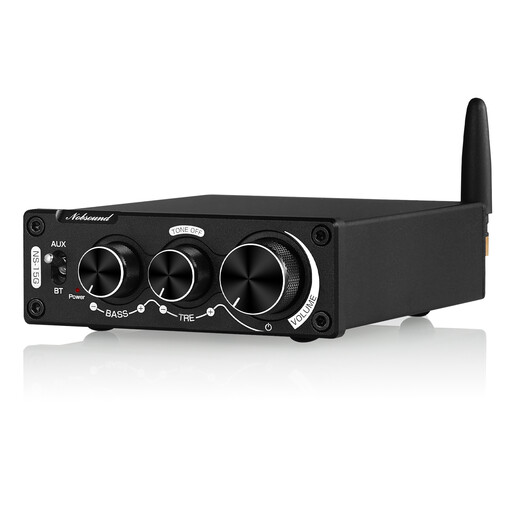
This selection includes a compact amplifier for use with a separate music source connected via Bluetooth or RCA.
 No image available
Nobsound 200 W Mini Bluetooth Digital Amplifier
Could be suitable for a compact set-up with Bluetooth or RCA input and compatible speakers.
The product details list Bluetooth and RCA input, as well as a speaker impedance range of 4–8 Ω.
As stated in the warning, use only the matching power supply provided.
View at Joybuy
Frequently asked questions
Do I need a GEMA licence for every shared lounge?
No, shared use alone doesn’t determine this. GEMA distinguishes between private and public music playback; if background music is played regularly in a public place, you should check which licence is required before playing it. Without details of who uses the lounge, it’s not possible to determine its exact status.
Can I use a personal Spotify account for background music in a business lounge that’s open to the public?
According to Spotify, the service is for personal, non-commercial use; Spotify prohibits public playback by a business using such an account. A GEMA licence, if required, doesn’t replace the permission you need from the music service.
Can I connect existing speakers to any stereo amplifier?
No. First check whether they’re passive speakers, then compare their impedance with the manual for the specific amplifier. For example, the Yamaha R-N600A manual describes a different impedance setting for speakers rated between 4 Ω and below 8 Ω.
How can I check speaker placement for quiet music across several seats?
Plan possible speaker positions and check the sound from the places people will actually use. Room surfaces and speaker placement affect reflections and the sound you hear; an amplifier’s power rating alone won’t answer this question.
Who should I contact if a newly purchased amplifier is faulty?
For a consumer purchase in Germany, the retailer is generally responsible for statutory liability for defects. The Verbraucherzentrale states that this usually lasts for two years from delivery; an additional manufacturer’s warranty is separate.


