TV and film soundtrack listeners
You want to connect your TV to two passive speakers, so you check the TV output and supported audio formats first.


Choose an amplifier to suit your TV connections and audio formats, as well as your passive speakers – don’t base your decision on wattage alone. Stereo or 2.1 may be right for you if two front speakers and, where needed, a subwoofer meet your listening needs; for separate centre and surround channels, you’ll need a multi-channel system. In an open-plan home, speaker placement and the volume at your actual listening positions matter too.
You want to connect your TV to two passive speakers, so you check the TV output and supported audio formats first.
You want to keep using your existing speakers and assess the connections, amplifier specifications and sound at your usual listening positions.
You want the option of adding a subwoofer for film soundtracks and adjusting the bass to suit your listening setup and home environment.
Start by checking the signal path from your TV, then decide whether stereo is enough or you need separate channels for film sound.
A good fit if: You want to connect your TV directly to two passive speakers.
Consider: HDMI alone doesn’t guarantee support for every audio format or provide separate surround channels.
A good fit if: Your TV has an optical audio output and PCM output is suitable for the model you’ve chosen.
Consider: This connection doesn’t offer HDMI ARC controls, and the formats supported depend on the model.
A good fit if: You want to set up a dedicated centre speaker and separate surround speakers.
Consider: Extra speakers and suitable multi-channel electronics take up more space and need to be positioned appropriately.
| What matters to you | What to look for | Who it matters most to |
|---|---|---|
| TV connection and audio formats | Check your TV’s output and ARC/eARC labelling against the inputs and supported formats of the specific amplifier. | If I want to connect my TV directly and listen to film sound without extra steps, the output and format need to match. Around 28% of consumers put TV compatibility first. |
| Speakers and listening positions | Check whether your speakers are passive or active, as well as their impedance, connections and comparable power ratings. | If you want to use your existing passive speakers in an open-plan living space, you’ll need a suitable combination and should consider your listening positions. Around 28% of consumers prioritise suitability for their speakers and listening positions. |
| Stereo or separate channels | Decide in advance whether two front speakers are enough or you want a dedicated centre speaker and surround speakers. | If a dedicated centre speaker and separate surround channels are important to me, a stereo-only setup won’t be enough. Around 17% of consumers put the channel setup first. |
| Bass and home environment | If you’re planning to add a subwoofer, check its type and the suitable output; take volume levels and local quiet-hour rules into account. | If I want to enjoy film soundtracks with extra low-end while keeping the volume suitable for my home and neighbours, bass control and how I use the system matter. Around 16% of consumers prioritise controlled bass. |
| Total cost and features | Factor in any extra equipment you need, what’s included and any features sold separately. | If you want to understand the full feature set and any potential additions before buying, don’t compare individual features in isolation. Around 11% of consumers pay particular attention to the total cost. |
WiiM lists stereo PCM or Dolby Digital for the Amp Pro’s TV input; DTS and Dolby Atmos are explicitly not supported on this model.
Before buying, check which TV output settings you can use and which formats the exact amplifier model accepts.
Power ratings may be based on different impedance levels and measurement conditions. On their own, they don’t tell you how the unit will sound with your speakers at your listening positions.
Compare ratings on a like-for-like basis with your speaker specifications, and consider placement at your usual listening spots.
WiiM specifies that the Amp Pro’s subwoofer output is for active subwoofers. A passive subwoofer needs additional amplification.
Before choosing an amplifier, check whether your subwoofer is active or passive and which inputs it has.
You may need an active subwoofer or additional amplification to make the connection.
NAD says that using it requires a licence purchased separately and a calibration microphone sold separately.
If you want to use room calibration, check the licence and microphone requirements as well as what’s included with the unit.
Room calibration also requires a licence and a calibration microphone, both sold separately.
The Amp Pro combines amplification for passive speakers with a TV connection and streaming.
The R-N600A is a network stereo receiver with an optical TV audio input and other hi-fi sources.
The C 3030 offers HDMI eARC, while the C 700 V2 features built-in BluOS and optional room correction.
The MODEL M1 is a compact 2.1 streaming amplifier with HDMI eARC and HEOS.
The Evo 150 SE and EXA100 differ in how they connect to a TV.
This selection features a 2.0 stereo amplifier for passive home speakers, with Bluetooth and RCA inputs.
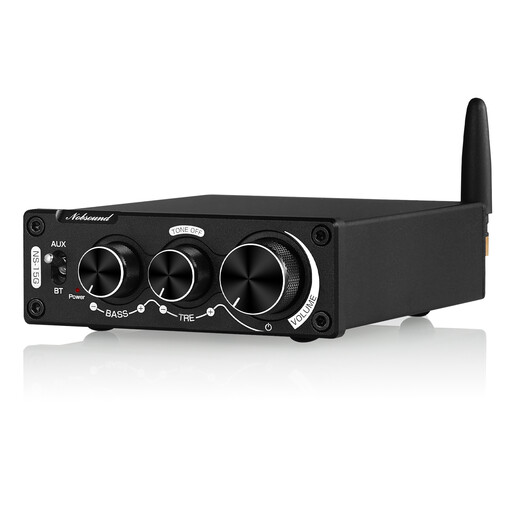 No image available
For passive home speakers when your audio source has Bluetooth or a stereo RCA output.
2.0 stereo output with speaker terminals, plus Bluetooth and RCA inputs.
The description mentions bass and treble controls, as well as a bypass function. Before buying, check that your TV output can connect to one of the listed inputs.
No. Supported output formats vary by model. WiiM lists stereo PCM or Dolby Digital for the Amp Pro, and rules out DTS and Dolby Atmos; the Yamaha R-N600A manual specifies PCM for its optical inputs. Check your TV’s output against the amplifier’s specifications.
WiiM says that the Amp Pro’s subwoofer output is designed for an active subwoofer. A passive subwoofer needs additional amplification, so check its type and inputs before connecting it.
NAD lists Dirac Live as an optional feature for this model. Using it requires a licence purchased separately and a calibration microphone sold separately.
There isn’t one set time that applies everywhere. The German Environment Agency points to state law, local regulations and house rules as possible restrictions on noise from neighbours’ activities. Check the rules where you live.