For soft, stoned peaches, a stick blender with a suitable blending jug is a space-saving choice if you’re making smoothies in batches. If you’re preparing several glasses, consider the jug’s capacity and how you’ll work; for regularly making large quantities or blending firmer ingredients, a jug blender may be more suitable. Assess blending results, splash protection and ease of cleaning for the specific model rather than relying on wattage alone.
Which stick blender is right for you?
Hosts serving several glasses
If you’re making several peach smoothies for dinner, consider the jug’s capacity, how many batches you may need to blend and how much it might splash while you work. SWR’s buying guide recommends stick blenders particularly for smaller quantities.
Fans of smooth fruit smoothies
If texture matters to you, compare the blending results of specific models rather than focusing on wattage alone. CHIP’s test assesses each model individually.
Everyday cooks short on space
If you want to put the appliance away after dinner and clean it easily, check which parts are detachable. Consider whether any extra attachments are worth the storage space for the tasks you do in your kitchen.
What should you look for when buying?
| What matters when buying |
What to check |
Who it matters most to |
| Servings and blending jug |
Check the stated capacity, exactly what’s included and the recommended filling level in the instructions. If needed, plan to use a suitable jug of your own. |
If I’m preparing several glasses for dinner, I want to know whether the jug and the process will work for the number of servings. Around 36% of consumers prioritise being able to make enough smoothie for a shared meal. |
| Desired consistency |
Compare model-specific information or test results on blending quality for the ingredients you plan to use; stone peaches before blending. |
If I want a smooth peach smoothie, I compare the blending results rather than looking at wattage alone. Around 29% of consumers put their preferred consistency first. |
| Splashes and cleaning |
Check which parts are detachable and read the cleaning instructions for the specific model; consider test findings on splash protection separately. |
If I want to keep washing-up and splashes to a minimum after dinner, I want to know how each part can be cleaned. Around 21% of consumers prioritise easy cleaning and fewer splashes. |
| Additional attachments |
Check exactly what’s included and consider whether you’ll actually use a chopper or whisk for other tasks. |
If I do more than make smoothies in the kitchen, I want to use attachments that suit my needs rather than store accessories I don’t use. Around 14% of consumers prioritise using their blender for more than smoothies. |
Common buying mistakes
-
Assuming wattage guarantees an especially smooth smoothie
Electrical power alone doesn’t tell you how well a particular model blends or how easy it is to handle while blending. CHIP’s test shows differences between models, including in blending results and splash protection.
Compare results for the specific model and ingredients you plan to use instead of choosing an appliance based on wattage alone.
-
Assuming jug capacity equals the amount you can blend for all your guests
The stated 500 ml for the Philips HR2522/00 and 700 ml for the WMF Kult X Set refer to their respective jugs. They don’t confirm the recommended filling level when blending or how much you’ll need for your guests.
Plan your servings and check the recommended filling level in the instructions. Also consider whether you can use a suitable jug of your own.
A smaller jug may mean blending in extra batches and cleaning up afterwards.
-
Choosing a set for attachments you’re unlikely to use
A set with extra attachments is only useful for everyday cooking if you’ll actually use them for other kitchen tasks. Otherwise, you’ll have more parts to store and clean.
Check that what’s included matches the tasks you have in mind. If you regularly make larger quantities of smoothies, also consider whether a jug blender would suit your routine better.
Extra attachments take up storage space and can mean more cleaning.
Key brands at a glance
Braun
The MultiQuick range includes models with different features. Braun says the MQ 5235 BK has 21 adjustable speed settings.
- CHIP gives the tested MultiQuick MQ 5235 positive ratings for blending and splash protection.
- CHIP also notes that this tested model is awkward to clean and comparatively noisy on its highest setting. These findings don’t automatically apply to other MultiQuick models or sets.
Bosch
According to Bosch, the ErgoMixx MSM66110 comes with a detachable metal blending foot, a beaker and two speed settings, including turbo.
- CHIP notes that the tested MSM66110 is easy to clean and blends well.
- CHIP rates the tested model’s splash protection as mediocre and its range of features as limited. Bosch’s AntiSplash claim is a manufacturer description and doesn’t replace this model-specific test assessment.
WMF
The Kult X stick blender set is an option if you want to tackle other kitchen tasks as well as making smoothies.
- WMF says the set includes a 700 ml blending jug, a chopper and a whisk.
- The larger selection of accessories doesn’t prove that it’s especially good at blending peach smoothies. Check whether you’ll use the attachments and have room to store them.
Philips
The 1000 Series HR2522/00 is listed as having 500 W of power and a 500 ml beaker.
- The stated beaker capacity can help you plan how many batches you may need to make several glasses.
- Philips describes smooth results and splash protection as manufacturer claims; they don’t establish an advantage in independent comparative testing.
ESGE
The manufacturer says the ESGE-Zauberstab M250 basic model has interchangeable attachments and can be repaired.
- ESGE lists 250 W of power and a maximum short-term operating time of five minutes for the M250 basic model.
- These details apply to the M250 basic model and can’t be assumed to apply to other models. Wattage figures alone aren’t a meaningful way to compare appliances with different designs.
Stick blenders at Joybuy
These models are options for making smoothies with a stick blender; depending on the model, different blending jugs and accessories are available.
 No image available
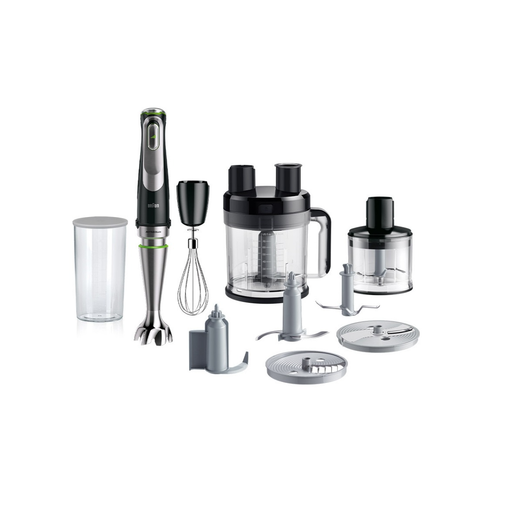
BRAUN MultiQuick 9 MQ 9195XLI, 2 L
An option if you’re planning to blend several glasses in a larger jug. Listed specifications include 1200 W of power and a 2-L blending jug.
Joybuy
 No image available
ochama 4-in-1 stick blender, 600 W
An option if you want to make smoothies and use additional attachments. Listed specifications include 600 W of power, two speed settings, an 800 ml beaker and a 500 ml chopper.
Joybuy
 No image available
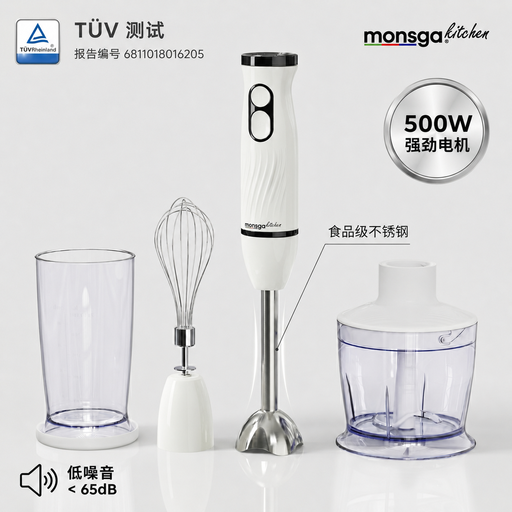
Monsga S100 2-in-1 stick blender
An option if you’re looking for a blending jug and extra attachments. This model is listed with normal and turbo modes, a 500 ml beaker and a 500 ml chopper.
Joybuy
 No image available
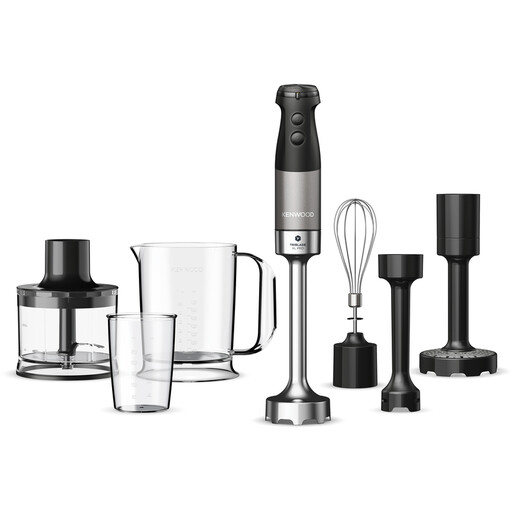
Kenwood Triblade XL Pro HBM80327BK
A stick blender option for making smoothies. Compare what’s included and the cleaning instructions with your needs.
Joybuy
 No image available
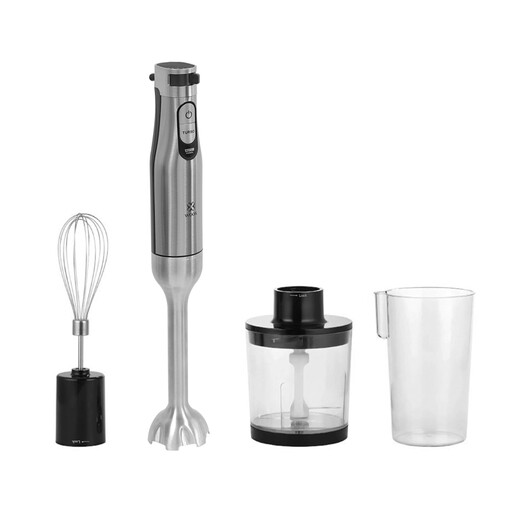
WOOX 4-in-1 stick blender, 1200 W
An option if you want to make smoothies and adjust the speed. Listed specifications include 1200 W of power, plus a chopper, whisk and milk frother.
Joybuy
Frequently asked questions
Do I need to prepare peaches before blending?
Yes. Wash the fruit thoroughly, use fresh ingredients with no signs of spoilage and remove the stones from the peaches before blending. Germany’s Federal Institute for Risk Assessment recommends using fresh ingredients with no signs of spoilage in smoothies; the consumer advice centre explains how to halve and stone peaches.
How should I clean my stick blender after dinner?
Unplug the appliance before changing attachments or cleaning it, and follow the instructions for your specific model. Clean food-contact surfaces and kitchen utensils thoroughly; the consumer advice centre also recommends washing your hands before and between tasks. Check the appliance instructions to confirm whether a detachable part is dishwasher-safe.
Who should I contact if the appliance is faulty: the retailer or the manufacturer?
In Germany, your statutory consumer rights apply against the seller; a manufacturer’s guarantee is a separate, voluntary offer with its own terms. If a product is faulty, you can initially ask for it to be repaired or replaced. The consumer advice centre explains the difference between statutory rights and a guarantee.
Does an electric stick blender sold in Germany need a CE mark?
A CE mark is required when a product falls under relevant harmonised EU rules that require it. It is the manufacturer’s declaration of conformity, not an independent quality mark. The rules that apply to a particular mains-powered or battery-operated appliance depend on its design, so check the product label and the manufacturer’s information. The EU explains the requirements for CE marking.


