Shoppers keeping an eye on salt
If you regularly prepare and season oats yourself, the salt content per 100 g gives you a more useful basis for comparison than the search term ‘reduced salt’. Check the figures for each variety, not just the brand.


If you’re stocking up on oats and keeping an eye on your salt intake, you don’t necessarily need a product labelled ‘reduced salt’: Kölln and REWE list 0 g of salt per 100 g for some plain varieties, while EDEKA lists 0.02 g for one fine variety. Check the current nutritional information and ingredients, choose a flake texture to suit your recipes, and make sure you have a dry place to store them in a tightly sealed container.
If you regularly prepare and season oats yourself, the salt content per 100 g gives you a more useful basis for comparison than the search term ‘reduced salt’. Check the figures for each variety, not just the brand.
If you make porridge, muesli, baked goods or savoury dishes, choose a flake texture that suits the way you use oats most often. If you’re buying larger quantities, you’ll also need a suitable place to store them.
If you have coeliac disease, the words ‘oats’ on the pack aren’t enough to show that they’re suitable. The Federal Centre for Nutrition advises people with coeliac disease to look for clear gluten-free labelling.
First, compare the salt content of the specific variety, then choose a flake texture and only buy as much as you can store properly and use up. If you need to follow a gluten-free diet for medical reasons, clear gluten-free labelling is also essential.
| Criteria | What to check | Who it matters to |
|---|---|---|
| Salt and ingredients | Salt per 100 g and the ingredients list on the current pack; check the information again for oat mixes. | If I season my porridge or savoury dishes myself, I want to know how much salt the oats contain. This is the top priority for around 50% of consumers. |
| Stock and storage | A quantity you can use, the condition of the pack and space to store it somewhere dry in a tightly sealed container. | Buying several packs is only worthwhile for me if I can store them safely until I use them. Storage is the top concern for around 30% of consumers. |
| Flake texture | Fine or thin flakes if you prefer a smoother texture; thick-cut flakes if you want more bite. | I don’t want to store several packs of a type of oat flake I’m unlikely to use in my usual recipes. The right texture is the top priority for around 20% of consumers. |
Plain oats can also have low declared salt levels. The wording on the pack also tells you nothing about the ingredients, flake texture or whether the product is labelled gluten-free.
Compare the salt per 100 g and the ingredients list on the current pack. Don’t assume that figures for one variety apply to other products from the same brand.
Pantry pests can infest dry foods and spread to other stored goods.
Plan a realistic amount to use, keep opened packs tightly sealed and check your supplies regularly. The consumer advice centre recommends tightly sealed containers to help limit the spread of pests.
Oats can come into contact with gluten-containing grains during growing and processing. That’s why regular oats aren’t automatically suitable for people with coeliac disease.
The Federal Centre for Nutrition advises people with coeliac disease to choose oats explicitly labelled gluten-free because of the way they’re produced.
The details below apply to the specific oats mentioned, not to a brand’s entire range. When stocking up, always check the nutritional information and storage guidance on the pack you’re buying.
Kölln offers oats in a range of textures. According to Kölln, its organic thick-cut oats are made from wholegrain oats.
Alnatura fine rolled oats are described as a 500-g pack containing wholegrain oats.
REWE sells ja! fine rolled oats in a 500-g pack containing wholegrain oats.
EDEKA describes its fine and extra-fine oats as being available in 500-g packs.
Brüggen describes itself as a producer of mill products and breakfast cereals, including grain flakes.
This selection includes fine, thin and thick-cut oats, as well as a gluten-free labelled option. Choose a flake texture to suit how you’ll use the oats and, if you’re keeping an eye on salt, check the nutritional information for the specific pack.
 No image available
A fine variety for porridge if you’re looking for oats with gluten-free labelling. The pack contains 500 g. If you need to follow a gluten-free diet for medical reasons, check the labelling on the current pack.
 No image available
An option if you prefer chunkier flakes in muesli or as a topping. The pack contains 500 g; don’t treat this variety as gluten-free labelled.
 No image available
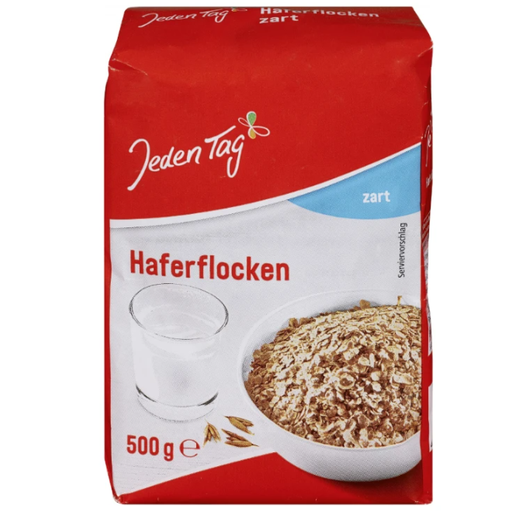
Fine flakes for anyone who prefers this texture in porridge or baking. The pack contains 500 g; it should not be treated as gluten-free labelled.
 No image available
A fine oat variety if you often make porridge or overnight oats. The pack contains 500 g; don’t confuse it with Kölln’s gluten-free labelled variety.
 No image available
A finely rolled organic option for anyone who prefers this texture in porridge or muesli. This pack contains 400 g; check its own nutritional information rather than relying on details for another Alnatura variety.
Not necessarily: some plain varieties from Kölln and REWE list 0 g of salt per 100 g, while one fine variety from EDEKA lists 0.02 g. Even so, check the current pack, especially if you’re buying a mix or a seasoned variety rather than plain oats.
It tells you the declared salt content of that particular variety, not whether it’s suitable for your health overall. Compare the nutritional information per 100 g and remember that oats are just one part of your diet.
Keep them somewhere dry and away from heat. An airtight container is a good option for opened packs. Check your supplies regularly for signs of pests.
Not automatically. The Federal Centre for Nutrition advises people with coeliac disease to choose oats labelled gluten-free because of the way they’re produced. Individual tolerance may also be a factor.