
Lieferung heute & morgen

Qualitätsgarantie

Willkommens-Angebote freischalten: KOSTENLOSE Lieferung | Bis zu 80 % RABATT | Kostenlose 30-Tage-JoyPlus-Testphase
App herunterladen
A storage bed promises the best of both worlds: a comfortable place to sleep and intelligent storage, all in one. It seems like the ideal solution, especially for smaller bedrooms, kids' rooms, or dorms. However, the market is flooded with models whose everyday practicality quickly falls short. Before you make a decision, it's crucial to understand the common weaknesses that can turn a supposedly smart investment into a costly mistake.
This guide focuses on the objective criteria that separate a good storage bed from a poor one, helping you distinguish marketing promises from real-world functionality.
Many beds look impressive in product photos but reveal their flaws only after a few months of use. Pay close attention to these three problem areas:
bed with a shelf at the headboard if the compartments are too shallow to fit a standard book? Or a bed with drawers that can't be fully opened because the nightstand is in the way? A well-designed storage concept considers everyday use and accessibility.To avoid these pitfalls, you should base your choice on verifiable, technical parameters. The following three points are crucial for the longevity and practical value of your storage bed.
A bed's stability is directly linked to the materials used and the quality of the frame's construction.
A critical specification is the manufacturer's stated maximum weight capacity in kilograms. For a single bed, this value should not be less than 120 kg. For a double bed with storage, 250 kg or more is a good benchmark for a solid build. Also, check whether a sturdy slatted frame is included or needs to be purchased separately.
A storage bed can only serve its purpose if the storage is practical to use. Analyse the different concepts:
teen bed with storage.Modern storage beds often offer additional tech features like a bed with LED and USB. It's worth taking a closer look at the details here:
Based on the criteria above, we have identified several models that are well-suited for specific user profiles.

Why This Fits Their Persona: Ideal for making the most of small spaces. It combines a sleeping area, drawers, shelves, and a bench at the foot of the bed, making separate small furniture unnecessary. The 90x190 cm size is perfect for children and teens.
The drawers are equipped with floor casters, which prevents jamming. The shelves at the headboard and footboard have a practical depth of 13 cm and feature stoppers to prevent items from falling off. The recessed mattress base secures the mattress in place.
Flexible assembly of the two deep drawers (can be mounted on the left or right); integrated bench at the foot of the bed provides additional storage and a surface area.
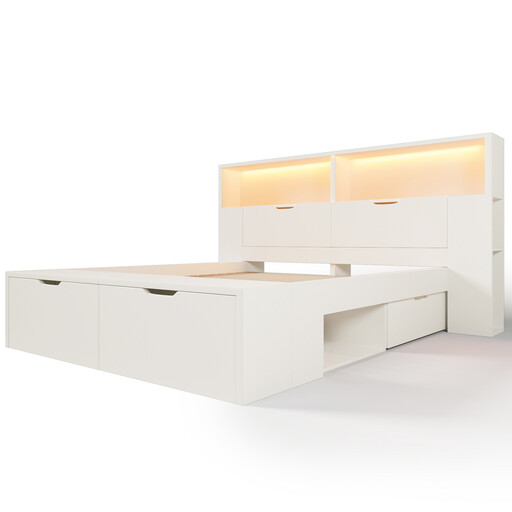
Why This Fits Their Persona: This bed is designed for users who see their bedroom as a multifunctional space. It serves as an entertainment and organisation hub with integrated technology for charging devices and ambient lighting.
The tech features are well-thought-out: it offers both USB-A and a future-proof USB-C port. The LED lighting is controllable via a Bluetooth app and offers over 60,000 colours, going far beyond a simple on/off function.
Comprehensive connectivity with 3 USB-A and 1 USB-C port; app-controlled LED lighting with a music sync function; bench at the foot of the bed features a soft-close hinge for quiet closing.

Why This Fits Their Persona: This set is an all-in-one bedroom solution that replaces the bed, nightstands, and a separate bench. It's aimed at couples who want a cohesive look, maximum storage, and high comfort without having to coordinate multiple pieces of furniture.
The construction is designed for a high load capacity (bed frame up to 300 kg). The bench uses a gas strut mechanism for safe and easy opening. The nightstands are movable and don't block any storage, allowing for flexible room layout.
Complete set including bed, movable nightstands, and bench; foldable linen headboard conceals additional storage; integrated, dimmable reading lights with USB ports.
Some of the most thoughtfully designed solutions combine storage directly with a seating area. We've curated a selection of products that meet these criteria.
Weight capacity is one of the most important, yet often overlooked, factors. It depends directly on the material quality (solid wood vs. particleboard) and the frame's construction. Don't rely on vague descriptions; look for the specific maximum weight capacity in kg in the technical specifications. As a rule of thumb: a single bed should support at least 120 kg, and a double bed for two people should support at least 250 kg.
Generally, no. You can use most standard mattresses. However, it's important to adhere to the manufacturer's recommended maximum mattress height. A mattress that is too thick can block access to headboard shelves or compromise the bed's design. The included or recommended slatted frame is also relevant, as it may be optimised for specific mattress types (e.g., memory foam, innerspring).
Assembly is typically more involved than for a simple bed frame. Models with numerous drawers, shelves, and integrated technology require more time and care. Before buying, check if clear assembly instructions and well-labelled parts are included. Assembly is often easier with two people. In most cases, the necessary tools are included in the package.