
Lieferung heute & morgen

Qualitätsgarantie

Willkommens-Angebote freischalten: KOSTENLOSE Lieferung | Bis zu 80 % RABATT | Kostenlose 30-Tage-JoyPlus-Testphase
App herunterladen
A storage bed can help you make the most of your space by storing clothes, bedding or suitcases. It can be particularly useful in small bedrooms, guest rooms and student accommodation. However, product descriptions can vary considerably: a bed with drawers may offer a very different type of storage from a hydraulic model or a pull-out day bed.
Before you buy, look beyond the colour and upholstery. The usable internal dimensions, how the storage works, the mattress size and the bed frame’s weight capacity are all key considerations.
Drawers need enough space at the sides to open. If the bed is right up against a wall or next to a wardrobe, you may not be able to pull them out fully. A hydraulic storage bed, on the other hand, makes use of the space beneath the entire sleeping surface. You’ll need to lift the bed to access it, which can take more effort and room to manoeuvre, especially with a heavy mattress.
Before buying, check:
A 140x200 cm storage bed is designed for a 140 × 200 cm mattress. The bed itself may be considerably wider and longer once you include the headboard, side rails or shelves. The same applies to a 160x200 cm storage bed.
So, measure the space the bed will occupy, taking into account:
A bed with LED lighting, a USB port or a USB-C port can be useful day to day. However, these features shouldn’t distract from the most important things to consider when buying. Check where the ports are positioned, how the cables are routed and whether the product description explains the power supply or adapter. Electrical components should be kept away from moisture and connected in accordance with the assembly instructions.
A bed with drawers is useful for items you need regularly, such as clothes or blankets. Castors can make the drawers easier to pull out, but they need a level floor. A hydraulic storage compartment usually offers one large, continuous storage area for boxes, suitcases or seasonal textiles.
A day bed with a pull-out sleeping surface can be a good option for a guest room or studio flat. Check how wide it is when extended and what mattress configuration you’ll need. Some models are designed for a second mattress, while others create one continuous sleeping surface.
Compare the stated maximum weight capacity with how you plan to use the bed. For a double storage bed, check that the figure covers the total weight, not just one person. Materials such as MDF, chipboard, plywood, solid wood, metal frames and wooden slats can give you an idea of how the bed is constructed, but they don’t replace a clear weight capacity figure.
Rounded or upholstered edges can be practical in a family home. It’s also important to check the screw joints after assembly and tighten them again in line with the instructions. On hydraulic models, the lifting mechanism should operate smoothly, and the mattress should be secured to stop it slipping.
A storage bed with upholstered fabric can create a cosy feel, but may be more susceptible to stains. Faux leather or PU surfaces can often be cleaned with a slightly damp cloth; always follow the specific care instructions. Check the number of packages, the weight of each one and the height of the room. Multiple packages may arrive on different days.
A bed frame without a mattress means you’ll need to choose a mattress separately. Check the mattress size and recommended height, and whether you need an additional box-spring base.
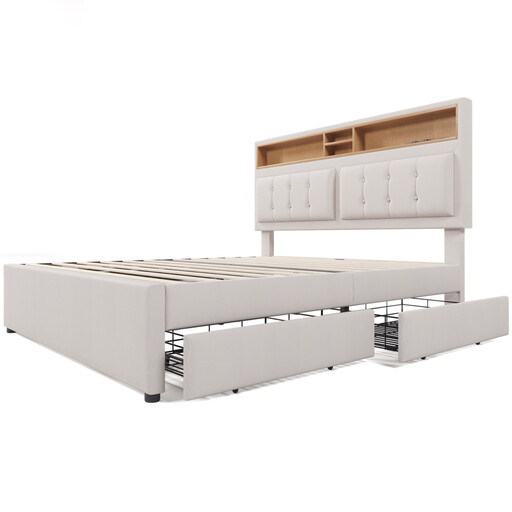
Why it suits this profile: This 140 × 200 cm upholstered bed combines four drawers on castors with extra compartments in the headboard. The product description says it has integrated USB, USB-C and standard European ports.
The drawers are clearly specified, rather than being described only as generic “hidden storage”. Before buying, check that there’s enough space at the side to open them.
Four drawers, an upholstered headboard and integrated charging ports. The product information gives a maximum weight capacity of 300 kg.
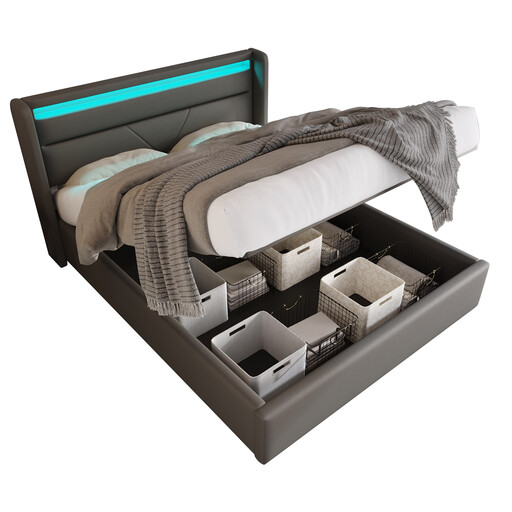
Why it suits this profile: This 160 × 200 cm model uses a hydraulic lifting mechanism and has an upholstered headboard with integrated LED lighting. According to the product description, the sleeping surface doesn’t require a box-spring base.
The storage is accessed using a clearly described lift-up mechanism. Before assembly, check the room height and the weight of your mattress.
A spacious storage compartment, steel frame and wooden slat base. The stated maximum weight capacity is 300 kg.

Why it suits this profile: This day bed is designed for guest rooms, living spaces and small homes. A pull-out bed, a 35 cm-deep compartment with adjustable shelves, and USB and USB-C ports offer extra ways to use it.
The product details specify the dimensions of the extended sleeping surface, the mattresses required and the assembly process. This makes it easier to plan how much space you’ll need.
A second pull-out sleeping surface, a reading light with a flexible neck, adjustable shelves and four charging ports according to the specifications.
We’ve put together a complete, regularly updated list of products that meet these strict selection criteria and fully comply with the safety regulations in force in the EU.
The key is the stated internal dimensions of the sleeping surface. A 140x200 cm storage bed will usually need a 140 × 200 cm mattress, while a 160x200 cm storage bed will need a 160 × 200 cm mattress. You should also check the recommended mattress height and the maximum total weight.
As well as the bed’s overall dimensions, you’ll need room to lift the sleeping surface. Measure the room height too, and allow for the headboard, mattress and bedding. A hydraulic model won’t necessarily suit every sloping ceiling or low room.
Its lifespan depends on the frame, joints, drawer castors and how much weight it carries. A level floor, evenly distributed contents and regular checks of the screw joints can help keep it working well. If the bed has electrical features, protect the cables, ports and power adapters from damage and moisture.