
Lieferung heute & morgen

Qualitätsgarantie

Willkommens-Angebote freischalten: KOSTENLOSE Lieferung | Bis zu 80 % RABATT | Kostenlose 30-Tage-JoyPlus-Testphase
App herunterladen
A storage bench is a smart solution for many households. It helps keep your home tidy by hiding blankets, cushions, or toys, while also providing extra seating. However, the market is flooded with models of widely varying quality. Many buyers only discover after a few months that the construction is unstable, the fabric is wearing out, or the storage space is impractically small.
This guide highlights the most common flaws and explains which technical features you should look for to find a durable, functional storage chest that meets your needs.
When choosing a storage bench, overlooked details often lead to disappointment. Pay close attention to these three potential problems:
To avoid a bad purchase, you should focus on objective, measurable parameters. These three criteria are decisive for the longevity and functionality of your storage bench.
The foundation of any sturdy bench is the material used. Look for models made from E1-grade MDF boards. These boards are not only more dimensionally stable but are also subject to stricter limits for formaldehyde emissions.
A critical value is the static load capacity. This figure indicates how much weight the bench can support in a stationary state.
Storage space is best specified in litres. Don't just compare the external dimensions (length x width x height); pay attention to the stated volume. This is a more honest indicator of the actual available space.
For homes with limited space or for flexible uses, such as in student dorms, a foldable storage bench is a practical option. These models can be folded down to a minimal height and stored to save space. When considering one, check that the folding mechanism does not compromise stability.
An upholstered storage bench should not only look good but also be easy to maintain.
Pay attention to the manufacturer's care instructions to ensure the longevity of the cover.
Instead of an overwhelming list, we present a few models tailored to specific use cases that meet the quality criteria mentioned.
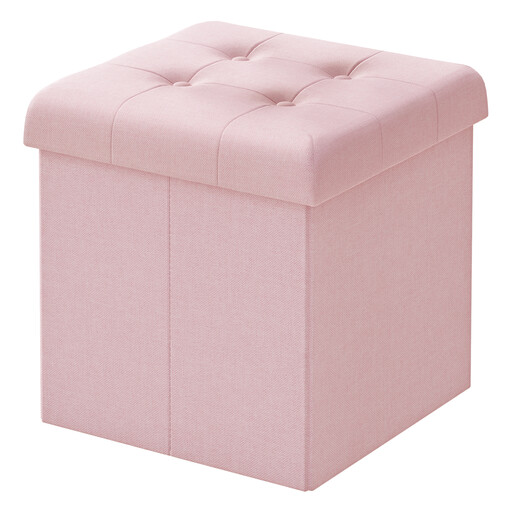
Why This Fits Their Persona: Ideal for students or residents of studio apartments who need a compact, multifunctional solution. The ottoman serves as a seat, footrest, and storage box, and can be easily stored away when not in use.
Despite being foldable, its construction with E1-grade MDF boards provides a high static load capacity of up to 300 kg (according to the manufacturer), countering the common problem of unstable folding furniture.
Folds down to just 6 cm in height; 43 litres of storage in a compact form factor.
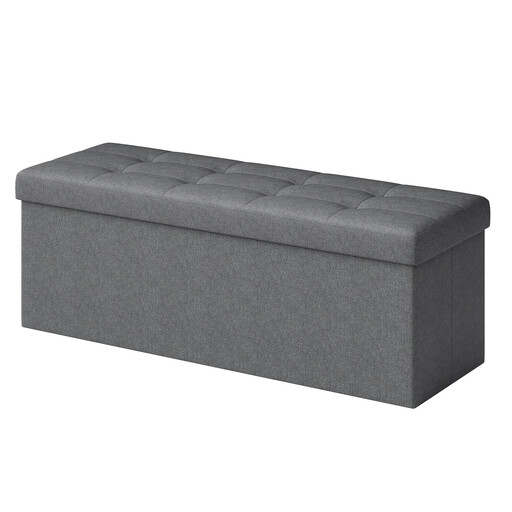
Why This Fits Their Persona: Perfect for families looking for a stylish solution to store toys, blankets, or cushions in the living room. The 110 cm length offers plenty of space and can also serve as a coffee table substitute.
Reinforced metal corners on the lid and robust MDF boards address the typical weakness of instability. The high load capacity of 300 kg (according to the manufacturer) ensures durability even with intensive use.
Large storage volume of 131 litres; elegant design with button tufting.
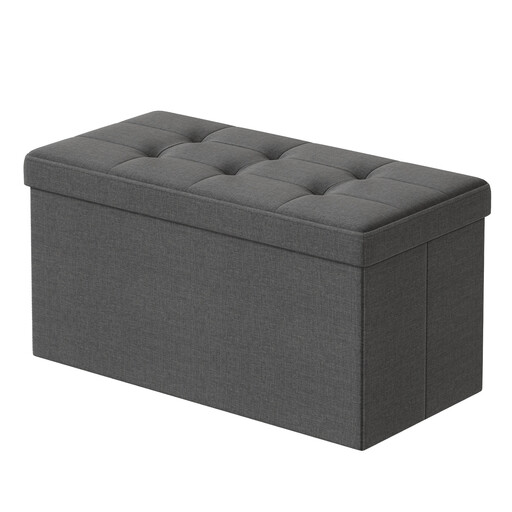
Why This Fits Their Persona: The medium 76 cm size makes this bench an ideal storage solution at the foot of the bed or a practical bench in the hallway without taking up too much space.
The construction is designed for longevity and offers a load capacity of 300 kg (according to the manufacturer). This makes it more stable than many visually similar but more weakly constructed models in this size class.
Good balance of size to footprint; 89 litres of storage volume.
We have compiled a complete, up-to-date list of products that fully meet these strict selection criteria and relevant safety standards.
The load capacity depends heavily on the construction and material. Pay attention to the specified static load capacity. A value of 300 kg, as stated for many of the featured models, means the bench can safely support this weight when stationary. This is an indicator of a robust build. Avoid jumping on the bench (dynamic load) and do not exceed the specified maximum load.
Yes, the mechanism is typically very simple. The body is unfolded, the base plate is inserted for stability, and then the lid is placed on top. The entire process usually takes less than a minute and requires no tools.
Covers made from linen-look fabrics or smooth polyester are generally low-maintenance. They can usually be cleaned with a slightly damp cloth and, if necessary, a mild detergent. Compared to real linen or cotton, they are less prone to stains and wrinkling.