
Lieferung heute & morgen

Qualitätsgarantie

Willkommens-Angebote freischalten: KOSTENLOSE Lieferung | Bis zu 80 % RABATT | Kostenlose 30-Tage-JoyPlus-Testphase
App herunterladen
A storage bench is a smart solution for apartments and homes where every square foot counts. It combines extra seating with valuable, hidden storage, helping to create order in your hallway, living room, or bedroom. However, the market is flooded with models of widely varying quality. Many buyers discover only after a few months that their new piece of furniture can't withstand the demands of daily use.
This guide will walk you through the three most common pitfalls and explain which technical features to look for to find a durable and functional storage ottoman that truly meets your needs.
Before you make a decision, it's important to understand the typical weaknesses that often only become apparent with daily use.
To avoid these problems, you should base your choice on objective technical parameters. These three features are crucial for the quality and longevity of your new storage bench.
The core of any sturdy storage ottoman is the material used. Look for models with a body made from MDF (Medium-Density Fibreboard). Unlike cheaper particleboard, MDF offers significantly higher density and bending strength. This is the foundation for a high load capacity.
Additional stability features include:
A well-constructed upholstered storage bench with these features provides safe seating and remains dimensionally stable even when fully loaded.
Two numbers are more relevant in practice than any product description: the maximum static load capacity and the volume in litres.
The cover fabric should not only be visually appealing but also durable and easy to care for. Linen-look fabrics made from synthetic fibres are often a good choice here, as they are robust and easy to clean. You can identify high-quality padding by the use of high-density foam. This material is dimensionally stable and ensures that the seat remains comfortable and doesn't form unsightly dents even after prolonged use. A grey storage ottoman is also a versatile colour and less susceptible to showing minor dirt.
Here are some models that, based on the criteria above, represent a considered choice for different user profiles.
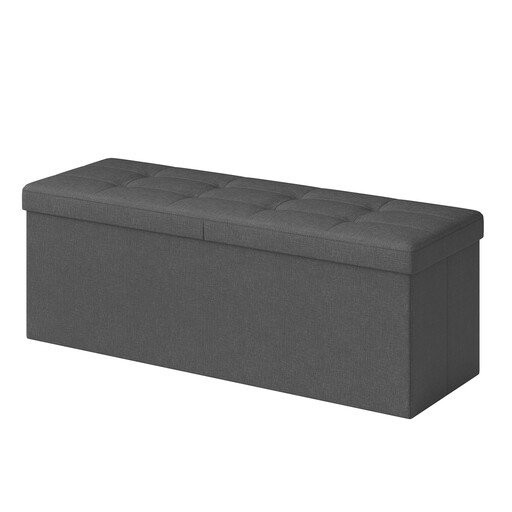
Why This Fits Their Persona: With a width of 110 cm and 131 litres of volume, this model offers maximum storage for blankets, toys, or bedding. It's ideal for living rooms or spacious hallways where both seating and organisation are in demand.
The construction with thick MDF boards and metal corner protectors prevents the lid from sagging, a common weakness in large benches.
High static load capacity of 300 kg according to the manufacturer; very large storage volume of 131 litres.
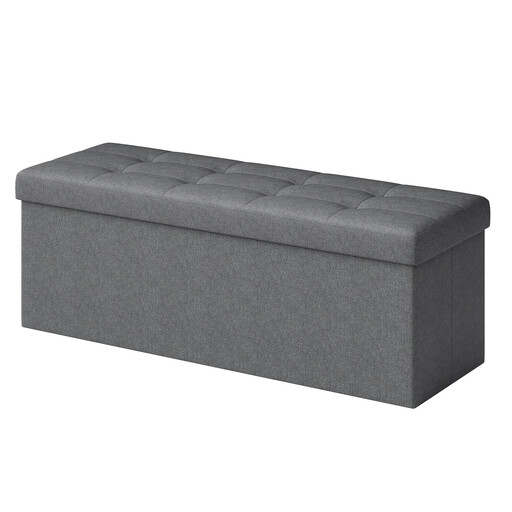
Why This Fits Their Persona: The tufted top gives this bench an elegant look that elevates it beyond a simple storage box. It's perfectly suited as a stylish end-of-bed bench in the bedroom or as a focal point in the living area.
Unlike purely decorative furniture, this model combines its appealing design with a robust MDF frame and a 300 kg load capacity.
Elegant, tufted design; double-layer fabric cover for enhanced durability.
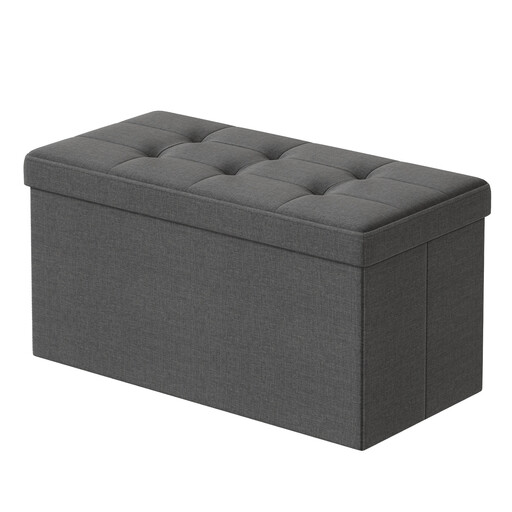
Why This Fits Their Persona: With a width of 76 cm, this bench fits perfectly into narrow hallways, small entryways, or alcoves. Despite its compact dimensions, it offers a considerable 89 litres of storage for shoes, scarves, or bags.
This model refutes the misconception that compact means unstable. It offers the same high load capacity of 300 kg as the larger versions.
Space-saving dimensions combined with high load capacity and generous storage space (89 L).
We have compiled a complete, up-to-date list of products that fully meet these strict selection criteria and relevant safety regulations.
The load capacity varies greatly depending on the model and construction. Pay attention to the maximum static load capacity specification. High-quality models that use MDF boards and a sturdy build often reach ratings of up to 300 kg. This allows for safe use as seating for several people. Cheaper models made of particleboard are often rated significantly lower.
For regular maintenance, it is sufficient to vacuum the surface with an upholstery attachment. Light stains can usually be removed with a slightly damp cloth and, if necessary, a mild soap solution. Always test cleaning agents on an inconspicuous area first. Avoid aggressive chemicals and excessive moisture to protect the fabric and the underlying padding.
No, assembly is typically very simple and can be done in a few minutes without any tools. It usually consists of three steps: