
Lieferung heute & morgen

Qualitätsgarantie

Willkommens-Angebote freischalten: KOSTENLOSE Lieferung | Bis zu 80 % RABATT | Kostenlose 30-Tage-JoyPlus-Testphase
App herunterladen
A storage bench combines seating and storage in one piece of furniture. In the hallway, it can provide a place to sit while putting on your shoes; in the bedroom, it can serve as a bed-end bench; and in the living room, it can double as a footstool with storage. This combination is especially practical in smaller homes, but storage benches vary considerably in capacity, materials, weight limit and folding mechanism.
A storage chest that is 76 cm wide won’t necessarily have enough room for blankets or bed linen. The upholstery, frame and lid all reduce the usable space inside. So, as well as checking the external dimensions, look at the stated capacity in litres.
For bulky textiles, a longer storage bench around 110 cm wide may be more suitable. For toys, books or accessories, a compact storage stool is often enough.
For many products, figures such as ‘up to 300 kg’ refer to static load capacity. This doesn’t automatically mean the bench is suitable for jumping on, leaping onto or standing on for long periods. It’s also important to distribute weight evenly and make sure the lid is fully in place.
If you’re choosing a bench for the hallway, the floor should also be level and non-slip. Models with separately fitted legs need to be securely assembled before use.
A folding bench or storage box can be tucked away to save space. However, the base, sides and lid should still be sturdy enough. With foldable models, check whether the base needs to be fully inserted and whether the lid should be completely closed before sitting on it.
Measure the available floor space, allowing for doors and drawers to open. As a guide:
The capacity should suit what you plan to store. A product with 43 litres of space, for example, is suitable for smaller textiles, books or toys. Larger models with around 80 to 131 litres offer more room for cushions, blankets or several pairs of shoes.
Avoid storing oversized items if they prevent the lid from closing fully. Some products specifically state that the lid must be fully in place before anyone sits on the bench.
Frames or side panels are often made from MDF boards. MDF stands for medium-density fibreboard. The thickness of the boards, the finish on the edges and the design of the lid all matter. Foam padding can make a seat more comfortable, but the type of foam shouldn’t be taken as a guarantee of durability.
Common finishes include linen-look fabric, velvet and teddy fleece. Textiles can create a cosy feel, but need to be cleaned in a way that’s suitable for the material. Check the care instructions before buying, and consider how durable the upholstery needs to be if you have children or pets.
The models below are assessed using the published product information. The stated weight limits come from the manufacturers and, where specified, refer to static load capacity.
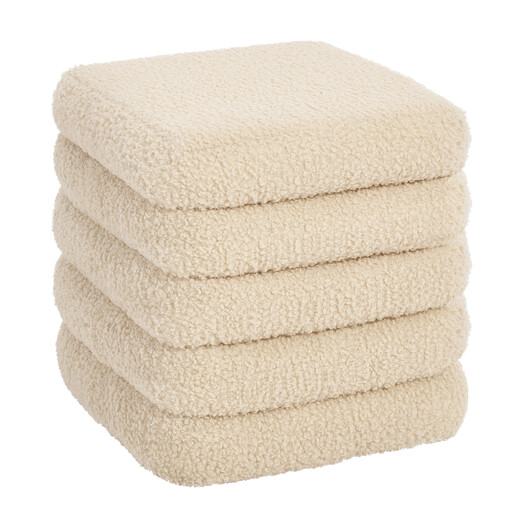
Why it suits this profile: This padded pouffe with a removable lid is a good choice if you’re looking for a compact seating and storage solution for your living room, bedroom or entrance hall.
The removable lid gives you access to the storage space inside. The product information specifically lists an MDF frame, but you should still check the dimensions and weight limit before buying.
Padded surface, teddy fleece upholstery, and can be used as a storage box or stool.
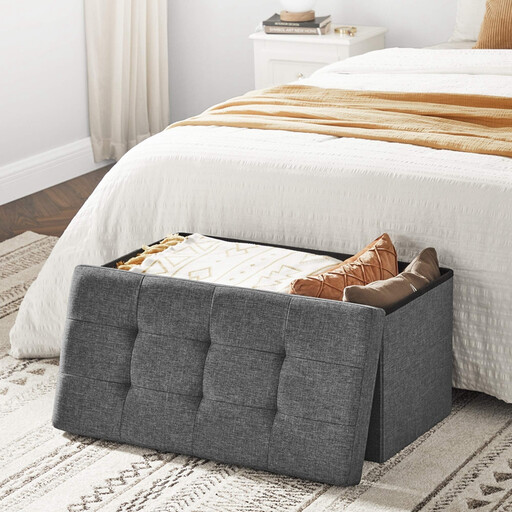
Why it suits this profile: With 80 litres of storage, a padded seat and a foldable design, this bench is a versatile choice for households looking for extra storage in the living room, bedroom or hallway.
The stated capacity makes it easier to plan what to store. The listed static load capacity of 300 kg shouldn’t be taken as approval for dynamic loads.
E1 MDF frame according to the product description, 80 litres of internal storage and a foldable design for easy storage when not in use.
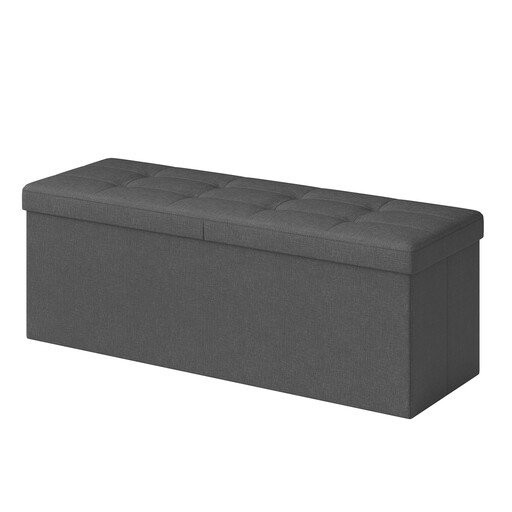
Why it suits this profile: With a capacity of 131 litres and a width of 110 cm, this storage bench is suitable for bed linen, blankets or cushions in the bedroom, living room or hallway.
The product information lists the external dimensions, storage capacity and foldable design. Before ordering, check that you have 110 cm of floor space where you plan to put it.
Stated capacity of 131 litres, static load capacity of 300 kg according to the product description, and a design that folds flat.
We’ve put together a complete, regularly updated list of products that meet these strict selection criteria and fully comply with the safety regulations in force in the EU.
To help your bench last longer, follow the care instructions:
Around 40 to 50 litres may be enough for books, toys or small accessories. For bed linen, blankets and several cushions, a model with 80 litres or more is more practical. Capacity isn’t the only thing to consider: the internal shape and size of the opening matter too.
That depends on the frame, lid, base and stated weight limit. A foldable bench should be fully assembled, with the base correctly in place. Check whether the manufacturer states a static load limit, and don’t use the furniture for dynamic loads.
For narrow entrances, look for models around 37 to 40 cm deep and with a suitable seat height. A compact storage chest or storage stool is easier to fit in than a 110 cm-wide bench. Before buying, consider the space between the bench and the wall, the door opening and how much room you need to put shoes away.