
Lieferung heute & morgen

Qualitätsgarantie

Willkommens-Angebote freischalten: KOSTENLOSE Lieferung | Bis zu 80 % RABATT | Kostenlose 30-Tage-JoyPlus-Testphase
App herunterladen
A storage bench can serve several purposes in the bedroom, hallway or living room. It gives you somewhere to sit, stores blankets and cushions, and can sometimes double as a footrest or side table. To make sure it remains practical in your home for years to come, consider more than just its colour and upholstery.
Claims such as ‘up to 300 kg’ often refer to the maximum static load capacity. This does not automatically mean the bench is designed to withstand dynamic loads, jumping or sitting on one side. With many models, the lid must also be fully in place before you use the bench as a seat.
A bench measuring 110 cm wide, 38 cm deep and 38 cm high might look spacious. But what matters is the internal capacity. Reinforced MDF panels, upholstery and the frame all reduce the usable space. So if you want to store bedding or several blankets, look for a stated storage capacity.
A folding storage bench saves space, but before use you need to fit the base correctly and make sure the lid is fully closed. If you plan to set it up and put it away frequently, choose a straightforward design. For everyday use, it’s also worth checking whether the lid is removable, hinged or simply placed on top.
Measure the space you have in mind before ordering, allowing room to move around. In a hallway, the bench shouldn’t narrow the passageway. If you’re using it at the foot of the bed, check the bed’s width and the distance from any doors. A bedroom upholstered bench measuring 110 cm wide, for example, will suit many single beds and smaller double-bed setups, but won’t necessarily fit every bed.
Check the following details:
MDF panels provide a sturdy base, while metal corner reinforcements can strengthen the lid area. The fabric covering should suit how you plan to use the bench. A linen-look finish creates a homely feel, but it isn’t the same as real linen. Check the care instructions and avoid leaving the bench in persistently damp or heavily soiled surroundings.
A storage chest bench or storage chest with foam padding can be used as a seat. Even so, only load it according to the manufacturer’s guidance. The products featured here have a stated maximum static load capacity of 300 kg. The lid must be fully closed, and oversized items should not be stored inside.
A capacity of 89 litres could be suitable for cushions, smaller blankets or books. At 131 litres, you’ll have more room for bedding, throws and home accessories. A removable divider can help you keep frequently used items separate.
For smaller rooms, a foldable storage box, a storage ottoman or an ottoman with storage could be a good choice. Some designs fold flat for storing under a bed or in a wardrobe when not in use. Check whether the base can be removed or folded away.
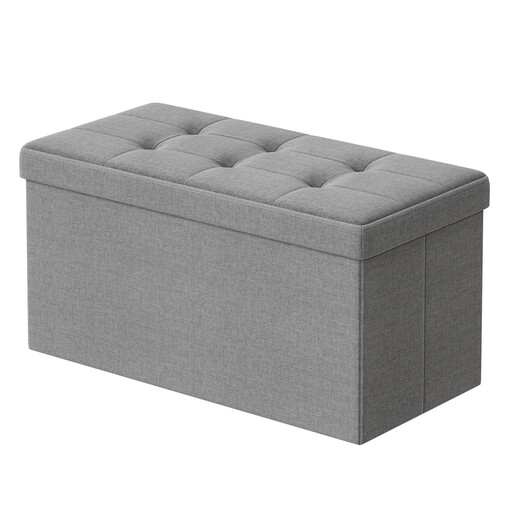
Why it suits this profile: At just 76 cm wide, this compact bench is a good fit for smaller homes, bedrooms or entranceways where floor space is limited.
Its stated capacity of 89 litres gives you a clearer idea of the available storage than dimensions alone. The base is fitted during assembly.
MDF construction, metal corner protection on the lid, a linen-look finish and a stated static load capacity of up to 300 kg.
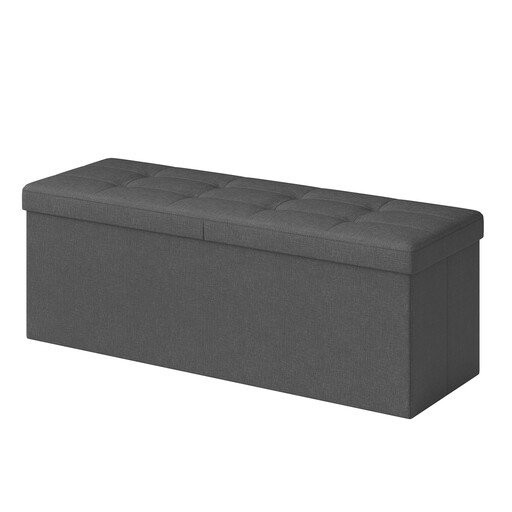
Why it suits this profile: If you’re looking for a well-defined combination of seating, storage and space-saving design, this 110 cm-wide bench folds away when not in use.
The external dimensions and 131-litre capacity are clearly stated. When it’s not in use, the bench folds flat.
MDF panels, metal corner reinforcements, foam padding and a stated load capacity of up to 300 kg.
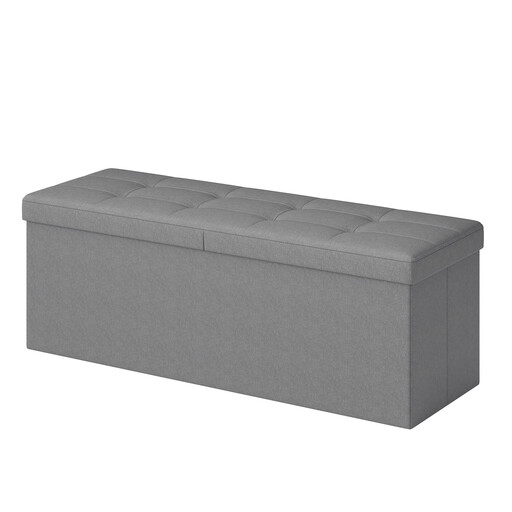
Why it suits this profile: The hinged lid and removable divider make it easier to reach your belongings when the bench is used regularly in the hallway, living room or bedroom.
The divider helps keep everything organised, while the folding design takes up less space when the bench isn’t in use.
131-litre capacity, hinged lid, removable divider and MDF panels with metal corner protection.
We’ve put together a complete, regularly updated list of products that meet these strict selection criteria and fully comply with the safety regulations in force in the EU.
Before using the bench for the first time, make sure all the base panels and lid components are fitted correctly. Then check that the lid sits flat. Don’t let items stick out over the edge of a bench with a lid, as this could stop it from closing fully.
To care for a fabric storage bench, regular vacuuming with a suitable upholstery attachment is usually enough. Treat stains according to the manufacturer’s instructions. Where possible, place heavy items at the bottom of the storage compartment to keep the centre of gravity low.
Around 80 to 90 litres may be enough for a few cushions or smaller blankets. If you want to store several throws, bedding sets or seasonal textiles, consider a model with around 130 litres or more. How much you can fit will also depend on the internal dimensions and the shape of the items.
This figure refers to the maximum static load capacity stated in the product description. It does not replace checking whether the bench is suitable for your intended use. Place it on a level surface, make sure the lid is fully closed and avoid putting it under sudden or jerky loads.
First, remove or fold away the base panel as instructed, then store the bench somewhere dry. Many folding models can then be put away under a bed or in a wardrobe. Before using it again, make sure the base and side panels are properly fitted and the lid is fully closed.