
Lieferung heute & morgen

Qualitätsgarantie

Willkommens-Angebote freischalten: KOSTENLOSE Lieferung | Bis zu 80 % RABATT | Kostenlose 30-Tage-JoyPlus-Testphase
App herunterladen
A storage bench can serve multiple purposes in your hallway, bedroom or living room: it provides a seat, hides blankets or books, and depending on the design, can be stored away to save space when not in use. With foldable models in particular, it’s worth taking a close look at the technical specifications. An attractive upholstery alone doesn’t tell you much about storage capacity, stability or everyday practicality.
A storage chest with a lid may look compact from the outside, but the usable interior can be significantly smaller due to MDF panels, floor reinforcement and padding. If you’re planning to store bedding, toys or larger cushions, you should pay attention not only to the external dimensions but also to the stated capacity in litres.
Claims such as “up to 300 kg” usually refer to static load under the conditions specified by the manufacturer. This is not the same as dynamic load from jumping, sliding or sitting on one side. For a storage bench, the lid should be fully in place and the bench should stand on a level floor. The manufacturer’s instructions are what matter.
A foldable storage bench is usually stabilised by inserting a base panel. If this panel is missing or not fitted correctly, the construction may be less sturdy. Before buying, check whether assembly is straightforward and how flat the foldable storage box can be collapsed when not in use.
For a hallway bench, depth and clearance width are the most important factors. A bench that is too deep can make the entrance feel cramped. In a bedroom, a bed-end bench is often placed at the foot of the bed. Make sure there is enough room between the bed edge, the wall and the walkway.
As a practical guide:
MDF panels are commonly used for the base, side walls and lid. Look for a clear material specification, such as E1-MDF, and check the construction of the load-bearing parts. Metal corner reinforcements can add extra stability to the lid, but they don’t replace correct usage.
For an upholstered bench, the following points are also relevant:
A storage ottoman with a lid is not automatically suitable for use as a permanent seat. What matters are the manufacturer’s stated maximum static load and the usage instructions.
The capacity should match your actual needs. For remote controls, books or small accessories, a compact compartment is sufficient. For blankets, bedding or several cushions, a volume of around 89 to 131 litres is more practical.
The folded size is especially important for small flats, guest rooms or seasonal use. A model that can be collapsed to just a few centimetres in height can be stored under the bed or in a wardrobe. However, check whether the cover and base panel can also be stored compactly.
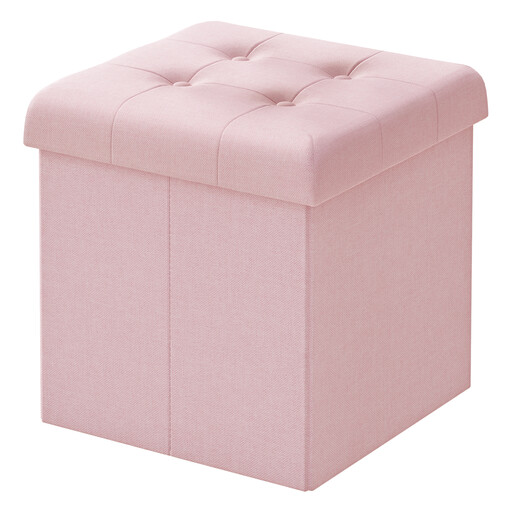
Why this product fits the profile: The compact cube shape is ideal for smaller rooms, a dressing table or a limited hallway area. According to the product details, this model can be folded down to around 6 cm in height.
The stated volume of 43 litres makes the available storage space easier to assess than simply looking at the external dimensions.
43 litres of storage, foldable construction, 2.55 kg product weight and, according to the product details, up to 300 kg static load capacity.
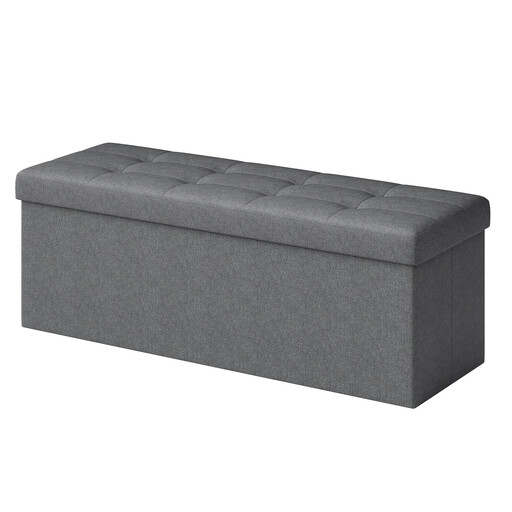
Why this product fits the profile: The 110 cm length is designed for the foot of a bed or a longer wall in the living area. The linen-look surface and tufted design complement a variety of interior styles.
The product details state both the dimensions and a volume of 131 litres. This makes it easy to match the space required with the planned storage.
MDF construction, metal corner reinforcements, 131 litres volume and, according to the product details, up to 300 kg static load capacity.
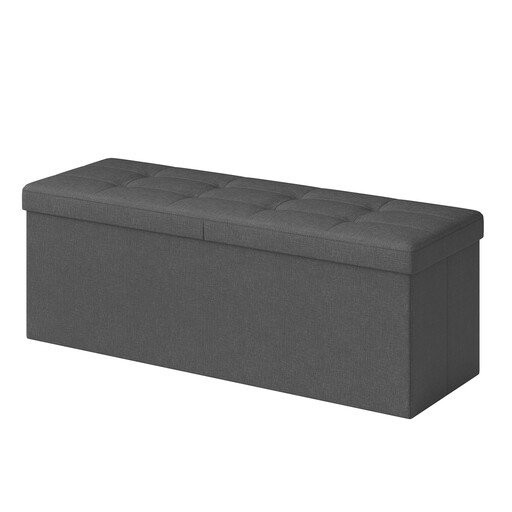
Why this product fits the profile: The long shape can be used as a bed-end bench, a seat in the hallway or a shelf under a window. When not in use, the construction can be folded and stored away.
The instruction to fully place the lid before sitting makes the intended use clear and helps avoid incorrect loading.
Foldable design, 110 cm width, MDF panels, upholstery and, according to the product details, 300 kg static load capacity.
We’ve put together a full, regularly updated list of products that fully meet these strict selection criteria and the safety regulations in force in the EU.
For cushions, small blankets or books, models with around 40 to 90 litres are often sufficient. For bedding, several blankets or seasonal textiles, 100 litres or more makes sense. What matters is that the internal dimensions fit the items you actually want to store.
That depends on the construction, base panel and manufacturer’s specification. Look for a stated static load capacity and only use the bench on a level floor. The lid should be fully closed. Jumping or point loading may fall outside the intended use.
For fabric and linen covers, start by removing dust with a soft brush or vacuum attachment. Light soiling can be treated with a slightly damp cloth, depending on the care instructions. Avoid harsh cleaning products or soaking the upholstery, unless the manufacturer advises otherwise.