
Lieferung heute & morgen

Qualitätsgarantie

Willkommens-Angebote freischalten: KOSTENLOSE Lieferung | Bis zu 80 % RABATT | Kostenlose 30-Tage-JoyPlus-Testphase
App herunterladen
A storage bench combines a place to sit with a handy storage solution. In the living room, it can hold blankets; in the bedroom, it can serve as a bed-end bench; and in the hallway, it can keep shoes or bags close to hand. To make sure your purchase is genuinely practical for everyday life, don’t focus on colour and upholstery alone.
A high weight limit may sound reassuring at first. However, it’s important to check whether it refers to static load capacity and whether the lid is fully closed. A storage ottoman isn’t automatically suitable for standing on or using as a step. Follow the manufacturer’s instructions, such as ‘Close the lid fully before sitting down’.
A storage bench may look spacious from the outside, while the inside is smaller because of the padding, frame or reinforcing elements. Long models with a capacity of around 80 to 130 litres are well suited to duvets and large cushions. For remote controls, toys or magazines, a small storage stool is often enough.
Before you buy, compare the width, depth and height with the space available. If you’re considering a storage bench for the end of a bed, also check that the lid can open fully. In a hallway, doors, radiators or a narrow passage can make it harder to use. A foldable bench is a practical choice if you’ll need to put it away from time to time.
Different sizes work well as a bench for the bedroom or hallway:
A stated capacity of 80 to 131 litres can be enough for soft household items. Avoid storing rigid or oversized items if they’ll stop the lid from closing fully.
MDF panels form the supporting structure of many upholstered benches. Metal reinforcements at the lid corners can make the construction more stable. When choosing an upholstered bench, also consider the padding thickness and cover: linen-look fabric, velvet and teddy fabric differ in feel, care requirements and appearance.
A removable or lift-off lid makes it easier to access the contents. If you’ll use the storage bench regularly, choose one with a lid that’s comfortable to lift. Foldable models can be stored neatly under the bed or in a cupboard when not in use.
The maximum weight capacity should suit how you plan to use the bench. Figures such as 120 kg, 150 kg or 300 kg are specific to each product and shouldn’t automatically be treated as equivalent. It’s also important to place the bench on a level surface, fit the feet correctly and close the lid fully. A bench in the hallway should stand securely and must not be used as a ladder.
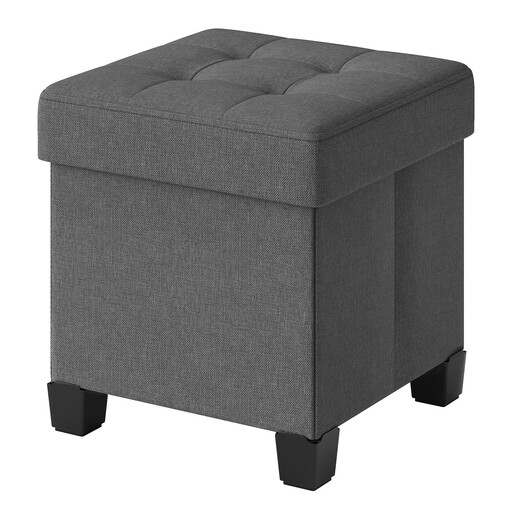
Why it suits this profile: Its compact size makes it a good choice for smaller homes, student accommodation or as an extra footrest in the living room. The interior has room for smaller everyday items.
The dimensions make it easy to see how much space it will take up. Its foldable design means it won’t permanently occupy floor space when you move house or aren’t using it.
38 × 38 × 40 cm, foldable design, MDF frame and a stated static load capacity of up to 300 kg.
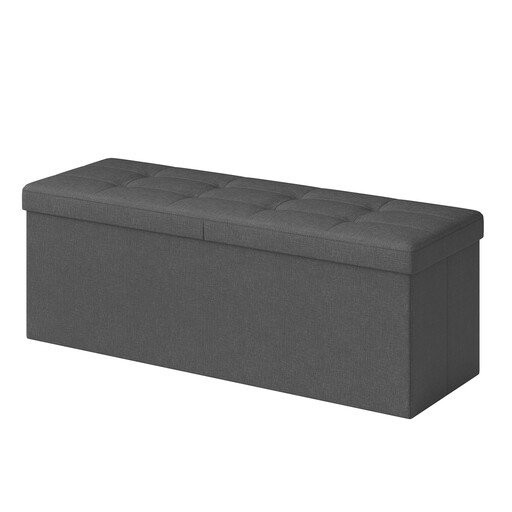
Why it suits this profile: At 110 cm wide, this bench is well suited to the end of a bed, the living room or a longer hallway. It combines a padded seat with a generous interior.
The product details include its external dimensions, material, padding and 131-litre capacity. This makes it easier to judge whether it’s suitable for storing bed linen.
38 × 110 × 38 cm, 131 litres of storage, metal reinforcements on the lid and a foldable design.
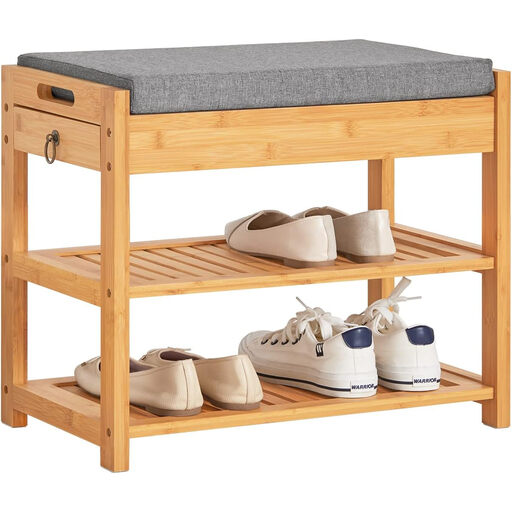
Why it suits this profile: Designed as a hallway bench, this model is made for storing shoes and small shoe-care items. Two internal shelves and a drawer at the side keep things neatly separated.
Instead of one large compartment, it offers dedicated storage areas. Felt pads can help protect the floor; this model needs to be assembled.
Bamboo construction, two internal shelves, a side drawer, a 4 cm-thick seat cushion and a stated weight capacity of up to 150 kg.
We’ve put together a complete, regularly updated list of products that meet these strict selection criteria and fully comply with the safety regulations in force in the EU.
For fabric covers, follow the relevant manufacturer’s cleaning instructions. Loose crumbs can usually be removed carefully with a vacuum cleaner; test a damp cloth on an inconspicuous area first. Place the bench on a level surface and avoid exposing it to high humidity or direct heat for long periods.
Children shouldn’t be left unsupervised to use a storage bench as a toy or climbing frame. Store heavy items at the bottom where possible to avoid unnecessarily shifting the centre of gravity. If you use the bench regularly, it’s worth checking the lid, seams and any feet from time to time.
Models with around 80 to 131 litres of capacity are often more suitable for storing a few blankets and cushions than compact ottomans. Capacity isn’t the only thing to consider: the internal height and shape of the storage space also matter.
Yes, as long as it doesn’t obstruct the passageway and is designed to be sat on. A hallway bench with shoe shelves or a drawer makes it easier to stay organised. For upholstered models, choose a cover that suits how you expect to use the bench and how easy it is to clean.
Its lifespan depends on the frame, fittings, cover, load and care. Using it correctly within the stated weight limit, keeping it on a level surface and closing the lid fully can help it stand up to everyday use. It isn’t possible to give a reliable guarantee of how long it will last without knowing how it will be used.