
Lieferung heute & morgen

Qualitätsgarantie

Willkommens-Angebote freischalten: KOSTENLOSE Lieferung | Bis zu 80 % RABATT | Kostenlose 30-Tage-JoyPlus-Testphase
App herunterladen
Moisture, dust and untidy spools can make day-to-day printing more difficult than it needs to be. If you’re looking for a 3D printer filament storage box, you’ll find plenty of containers advertised as ‘airtight’ or ‘universal’ — but that doesn’t mean they’ll suit every spool. The key things to consider are the design, the internal dimensions and how you’ll use the box in your workspace.
A lidded storage box keeps dust out, but it isn’t automatically an airtight filament box. For storing filament, a seal that runs all the way around the box is important. According to the product description, the 4-litre filament boxes in the sets featured here have a double silicone seal and a snap-lock closure. Even so, the lid should close evenly, and the seal should be kept clean and undamaged.
A box also can’t protect against humidity indefinitely. If you’re storing filament for a particularly long time, you can add desiccant and a small hygrometer. Make sure the desiccant is suitable for the intended use, and replace or dry it regularly according to the manufacturer’s instructions.
A standard filament spool needs enough room for its diameter, width and hub. The 4-litre boxes mentioned here measure 23,5 × 21,5 × 8,5 cm. According to the product description, they’re designed for standard spools with a universal adapter. Even so, check the dimensions of your own spools before buying, especially if you have non-standard formats, large rolls or spools with a wide rim.
A storage box for 3D printer spools shouldn’t leave the spool jammed inside. Too little clearance makes it harder to remove and can put lasting strain on the plastic or the box lid.
A stackable filament box saves shelf space, but not every box is suitable for tall stacks. Look for a flat top, a sturdy base and a design that stops the containers from slipping easily. If you’re stacking several boxes, put the heavier ones at the bottom.
Transparent plastic sides make it easier to identify colours. But they’re no substitute for labels: with a filament box with labels, you can quickly check the material, colour, diameter and, where relevant, recommended printing temperature.
A moisture-resistant filament box should have a continuous seal and a closure that presses the lid down evenly. Once closed, check that the lid sits flat all the way around. If you’re storing filament for a long time, avoid opening the box more often than necessary.
The location also matters when it comes to keeping filament dry in storage. Avoid damp cellars, direct sunlight and significant temperature fluctuations. Even a well-sealed box shouldn’t be filled with wet or already damp spools.
A 4-litre filament storage box is a space-saving option for individual standard spools. If you have several materials, a multipack may be more practical than one large storage box, as you can label and remove each spool separately.
Before buying, check:
Transparent plastic lets you check what’s inside without opening the container. For everyday use in a workshop, practical features include sturdy sides, a lid that closes securely and easy-to-read labels. Claims such as ‘food-safe’ refer to the material; they don’t automatically mean the box is suitable for every temperature, cleaning method or industrial use.
A 3D printer filament container with an additional filament feed-through can be useful while printing. For the products featured here, check whether a feed-through is actually included. A storage box alone isn’t automatically an active dry box with a heating function or controlled filament feed.
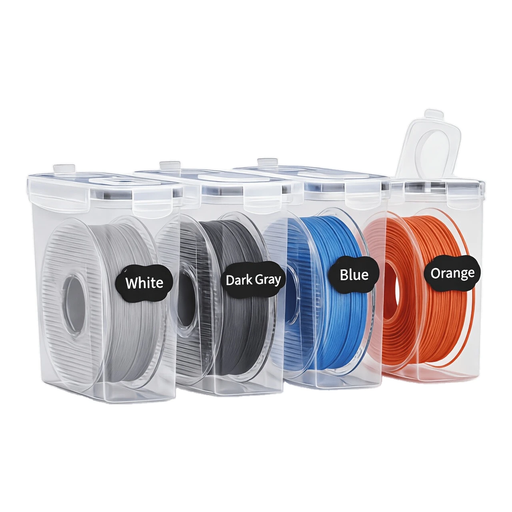
Why this product suits this profile: This set is for users who want to keep several standard spools neatly stored without investing in a larger workshop storage system. Measuring 23,5 × 21,5 × 8,5 cm, each 4-litre box is designed for compact storage.
According to the product description, it has a snap-lock closure, a double silicone seal and a universal adapter. You should still check your spool dimensions before buying.
Transparent plastic, a stackable design, plus 24 labels and a marker according to the product details.
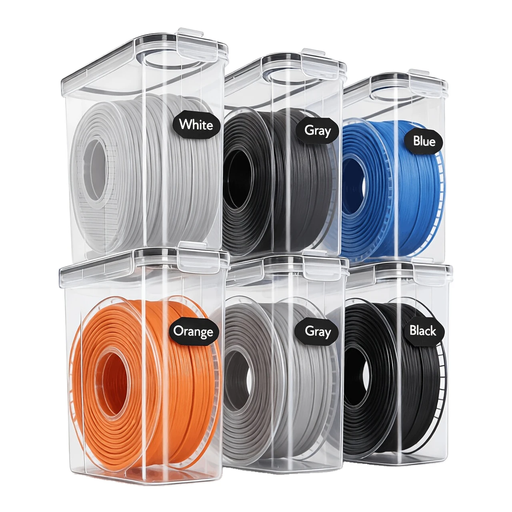
Why this product suits this profile: This multipack is a good fit for homes, schools and workshops where different materials or colours need to be stored separately and labelled.
Several individual containers mean you don’t need to open one large box as often. Before storing filament for a long time, check that each seal is clean and properly in place.
Six 4-litre containers, a transparent design, stackable construction and a set of labels according to the product description.
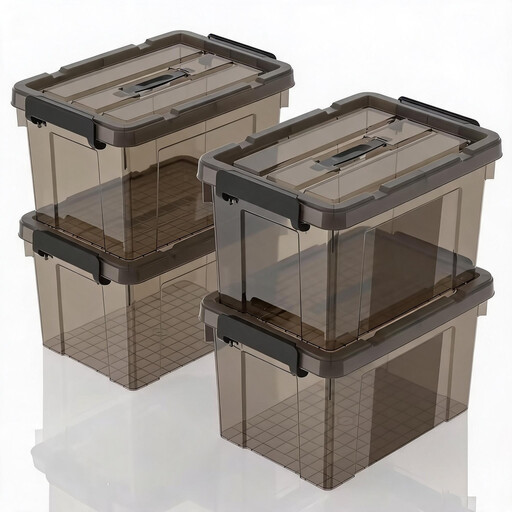
Why this product suits this profile: These larger containers may appeal to workshops looking to store accessories, empty spools or packaged material together. They’re not automatically specialist filament boxes.
A larger capacity doesn’t guarantee protection from moisture. If you plan to store filament in these boxes, check the internal dimensions and closure particularly carefully before buying.
20-litre capacity, transparent plastic, a lid, clips and carry handles according to the product details.
We’ve put together a complete, regularly updated list of products that meet these strict selection criteria and fully comply with the safety regulations in force in the EU.
To keep an airtight filament box that way, check the seal and closure regularly. Wipe away dust with a soft, dry cloth and avoid harsh cleaning products unless the manufacturer recommends otherwise. Make sure both the spool and the container are completely dry before storing them.
Label each box with:
Store the spool in a sealed container with an intact seal, in a dry place. You can also use suitable desiccant and a hygrometer. A storage box won’t automatically dry filament that’s already damp.
It depends on the material, how much moisture it contains, how airtight the container is and how often it’s opened. So it isn’t possible to give an objective timeframe. Check the filament before printing and follow the processing instructions provided by its manufacturer.
No. A general-purpose plastic box can keep dust out, but it may not fit your spools or be stackable or moisture-resistant. Check the internal dimensions, closure and seal, and make sure the product is specifically stated to be suitable for standard spools.