
Lieferung heute & morgen

Qualitätsgarantie

Willkommens-Angebote freischalten: KOSTENLOSE Lieferung | Bis zu 80 % RABATT | Kostenlose 30-Tage-JoyPlus-Testphase
App herunterladen
Storage boxes create extra space when you need to organise clothing, shoes, toys, books or small items neatly. The range extends from storage boxes with lids to foldable fabric models and transparent plastic boxes. However, not every box suits every location.
A common mistake happens when you focus only on price or exterior design. What really matters are dimensions, load capacity, accessibility and where you plan to place the box. The following guidance will help households, families, students and office users compare suitable storage boxes objectively.
A box measuring 30 × 30 × 30 cm does not automatically fit into every cube shelf. The gap between boxes, handles and lids can take up extra room. Before buying, you should measure the internal dimensions of the shelf compartment, the opening direction and the clear height.
For under-bed storage boxes, the height available beneath the bed is also crucial. A box that is 18 cm high may be unsuitable if crossbars or castors reduce the available space.
Stackable storage boxes should have a stable base surface and ideally a matching lid or connecting elements. With heavy items, thin walls, uneven floors or a lack of reinforcement can lead to deformation.
For books, tools or full household boxes, the manufacturer's specifications for static load capacity are more important than a general marketing claim. Lightweight fabric boxes are better suited to clothing, bedding and smaller items.
Transparent plastic boxes make it easy to see the contents, but they do not always protect against dust, moisture or heat. Fabric storage boxes can be visually more discreet and are often foldable. However, they are generally not intended for damp cellars, balconies or areas close to heat sources.
A lid also does not automatically make a box airtight. For shoes, textiles or seasonal clothing storage, the contents should be clean and dry when put away.
Compare not only length, width and height, but also the actual usable internal dimensions. For clothing, long models or under-bed storage boxes work well. Books need sufficient floor area and a sturdy construction. For small items, compartment boxes or wardrobe organisers with several sections are more practical.
For shoe storage boxes, you should check the length of your shoes including any overhang. The JOYFURNOS boxes measure approximately 33.3 × 23.2 × 14.3 cm per unit. The manufacturer explicitly advises checking your shoe size against the box dimensions before buying.
PP plastic is wipe-clean and suitable for transparent boxes with lids. For the thick plastic boxes mentioned, a 2.5 mm thick PP body with reinforcing ribs, a non-slip base and snap-on lid is described. Such details are more relevant for cellars, storage rooms, wardrobes or car boots than a vague label like "extra sturdy".
Fabric boxes are often made from non-woven fabric with cardboard reinforcement. According to the product details, the JOYFURNOS cube storage boxes feature 80 g/m² non-woven fabric, a cardboard structure and a maximum static load capacity of 5 kg per box. They should be stored in a dry place and cleaned only with a slightly damp cloth.
A lid protects against dust but can slow down everyday access. Front openings, handles or transparent sides make use easier. For shoes, transparent front flaps and ventilation openings are practical, provided the shoes are stored dry.
For tea, coffee, snacks or small office items, divided desktop organisers can be more useful than large storage boxes. The JORDAN&JUDY box measures 26.5 × 15.3 × 8.9 cm and is described as having several compartments for visible sorting.
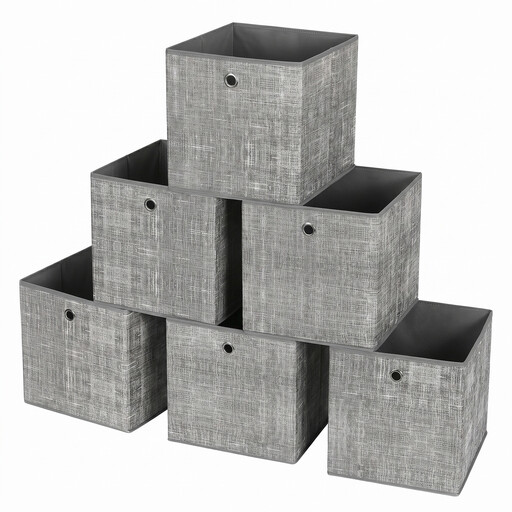
Why this product fits the profile: The set of 6 offers a uniform solution for shelf compartments and cube storage boxes. The dimensions of 30 × 30 × 30 cm are intended for compartments of at least 30.5 cm.
The stated dimensions and maximum static load capacity of 5 kg per box make the usage limits clear. When not in use, the model can be folded flat.
6 boxes, insert base, carrying handles and foldable construction; suitable for clothing, books and smaller household items.
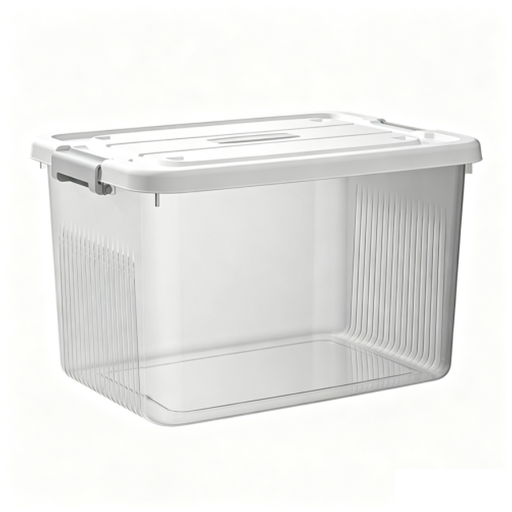
Why this product fits the profile: The larger version is intended for seasonal clothing, household items or use in a storage room, provided the space can accommodate the dimensions.
According to the product description, the box features snap-on lids, reinforcing ribs and a non-slip base. This supports tidy stacking, but does not replace adhering to the load limits.
Transparent PP material, 2.5 mm body thickness, integrated handles and a set of 4.
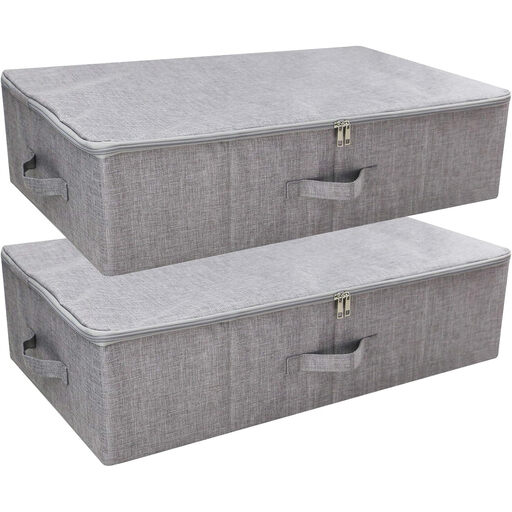
Why this product fits the profile: At 70 × 43 × 18 cm per box, the set of 2 makes use of the space under many beds for clothing, accessories or household items.
The low height makes it necessary to measure the bed area beforehand. The boxes are foldable and, according to the details, should not be loaded with excessive weight.
2 boxes, zip cover, foldable design and a suitable format for space-saving clothing storage.
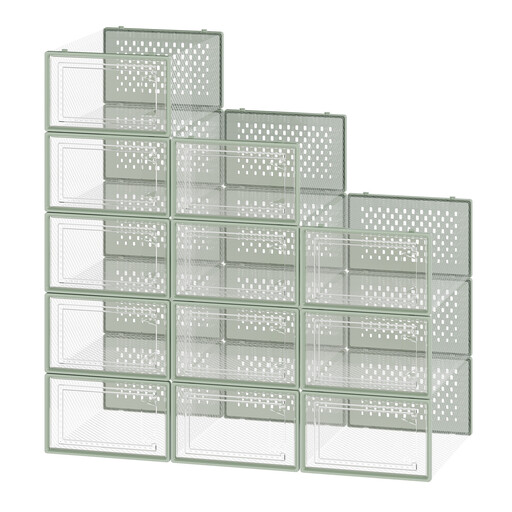
Why this product fits the profile: The set of 12 is designed for organised shoe storage. Transparent panels and front doors make selection easier without having to open every box.
The product details mention interlocking connections and ventilation openings. Before buying, you need to check the length of your own shoes against the dimensions of 33.3 × 23.2 × 14.3 cm.
12 units, stackable construction, transparent front and PP/PS plastic finish.
We have put together a complete, regularly updated list of products that fully meet these strict selection criteria and the safety regulations in force in the EU.
For clothing, foldable fabric boxes, boxes with lids and under-bed storage boxes are practical. What matters is sufficient internal dimensions, a sturdy base and a dry storage location. For seasonal textiles, larger models are a good choice, while wardrobe organisers are suitable for frequently worn items.
That depends on the temperature, humidity and the model. Transparent PP boxes are wipe-clean and protect the contents from dust. However, they are not automatically waterproof or designed for permanently damp rooms. In the cellar, they should be placed on a raised, dry surface and not directly against damp walls.
First, sort items by category and frequency of use. Label non-transparent boxes and use dividers for small items. Frequently needed items should go at the front or in boxes with front openings. Uniform dimensions make it easier to create stackable, space-saving storage systems.