
Lieferung heute & morgen

Qualitätsgarantie

Willkommens-Angebote freischalten: KOSTENLOSE Lieferung | Bis zu 80 % RABATT | Kostenlose 30-Tage-JoyPlus-Testphase
App herunterladen
A storage cabinet should bring order to your home, but it shouldn't make the room feel unnecessarily smaller. Particularly in British homes with narrow hallways, compact bathrooms or limited storage space, unclear measurements and exaggerated product promises can quickly lead to a bad purchase. So before you buy, it's worth checking not just the colour and price, but above all the footprint, weight capacity and internal layout.
A cabinet can look spacious in the product image, even though the doors, back panel or drawers take up a lot of room. What really matters are the external dimensions in width, height and depth, as well as the actual shelf heights. For a narrow cabinet in the hallway, you should also check whether the doors can open fully and whether there's enough clearance to move around.
Material descriptions like MDF, particle board, steel or PP plastic give you an initial idea, but they don't replace specific care and placement instructions. In a bathroom, a bathroom cabinet shouldn't be standing permanently in puddles. Feet or a raised base make floor cleaning easier and reduce direct contact with splashes.
A multi-purpose cabinet is only truly versatile if the shelves are adjustable or removable. Fixed compartments can be unsuitable for shoes, tall bottles, ring binders or storage boxes. Castors aren't automatically an advantage either: if you plan to move the cabinet frequently, you need sturdy wheels, a level floor and a stable standing position.
Measure the intended area at several points. For a hallway cabinet or shoe cabinet, you need to consider not just the width but also skirting boards, radiators and the door swing. A model with flap doors needs extra space in front; drawers require a clear pull-out zone.
For small homes, vertical models with a shallow depth are often a good choice. A cabinet on castors can be positioned more flexibly, but it shouldn't become unstable when fully loaded. A foldable storage cabinet is worth considering if you only need it occasionally and want to store it away compactly when not in use.
Adjustable shelves allow you to adapt the cabinet to different items. Pay attention to the number of positions and the spacing of the holes. For drawers, consider the internal dimensions and the maximum load per drawer. Heavy books, crockery or full storage boxes need a different construction than lightweight textiles.
A cabinet with doors protects the contents from dust and prying eyes. Open shelves, on the other hand, make it easier to grab things quickly. A sideboard with drawers combines both and often works well in living rooms, bedrooms or dining areas.
Particle board and MDF are common in furniture, but they differ depending on the finish and surface coating. Steel is easy to care for and moisture-resistant, though it can be heavier. PP plastic is easy to clean and practical for mobile, foldable models; for heavy loads, always refer to the manufacturer's specifications.
For taller or heavily loaded furniture, anti-tip wall fittings are an important safety feature. The wall type, suitable wall plugs and the assembly instructions all need to match. A storage cabinet should also stand on as level a surface as possible. Children should not be allowed to climb on furniture or hang from doors and drawers.
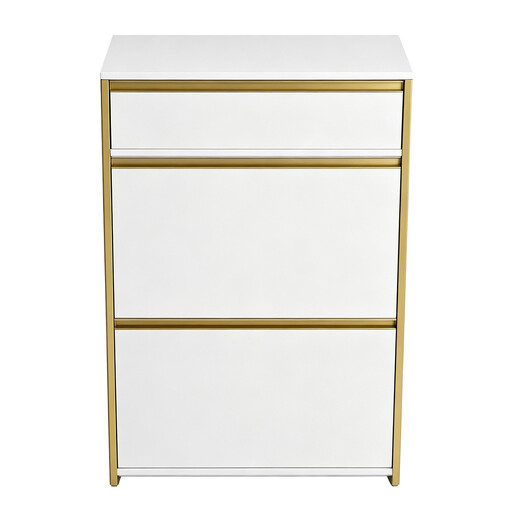
Why this product fits the profile: At 60 × 24 × 104.5 cm, this narrow cabinet is ideal for hallways and tight spaces. It combines shoe compartments, a drawer and a top shelf.
The shelves are adjustable and removable. This means you can adapt the interior to different shoe heights and small items.
Space for up to 12 pairs of shoes according to the product specifications, multiple usage scenarios and an included anti-tip wall fitting.
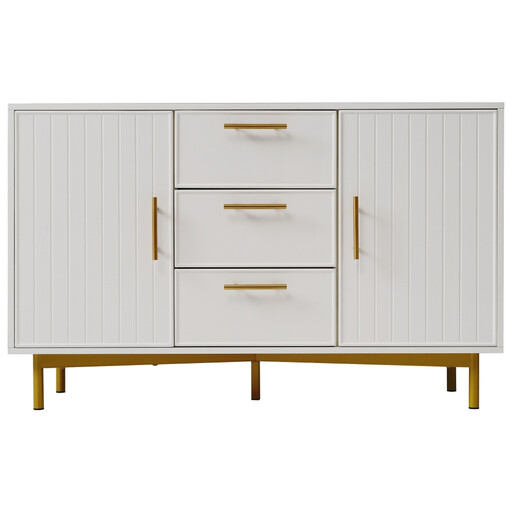
Why this product fits the profile: This 120 × 40 × 75 cm sideboard with drawers is perfect for living rooms and bedrooms where you need closed storage and a usable worktop.
The two shelves can be adjusted to three positions in 5 cm increments according to the product specifications. The weight limits are clearly stated.
Three drawers, two doors, height-adjustable shelves, 14.5 cm clearance underneath and an adjustable centre leg for levelling.
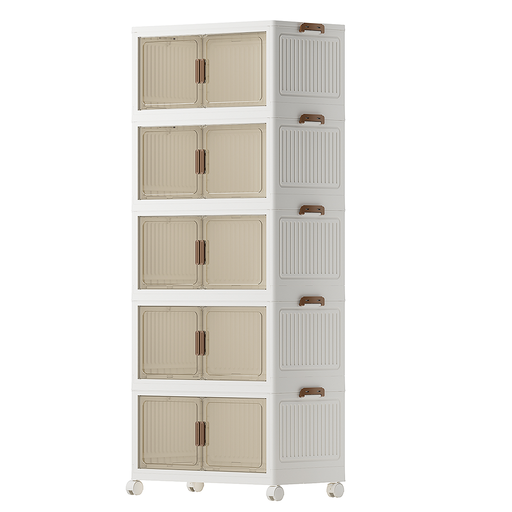
Why this product fits the profile: This mobile model made from PP plastic is designed for bedrooms, kitchens, living rooms or home offices and can be set up without any tools.
The structure unfolds and is secured with magnetic fasteners. This means there's no traditional assembly with tools required, yet the compartments remain clearly organised.
Four castors make it easy to move around, five compartments provide plenty of storage space, and the model can be folded flat when not in use.
We've put together a complete, regularly updated list of products that fully meet these strict selection criteria and the safety regulations in force across the EU.
Place the furniture on a level surface and adjust any levelling feet. Taller or heavier models should be secured to the wall using the provided anti-tip fittings. Use fixings that are suitable for your wall type and follow the assembly instructions.
The lifespan depends on the material, load, moisture, assembly and care. Never exceed the stated shelf or drawer load, or the maximum weight for the top surface. Wipe up any spills promptly and use the cleaning products recommended by the manufacturer.
A classic storage cabinet normally doesn't incur any running energy costs. However, when choosing one, you should consider the assembly effort, any wall fixings required, maintenance needs and the availability of spare parts. Mobile or foldable models can also be a good option if you only need the piece of furniture temporarily.