
Lieferung heute & morgen

Qualitätsgarantie

Willkommens-Angebote freischalten: KOSTENLOSE Lieferung | Bis zu 80 % RABATT | Kostenlose 30-Tage-JoyPlus-Testphase
App herunterladen
A tidy home starts with the right storage furniture. But the search for the perfect shelf or cabinet can quickly become overwhelming. Many products overpromise and underdeliver, leading to buyer's remorse. This guide will help you avoid common pitfalls and make an informed decision to create more storage space that lasts.
Before you invest, you should be aware of the typical flaws that often only become apparent after assembly or a few months of use.
To avoid these problems, focus on three objective criteria. These will help you realistically assess the quality and functionality of a piece of furniture.
The material is the foundation of any furniture's longevity. Pay attention to the specified material type and thickness. An 18 mm thick particle board is generally more stable than a 15 mm one. The maximum load capacity per shelf specified by the manufacturer is also crucial. This value indicates how much weight a shelf can support without warping. This is especially important for storing heavy items like books or dishes and is a core aspect of functional organization systems.
Flexibility is the key to long-term useful living room storage or kitchen organization. Check if the shelves are adjustable. Furniture with pre-drilled pin holes allows you to adjust the compartment height to your needs at any time—whether for tall vases, small paperbacks, or bulky kitchen appliances. Such space-saving furniture adapts to your life, not the other way around.
Don't just measure the available space in your home; compare it precisely with the product dimensions. Even more important are the internal dimensions of the compartments and drawers. A good product data sheet should include this information. For example, a piece of furniture advertised as a filing cabinet should have a compartment height of at least 32 cm to easily accommodate standard A4 binders.
Here are some recommendations tailored to specific user profiles and room situations.
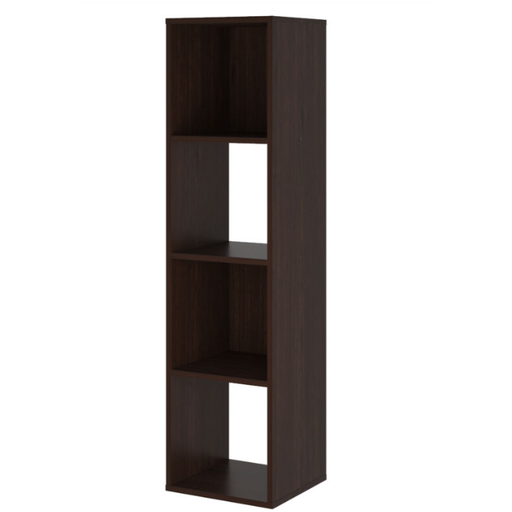
Why This Fits Their Persona: Ideal for renters or young households looking for a simple, budget-friendly, and flexible solution for books, decor, or storage baskets in the living room or bedroom.
The open cube structure makes the internal dimensions immediately clear. By allowing it to be used horizontally as a low sideboard, weight is distributed evenly, which counteracts shelf sagging under light to medium loads.
Can be placed vertically as a small shelf or horizontally as a TV stand. This dual orientation offers maximum flexibility in room design.
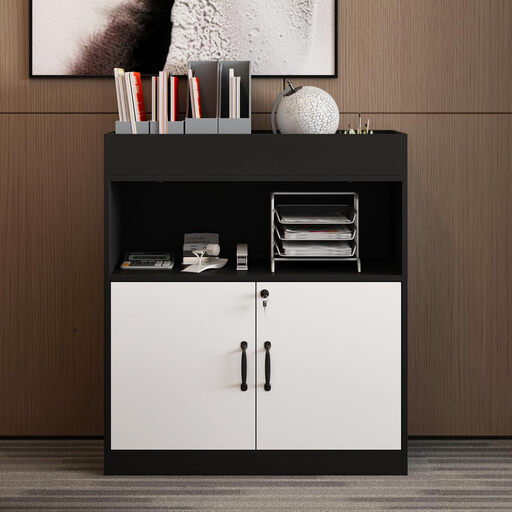
Why This Fits Their Persona: Suitable for a home office or study where confidential documents, binders, and office supplies need to be stored securely and neatly.
This model combines open and closed compartments, thus avoiding the pitfall of inflexibility. The lockable doors provide a specific function that generic shelves lack. The 40 cm depth is designed for binders and office supplies.
The two lockable doors allow for the secure storage of important documents. The anti-tip device provides additional stability and safety for everyday office use.
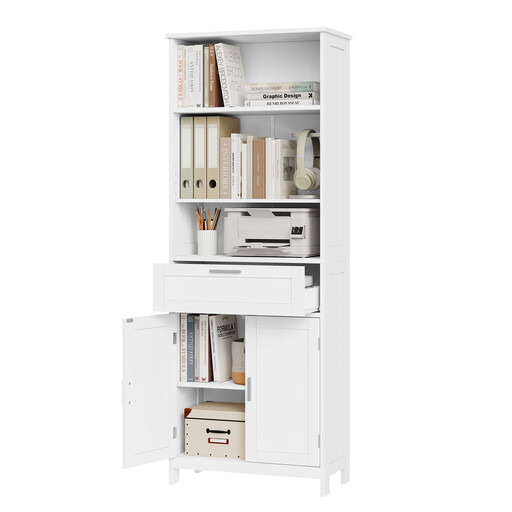
Why This Fits Their Persona: Perfect for anyone needing to create vertical storage in a narrow bathroom, small kitchen, or tight hallway without sacrificing much floor space.
This cabinet masterfully solves the problem of inflexibility: the shelves are adjustable to multiple positions. The material, described as water-resistant (E1 grade engineered wood with melamine veneer), is a crucial detail for use in damp environments.
The combination of open compartments, a drawer, and a closed cabinet section on a small footprint (60x30 cm) offers high storage density. The adjustable shelves maximize its utility.
We have compiled a complete, up-to-date list of products that fully meet these strict selection criteria and safety regulations.
The load capacity depends heavily on the board's thickness, the shelf's span, and the overall construction. A typical value for a 60-80 cm wide shelf made of 16 mm particle board is often between 5 and 10 kg. For heavy loads like books or binders, you should look for furniture with thicker shelves (18 mm+), shorter spans, or additional supports. Always check the maximum load capacity specified by the manufacturer.
Look at the product description. Phrases like "includes illustrated instructions" and "numbered/labeled parts" are good indicators. The estimated assembly time and the number of people required also provide a clue. Furniture designed for self-assembly by non-experts often uses simple fasteners and requires only standard tools.
Utilize the height of your rooms with narrow, tall shelves and cabinets. Multifunctional furniture, such as a sideboard that also serves as a TV stand, or beds with built-in drawers, are also effective. Space-saving furniture with a shallow depth is well-suited for hallways. Open organization systems can make a room feel larger than bulky, closed cabinets.