
Lieferung heute & morgen

Qualitätsgarantie

Willkommens-Angebote freischalten: KOSTENLOSE Lieferung | Bis zu 80 % RABATT | Kostenlose 30-Tage-JoyPlus-Testphase
App herunterladen
Storage hooks create extra space without the need for another piece of furniture. They provide a neat place for clothes, towels, bags, keys and kitchen utensils on doors, walls, cabinets and rails. They are particularly practical for rented homes, student flats and households with limited storage space.
However, hooks vary considerably in terms of installation, load capacity and intended use. An inexpensive solution can become unusable if the surface is unsuitable or the door no longer closes properly because the bracket is too thick. The following criteria will help you avoid buying the wrong product.
Self-adhesive hooks require a clean, dry and preferably smooth surface. Dust, grease, moisture or a rough wall can reduce adhesion. The stated load capacity is also not automatically valid for every surface.
Before installation, you should check:
On wallpaper, porous walls or delicate paintwork, removal may also leave marks. The term ‘damage-free’ should therefore be understood as a product feature, not a guarantee for every type of surface.
No-drill door hooks and over-door hooks are easy to install, but they require sufficient space between the door leaf and frame. The key factors are the bracket depth, door thickness and distance from the seal. A bracket that is too thick can make the door difficult to close or cause pressure marks.
Before buying, it is advisable to measure the top edge of the door. If the door has a rebate, seal or unusual construction, you should also check whether the hook is designed for it.
A multipack of hooks or a model with several hanging points makes sense if you regularly need to organise several lightweight items. However, when hanging heavy bags, thick jackets or damp towels, the material, fixing method and even distribution of weight matter more than the number of hooks alone.
Stainless steel hooks are worth considering for areas with higher humidity, such as the kitchen or bathroom. Nevertheless, read the product details carefully: stainless steel, coated steel, metal and mixed materials are not the same. Decorative wall hooks may also be made from MDF, bamboo or ceramic. These models should be protected from direct contact with water if specified by the manufacturer.
Pay attention to:
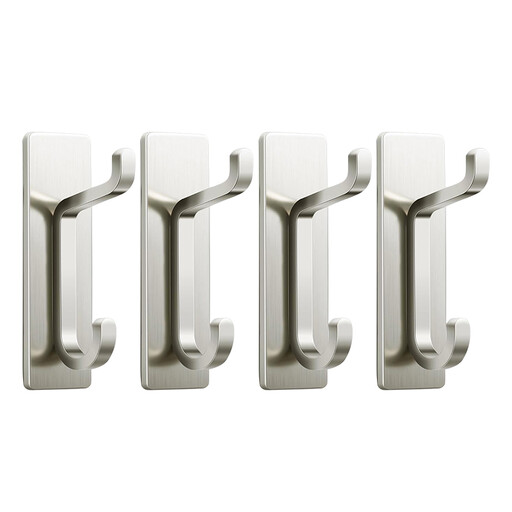
Why this product suits this profile: Four self-adhesive stainless steel hooks provide a no-drill solution for smooth surfaces in the kitchen, bathroom, bedroom or hallway.
Installation requires no drilling; the surface should be cleaned before use and the permitted load must be observed.
Stainless steel construction, silver finish and a 4-pack for several storage points.

Why this product suits this profile: This model provides ten hanging points and makes use of the door surface without requiring permanent wall installation.
The door dimensions and positioning must be checked in advance; according to the product details, the hook must not be overloaded.
Ten hooks, steel construction, silver finish and tool-free installation.
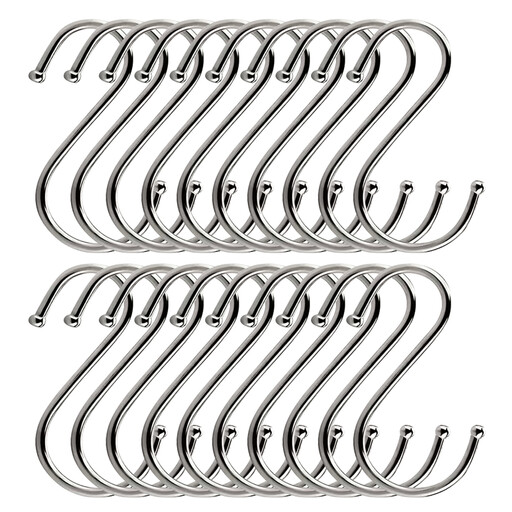
Why this product suits this profile: A set of 20 S-hooks is suitable for flexible storage on rails, racks or edges in the kitchen, bathroom, bedroom, office and garden.
The hooks are simply hung in place; the relevant rail or edge must be sufficiently sturdy and able to distribute the load evenly.
75 mm length, 20 pieces per pack and a smooth, rust-resistant finish according to the product description.
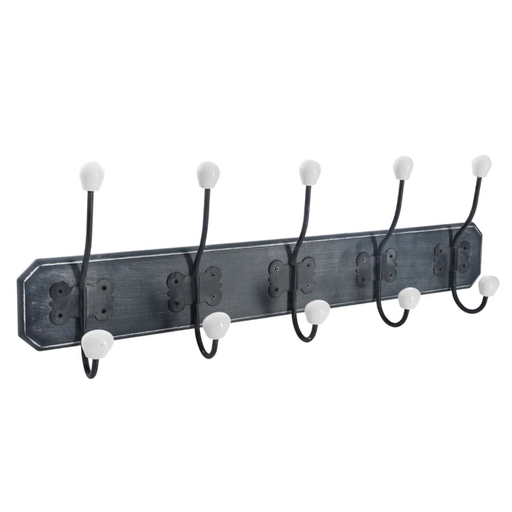
Why this product suits this profile: The 60.5 cm-wide coat hook is designed for a permanent place on the wall in the entrance hall or bedroom.
Wall installation makes the fixing method clear: suitable wall plugs and screws must be selected for the wall type and intended load.
Five hooks, 60.5 cm width and MDF, ceramic and steel materials for indoor use.
We have put together a complete, regularly updated list of products that fully meet these strict selection criteria and the safety regulations applicable in the EU.
With self-adhesive hooks, the surface should first be cleaned with a suitable, low-residue cleaning product and allowed to dry completely. The hook should then be pressed firmly into place without moving it sideways. Do not load it until the waiting time specified by the manufacturer has elapsed.
For over-door hooks:
S-hooks do not require permanent installation. Nevertheless, the rail, shelf or rack must be suitable for the weight. In damp conditions, regular checks of the surface are recommended.
Self-adhesive hooks are an option for smooth, load-bearing surfaces. No-drill door hooks are another option, as they do not require holes to be drilled in the wall. With delicate wallpaper or an unstable surface, the installation method should be chosen particularly carefully and the manufacturer’s instructions followed.
This depends on the surface, humidity, adhesive area and load. Smooth tiles or glass are generally more suitable than porous or uneven surfaces. Before hanging heavy or persistently damp items, check whether the specific hook is designed for this purpose.
There is no single answer. The decisive factors are the product specifications, installation method, surface and weight distribution. With wall hooks, wall plugs and screws affect the load capacity; with over-door hooks, the door thickness and fit also play a role. The stated maximum load should never be exceeded.