
Lieferung heute & morgen

Qualitätsgarantie

Willkommens-Angebote freischalten: KOSTENLOSE Lieferung | Bis zu 80 % RABATT | Kostenlose 30-Tage-JoyPlus-Testphase
App herunterladen
A storage jar with a wooden lid combines clear storage with a natural look. The right jar can help keep cupboards and shelves tidy while storing pasta, rice, flour, sugar, coffee or tea. However, models can vary significantly in capacity, seal, care requirements and materials.
If you buy on looks alone, it’s easy to overlook important details. The points below will help you look beyond the marketing claims and choose a glass storage jar that suits your household.
A wooden lid alone won’t automatically make a jar airtight. What matters is a silicone seal, or a comparable sealing element that fits snugly against the rim of the jar. If this isn’t specified, it’s hard to know how well the container protects its contents from air and moisture.
For jars described as having a hermetic seal, also check that the seal can be fitted correctly and that the lid closes securely. This is particularly important for dry foods, as moisture can affect their texture and storage life.
The external dimensions of a kitchen storage container don’t tell you how much it can hold. For example, a jar that’s 22 cm tall needs enough clearance on the shelf, while a square model uses shelf space differently from a round one.
Check the usable capacity in litres and compare it with the usual pack size of the food you want to store. A 0.4-litre jar may be enough for spices or tea. Depending on the quantity, pasta, rice or flour may need a jar of 0.75 to 1.3 litres.
Glass is often easy to care for, but wooden lids need different treatment. Some jars are dishwasher-safe, while others can only be washed by hand. Even if the glass body is dishwasher-safe, that doesn’t necessarily apply to the lid, seal and fastening.
Another point to bear in mind: not every storage jar is suitable for the microwave, oven or hot liquids. A glass container for pasta and rice is primarily intended for dry foods. Always check the manufacturer’s instructions before use.
For storage, the product should be expressly suitable for food contact. The jars featured here have glass bodies, with some models made from borosilicate glass. This material is often used for household containers, but sudden changes in temperature should still be avoided.
Wood types such as pine and acacia differ in appearance. For everyday use, however, the finish, how well the lid fits and the care instructions matter most. A more sustainable way to store food in the kitchen isn’t down to the wood look alone, but to using the jar repeatedly over as long a period as possible.
An airtight storage jar should have a silicone seal and a sturdy fastening. Some models also have a stainless steel clip. Before buying, check:
These details help you tell the difference between a decorative jar and a genuinely practical storage container.
The right size depends on the food and how much you use:
A matching set can create a more coordinated look, but it takes up more space and isn’t always cost-effective if you only want to decant a few individual foods. Measure the shelf height and width before ordering.
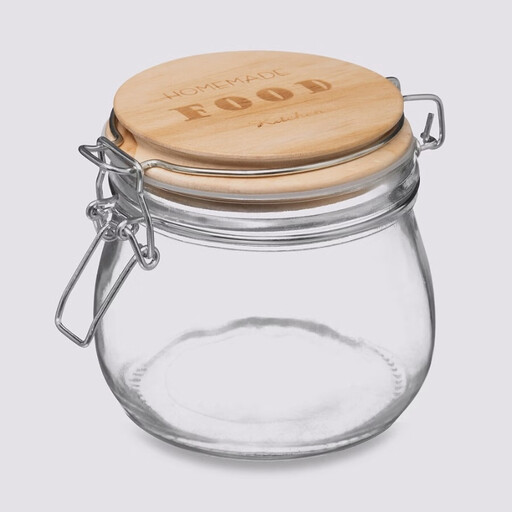
Why this product suits this type of buyer: With a usable capacity of 0.5 litres, it’s suitable for smaller quantities and individual ingredients, without the need to buy a complete set of storage jars.
The product details specify silicone for the seal and stainless steel for the clip. This gives a clearer picture of how it closes than you’d get from a purely decorative jar.
0.5-litre usable capacity, glass body, pine lid, suitable for food contact and, according to the product details, dishwasher-safe.
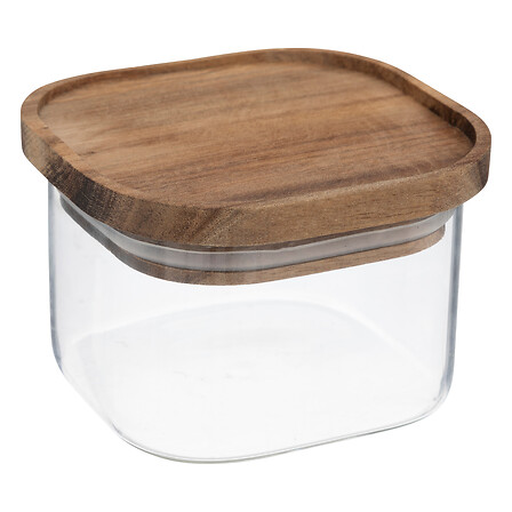
Why this product suits this type of buyer: The square shape makes organised use of shelf space. Its specified borosilicate glass and acacia wood lid will appeal to buyers who prioritise material details over appearance.
The product details specify a silicone seal, an airtight closure and clear restrictions to dry foods. The lid should be washed by hand.
0.4-litre capacity, square shape, borosilicate glass, acacia wood and a hermetic seal according to the product description.
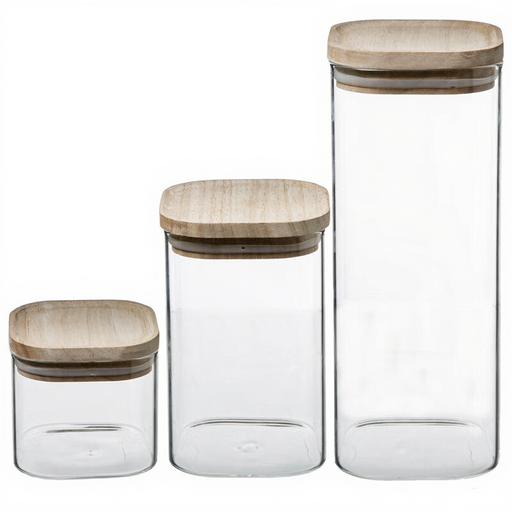
Why this product suits this type of buyer: This set of three jars is designed for households that want to store several staple ingredients in a coordinated way, where they’re easy to see.
The product description specifies three jars, each with a 1-litre capacity, and an integrated silicone seal. The wooden lids should be cleaned with a damp cloth.
Three jars, each with a 1-litre capacity, hermetic seal, food-safe borosilicate glass and dishwasher-safe glass bodies according to the product details.
We’ve put together a complete, regularly updated list of products that meet these strict selection criteria and the safety regulations applicable in the EU.
Before filling the jar for the first time, clean the glass, lid and seal according to the manufacturer’s instructions, then dry them thoroughly. Moisture inside the jar can make flour, sugar, rice or pasta clump together.
If needed, label the contents with the product name and the date you decanted them. This makes it easier to use older supplies first. Wooden lids shouldn’t be left in water for long periods. When changing the contents, it’s also important to remove all residue, particularly after storing coffee, spices or strongly flavoured foods.
For opened jars of pasta sauce, follow the instructions on the original jar. A storage jar with a wooden lid isn’t automatically suitable for moist foods or for storing food in the fridge. If you’re looking for pasta sauces in jars, you can browse the linked category separately.
Only if it has a suitable seal and fastening. Look for details such as a silicone seal, or descriptions like “hermetic” or “airtight”. A wooden lid that simply rests on top will keep out dust, but it isn’t a substitute for a sealed closure.
For the leftovers from a single pack, 0.75 to 1 litre is often a practical size. Larger quantities may need a jar with a capacity of more than 1 litre. The key factors are the actual quantity, the size of the opening and the space available in your cupboard.
Its lifespan depends on the glass, fastening, seal and how well you care for it. Glass can be reused many times when handled carefully. Avoid knocks and sudden changes in temperature. Wooden lids should be stored dry and cleaned according to the care instructions. If the seal is damaged, don’t continue using it for airtight storage.