
Lieferung heute & morgen

Qualitätsgarantie

Willkommens-Angebote freischalten: KOSTENLOSE Lieferung | Bis zu 80 % RABATT | Kostenlose 30-Tage-JoyPlus-Testphase
App herunterladen
A storage ottoman combines a seat and storage in one compact piece of furniture. In the living room it doubles as a footstool or side table, in the bedroom as a bed bench, and in the hallway as a bench with storage for scarves, bags or accessories. It’s precisely this versatility that makes choosing one a little tricky: not every model is equally suited to sitting, stowing or frequent repositioning.
As a Joybuy Product Recommendation Officer, I filter the relevant product details using clear, transparent criteria. That way, you can avoid the usual missteps instead of being guided purely by colour, padding or marketing claims.
A stated maximum load capacity sounds clear-cut at first glance. What really matters, though, is the conditions under which it applies. For many products, the figure refers to a static load with the lid closed and seated correctly. Jumping, bouncing or standing on a padded ottoman can cause damage or tipping regardless of the stated value.
So look out for wording such as “maximum static load capacity” and follow the usage instructions. A storage chest ottoman is generally designed as seating, not as a step or ladder.
A storage stool can look compact on the outside yet offer significant internal volume. For blankets, cushions or bedding, it’s not just the volume that matters but also the opening. A narrow lid or fixed internal divider can make it harder to store bulkier textiles.
Models with a removable divider are handy if you want to keep smaller items organised. For bulky items, check the internal height and width against what you plan to store. Items that are too large or protrude should not be kept inside the ottoman.
A folding ottoman is easy to store, but it requires a fully inserted base plate or correctly secured structure. If a folding storage stool isn’t completely unfolded, its stability can be compromised. For designs with hinges or removable feet, make sure all parts are securely fastened before use.
Measure the available space first. A longer ottoman around 110 cm wide works well as a storage bench, bed bench or seat in front of a window. For small flats, a student room or a narrow hallway, a model around 38 cm wide is often easier to place.
Also factor in the lid’s opening clearance. In front of a chest of drawers or at the foot of the bed, you’ll need enough room to access the storage with ease.
MDF panels form the load-bearing structure in many storage ottomans. Terms like MDF E1 denote a specific emissions class for the engineered wood; they don’t replace checking all of the product details. Reinforced lid corners, metal fittings or a sturdy frame can add further support to the build.
Upholstery options include foam, polyester, velvet, corduroy or linen-look fabrics. A padded ottoman with a foam top can be suitable as a seat or footstool. For care, it’s crucial whether the cover is removable and which cleaning method the manufacturer recommends.
Match the maximum load capacity to how you intend to use it. A model rated to 120 kg may be designed for one seated person; some products quote up to 300 kg as a static load. That doesn’t mean the ottoman is suitable for jumping on or standing on for extended periods.
The ottoman should stand on a level, stable and non-slip surface. Children shouldn’t play inside the storage space. Padding and textile covers should also be kept away from open flames or intense heat.
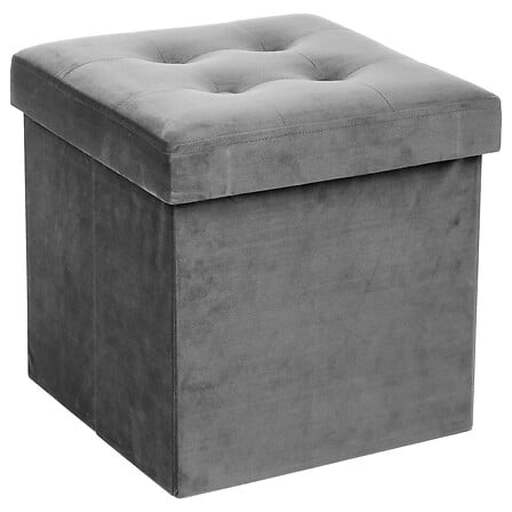
Why this product fits the profile: Measuring 38 × 38 × 38 cm and weighing 2.4 kg, this folding ottoman suits smaller spaces, the hallway, or as a flexible extra perch.
The foldable design is intended for space-saving storage. Before use, the ottoman must be fully unfolded and placed on a stable surface.
Compact dimensions, low weight and a grey velvet cover that blends with various interiors.
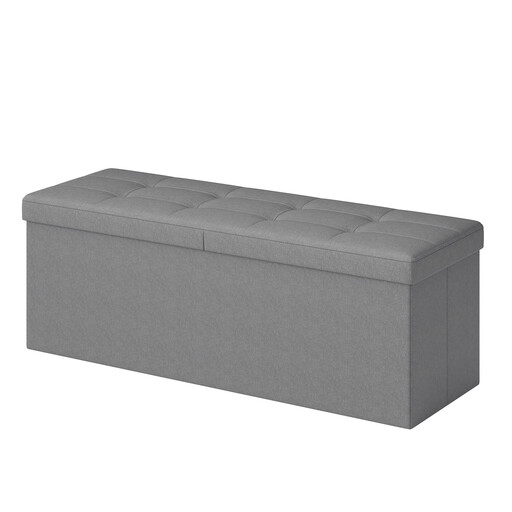
Why this product fits the profile: This bench, 43 cm wide and 110 cm long, combines 131 litres of storage with a padded surface and works as a bed bench or storage bench in the bedroom and living room.
The product details list internal volume, a removable divider, plus MDF panels and metal reinforcements on the lid. That makes the storage and construction easier to assess.
131 litres of capacity, a foldable design and a stated maximum static load of 300 kg.
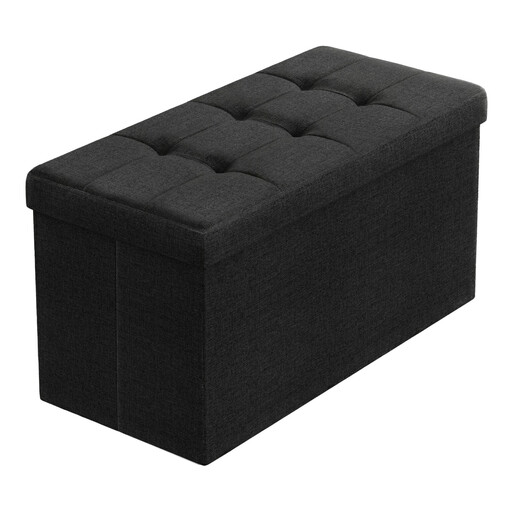
Why this product fits the profile: A middle width of 76 cm provides two seats or extra surface area without the footprint of a long storage bench.
The specs list 89 litres of volume and a foldable design. Before sitting, the lid must be fully closed; oversized items don’t belong in the compartment.
89 litres of storage, 76 cm width and a stated maximum static load of 300 kg.
We’ve compiled a complete, continuously updated list of products that fully meet these strict selection criteria and the safety regulations in force in the EU.
That depends on the specific model and the type of load stated. Some products quote 120 kg or 150 kg, others up to 300 kg as a static load. These figures apply only when used as intended with the lid fully closed. Standing, jumping or point loads may be excluded.
There’s no one-size-fits-all lifespan. It depends on how often it’s used, the weight applied, the surface it stands on, and how it’s cared for. A fully unfolded frame, a correctly seated lid and observing the load limit reduce mechanical stress. If you notice visible damage to the cover, seams or structure, stop using the item.
A longer model around 110 cm wide can be used as a bed bench at the foot of the bed, provided the room’s depth and the stated load capacity are appropriate. Check the seat height, the lid’s opening direction and the distance to the bed before buying. For a narrow hallway or a small bedroom, a compact footstool is often easier to integrate.