
Lieferung heute & morgen

Qualitätsgarantie

Willkommens-Angebote freischalten: KOSTENLOSE Lieferung | Bis zu 80 % RABATT | Kostenlose 30-Tage-JoyPlus-Testphase
App herunterladen
A storage shelf should help you stay organised, make good use of the space you have and suit your home’s style. But poor choices often only become clear after assembly: the shelf may not be suitable for the wall you’re fixing it to, the surface area may be too small, or the stated load capacity may be mistaken for the capacity of the shelf once it’s mounted on your wall.
To make choosing easier, it’s worth looking out for three common buying pitfalls:
For a wall shelf in the living room or bedroom, engineered wood and metal are often suitable, provided the finish and fixings can support the weight. In the kitchen and bathroom, look for a surface that’s easy to clean. A painted or otherwise coated wooden surface can make wiping it down easier, but it still needs proper care.
Look for specific details such as:
With a floating wall shelf, the brackets are particularly important because they transfer the load to the wall. Concealed fixings also affect what’s needed to secure the shelf to the wall. If you’re unsure, check the wall type before buying.
A stated load capacity isn’t a blanket figure that applies to every installation. It depends on factors including:
The kapanou model is rated to hold up to 20 kg or 44 lbs. This limit must not be exceeded, and assumes the shelf is securely mounted at suitable points or with appropriate wall anchors.
Measure not only the available wall width, but also the depth, distance from doors and height of the items you plan to store. Books need a different shelf depth from spice jars or small toiletries. A space-saving shelf can be particularly useful in narrow hallways, small bathrooms or above worktops.
There are several options for the kitchen:
For the bathroom and living room, also consider whether you want your items to be on display. Open shelves are ideal for decorative objects, plants or bathroom essentials you use often. Closed storage offers better protection from dust, but isn’t included in this selection.
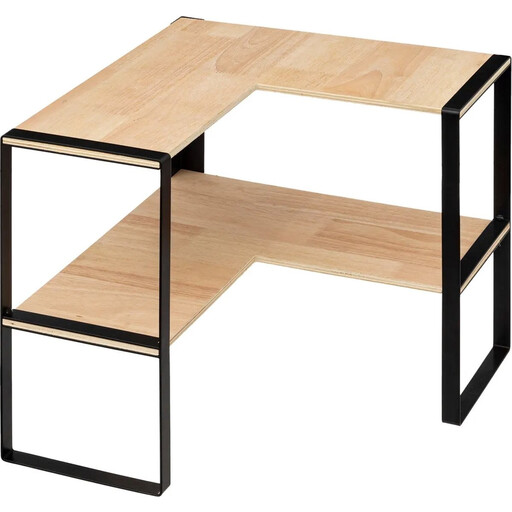
Why it suits this profile: This compact corner unit is designed for worktops, cupboards or the space under the sink. Measuring 40 × 40 × 35 cm, it has two tiers for storing spices, food containers or smaller kitchen utensils.
The precise external dimensions and the materials—steel and plywood—make it easier to plan where it will go. As it isn’t a wall shelf, there’s no need to choose wall anchors.
Two tiers, a corner design, self-assembly and versatile use in the kitchen, bathroom, garage or cellar.
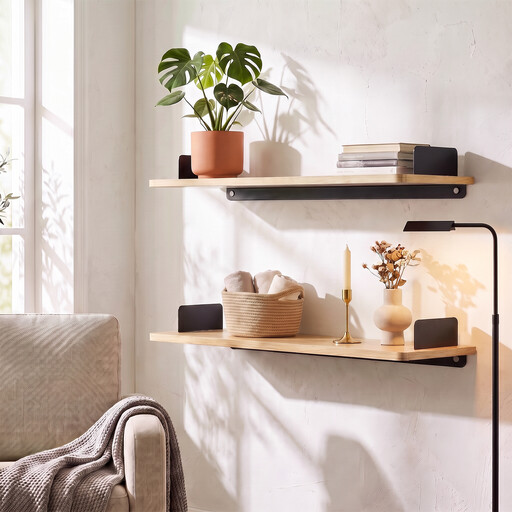
Why it suits this profile: This wall shelf combines rubberwood with aluminium alloy brackets and a painted finish. It’s suitable for books, photo frames, plants, bathroom essentials or kitchen utensils when you’re looking for a wall-mounted option.
The materials, maximum load and mounting instructions are clearly specified. The shelf must still be fixed at suitable points or with appropriate wall anchors.
Rated to hold up to 20 kg, made from two materials and suitable for use in the living room, bathroom, kitchen or office.
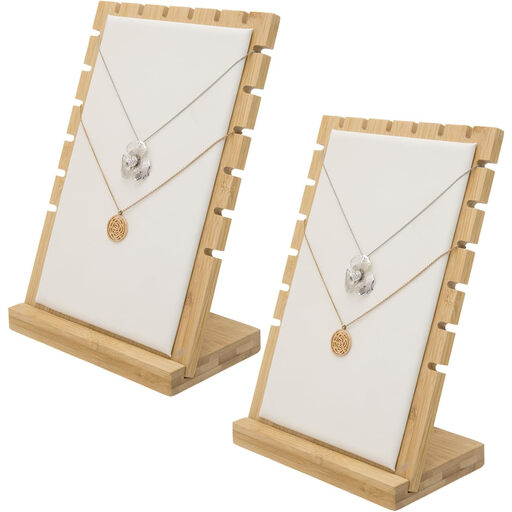
Why it suits this profile: This two-part jewellery stand is designed for households, jewellery shops, market stalls and crafters who want to display necklaces, pendants or chains neatly.
The multiple hanging levels keep chains of different lengths separate. The removable feet make it easier to transport and store compactly.
A bamboo frame, white PU panels, a two-part design and a construction made for use on a table, sales counter or dressing table.
We’ve put together a complete, regularly updated list of products that meet these strict selection criteria and the safety regulations in force in the EU.
Before installation, use a spirit level to check the position and make sure there are no cables or pipes in the wall. For a wall shelf, choosing suitable screws and wall plugs is an important part of making sure it’s safely installed. Don’t exceed the maximum load, even if you add more items later.
A few simple steps can help your shelf last longer:
A shelf for the bathroom or living room may react differently to humidity depending on its material. If it’s going in a consistently damp area, the specific care and material details matter more than a general description such as ‘water-resistant’.
It depends on what you’ll use it for. Lighter loads are fine for decorative items, while books, plant pots or jars of food need a higher load capacity. The manufacturer’s rating isn’t the only thing to consider: the shelf must also be securely fixed to the type of wall you have.
Use wall plugs specifically designed for plasterboard and check their load limit. For heavy items, fix the shelf to supporting studs or other suitable points in the wall wherever possible. Always follow the instructions for the specific product.
A tabletop model with removable feet can be handy for displays you need to move around. Before buying, compare its footprint, packed dimensions, stability and the number of hanging points you need.