Strategy players with limited desk space
If you want to see the whole game interface while sharing a desk or room, screen width and stand dimensions are important factors to consider.


If desk space is limited, a compact 16:9 monitor could be a sensible choice; a 27-inch QHD model is worth considering if your desk, viewing distance and PC can accommodate it. RTINGS.com recommends smaller 24-inch displays for sitting close and seeing the whole screen at a glance, while ASUS lists the TUF Gaming VG27AQL3A as a 27-inch QHD model. Also check reflections, brightness controls, ergonomics and connectivity. A particularly high refresh rate or OLED won’t remove the need to weigh up these factors.
If you want to see the whole game interface while sharing a desk or room, screen width and stand dimensions are important factors to consider.
A larger screen can be useful for maps, units and text, provided you have the space and your PC can handle QHD.
If someone else shares the room, factor in brightness controls, reflections and how practical the monitor will be to position.
Start by considering screen format, viewing distance and available space. Then check the lighting and connections, before deciding whether extra features such as a high refresh rate or OLED suit the way you play.
| Criteria | What to look for | Who is it important for? |
|---|---|---|
| Overview and readability | Consider screen size and native resolution together; check the text and menu sizes in the games you play. | If I want to make out the map, units and menus at the same time, the display needs to suit my viewing distance. Around 27% of consumers put an overview and readability first. |
| Space and positioning | Compare the desk’s available width and depth with the dimensions of the exact model’s casing and stand; check its adjustment options. | If space is tight, I want to know whether the screen and stand will fit on the shared desk. Around 27% of consumers prioritise the space a monitor takes up. |
| Room lighting | Check the specific model’s brightness controls, reflections, positioning angle and any lighting on the casing. | If I play in the evening, I consider how easy it is to adjust and position the monitor in a shared room. Around 20% of consumers place particular importance on being considerate of others. |
| Motion handling | Check the refresh rate at your preferred resolution, compatible connections and variable refresh rate support; treat advertised millisecond figures as manufacturer claims. | If smooth-moving units and camera pans matter to me, the refresh rate needs to work with my PC and connection too. Around 13% of consumers prioritise motion handling. |
| Energy and support | Compare the specific model’s EU energy label and distinguish statutory consumer rights from a voluntary manufacturer’s warranty. The European Commission explains the efficiency scale for displays, while Germany’s Consumer Advice Centre describes the difference between statutory rights and a guarantee. | If I use my monitor regularly, I want to consider its energy figures and what would happen if it developed a fault. Around 13% of consumers prioritise running costs and support. |
For a clear view of the game, readability, available space and the frame rate your PC can actually deliver may matter more. A high refresh rate on the monitor alone doesn’t tell you what frame rate your system will achieve in-game.
First check the screen format and game interface, then compare the frame rate and connections supported by your whole system.
Even a screen with the right diagonal measurement needs to fit the available space, taking its casing, stand and viewing distance into account.
Measure the desk’s width and depth, then compare them with the dimensions of the specific monitor and its stand.
A stand that doesn’t fit could mean making changes to your desk or setup.
If a static game interface stays on screen for long periods, burn-in remains a risk to consider. MSI describes OLED Care 2.0 as a way to reduce the risk, not eliminate it.
Check the care features and warranty terms for the exact OLED model, and compare it with an LCD option.
The 24G4XE is a compact 23.8-inch Full HD IPS option for limited desk space.
The TUF Gaming VG27AQL3A is a 27-inch QHD IPS option if your desk and PC can accommodate this size.
The MPG 271QRXDE QD-OLED is an OLED option for buyers who prioritise contrast and fast image output.
The Odyssey OLED G81SF (S27FG814SU) is an OLED model to consider; whether it suits a shared bedroom also depends on space and where you’ll position it.
The 27GX790B-B is another OLED gaming monitor to consider.
The models below include compact Full HD monitors and larger 27-inch QHD options. Choose the right size based on your available space, viewing distance and preferred display.
 No image available
A 27-inch QHD option if you have room on your desk for a larger display.
27 inches, 2560 × 1440 pixels, 144 Hz, Fast IPS, FreeSync and a height-adjustable stand.
 No image available
A larger QHD option if you have room for a 27-inch screen and want to make use of the stand’s adjustment features.
27 inches, QHD, 275 Hz, IPS and Mini-LED with 1,152 zones; the product description lists height, tilt and swivel adjustments. It also mentions an RGB lighting effect on the back; check whether that works for your shared room.
 No image available
A 27-inch QHD option if you want more room for maps and menus and your desk can accommodate the larger screen.
27 inches, 2560 × 1440 pixels, 120 Hz, IPS and Adaptive Sync.
 No image available
A compact option if you want to see the whole screen at a glance without needing much desk space.
24 inches, Full HD, 144 Hz, IPS, Adaptive Sync and tilt adjustment.
 No image available
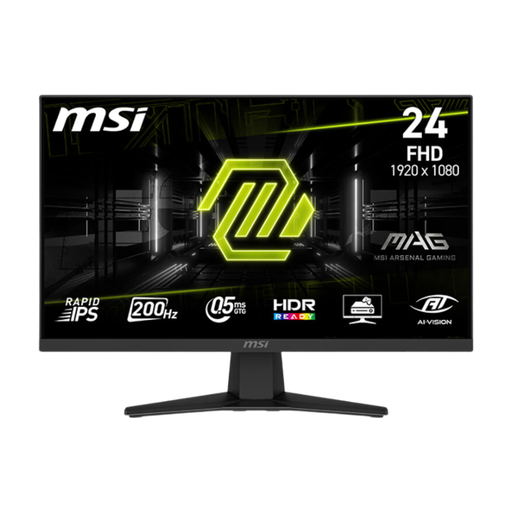
A compact Full HD option if screen width and positioning in a shared room are important to you.
23.8 inches, Full HD, Rapid IPS, 200 Hz and 16:9.
Start with available space, viewing distance and how easy it is to read your game interface. Then check what refresh rate your PC, connection and monitor can support together at your preferred resolution.
Measure the desk’s available width and depth, as well as your usual viewing distance. Then compare these with the dimensions of the specific model’s casing and stand, and check whether you can position the screen at a suitable angle.
Check the OLED care features and warranty terms for the exact model. MSI describes OLED Care 2.0 as a way to reduce the risk of burn-in, not as a guarantee that there’s no risk.
Compare the EU energy label details for the specific monitor models. In Germany, the seller is generally responsible for statutory consumer rights when a product is faulty, as the Consumer Advice Centre explains; this is separate from a manufacturer’s warranty.
The electrical product on sale must meet the relevant EU requirements. Germany’s Federal Network Agency lists the appropriate CE marking and required accompanying information in German as points to check; CE marking is not an independent product recommendation.