If you often listen at low volumes, check whether the amplifier adjusts bass and treble according to the volume or whether you need to set them yourself using a fixed EQ. Yamaha documents this volume-dependent feature for the R-N800A after a YPAO measurement. For other models, consider how well they suit your speakers, preferred music services and connections. A high wattage alone won’t tell you how balanced music will sound at low volumes.
Who are these amplifiers for?
Listeners who enjoy electronic music at low volumes
If you often listen at low volumes and want to hear the bass without turning everything up unnecessarily, check whether the tone controls adjust with the volume or need to be set manually. Yamaha documents YPAO Volume as a volume-dependent feature.
Owners of passive speakers
If you want to keep using your existing speakers, check that their type, connections, impedance and power-handling specifications are compatible with the amplifier. WiiM and Bluesound offer models designed for passive speakers.
Listeners with multiple sources
If you want to use music services, your own files or TV audio through the same device, check that the specific model supports each source you need. Yamaha lists MusicCast, but streaming and connection options vary by model.
What should you look for when buying?
| Buying consideration |
What to check |
Who will find this important? |
| Sound at low volumes |
Check whether the tone controls adjust with the volume or are fixed. Yamaha says YPAO Volume requires a YPAO measurement. |
When I listen to electronic music quietly, I want to hear the bass without turning everything up unnecessarily. This is the top priority for around 36% of consumers. |
| Connecting compatible speakers |
Check whether the speakers are active or passive, and compare the connections and impedance specifications of the specific devices. The Marantz MODEL M1 datasheet lists 4–16 Ω for connected speakers. |
If I want to keep using my existing passive speakers, the connections and amplifier need to be compatible. Getting the speakers and amplifier to work together is the main concern for around 29% of consumers. |
| Music sources and control |
Check each service and connection method you need. WiiM’s model comparison lists AirPlay 2 for the WiiM Amp, but not for the Amp Pro. |
If I want to use specific music services or my own files, I need the right access and controls to suit my everyday routine. Access to music sources is the main priority for around 21% of consumers. |
| TV, subwoofer and room correction |
Check the specific model for the TV connections, subwoofer type and room-correction features you need. Yamaha Germany does not list an HDMI-ARC connection for the R-N800A. |
If I want to connect TV audio, a subwoofer or room correction, I need to make sure those exact features are available. This is the deciding factor for around 14% of consumers. |
Common buying misconceptions
-
Assuming a fixed EQ is the same as automatic loudness compensation
A fixed EQ doesn’t adjust automatically when you change the volume. Yamaha documents a volume-dependent feature for the R-N800A; the EQ specifications for the WiiM Amp and Amp Pro don’t, on their own, confirm automatic adjustment.
Check the manual for the exact model to see whether the tone correction changes with the volume and what setup is required.
-
Assuming similarly named amplifier models have the same features
WiiM’s model comparison lists AirPlay 2 for the WiiM Amp, but not for the WiiM Amp Pro.
Check the full model name against the streaming methods you need.
-
Assuming a subwoofer or room correction is a complete solution
A subwoofer output alone doesn’t tell you what type of subwoofer you can connect. NAD says Dirac Live Bass Control is an optional licence; the Dirac Live licence included with the M10 V3 covers frequencies up to 500 Hz.
Decide which bass features you need, then check the connections and licence included with the specific model.
A suitable active subwoofer or an additional licence may mean extra purchases.
Relevant brands and model ranges
Yamaha
The R-N800A combines network streaming with traditional hi-fi connections and documented volume-dependent tone control.
- Yamaha describes YPAO Volume as a feature that adjusts bass and treble according to the volume after a YPAO measurement.
- At 435 × 151 × 395 mm, the R-N800A is relatively large, and the German specifications don’t list an HDMI-ARC connection. These are model specifications, not an independent sound comparison.
WiiM
The Amp and Amp Pro are compact streaming amplifiers for passive speakers, with EQ and an output for an active subwoofer.
- WiiM documents graphic and parametric EQ for both models.
- An adjustable EQ isn’t proof of automatic volume compensation. The model comparison lists AirPlay 2 for the Amp, but not for the Amp Pro.
Marantz
The MODEL M1 combines HEOS music streaming with HDMI eARC and a subwoofer output.
- The European manufacturer’s datasheet lists adjustable filters and bass and treble controls.
- It doesn’t list an automatic loudness feature that adjusts according to the music listening volume. Availability of the listed music services may vary by region.
NAD
The M10 V3 is aimed at buyers who want to set up BluOS, subwoofer integration and limited Dirac Live room correction.
- NAD lists two subwoofer outputs and an included Dirac Live licence covering frequencies up to 500 Hz.
- NAD says Dirac Live Bass Control is available only with an additional licence. Room correction isn’t proof of an automatic loudness feature.
Bluesound
The POWERNODE EDGE is a compact BluOS option for passive speakers.
- Bluesound lists 40 W per channel, a subwoofer output and Bluetooth headphone output for this model.
- These specifications describe the model’s features, not how it sounds at low volumes.
Joybuy product selection
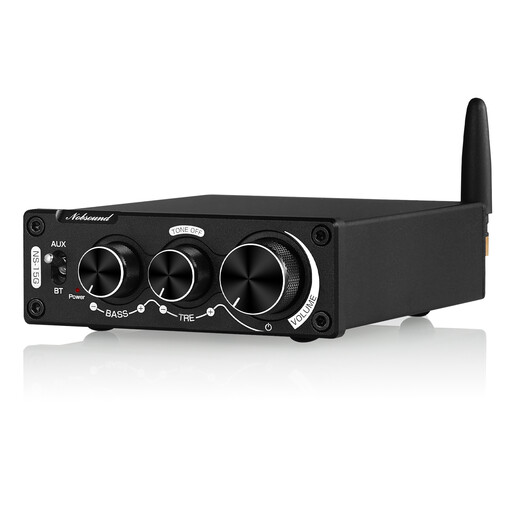
This selection includes a compact amplifier with manually adjustable tone controls for use with passive speakers.
 No image available
Nobsound 200 W Mini Bluetooth Digital Amplifier
Designed for passive speakers, with tone controls you can adjust yourself; Bluetooth and RCA are listed as inputs.
The product listing specifies speaker outputs and bass and treble controls with ±10 dB adjustment. The tone controls are manual; automatic adjustment according to the volume isn’t specified.
Joybuy
Frequently asked questions
Is a high wattage enough to make electronic music sound balanced at low volumes?
No. The wattage doesn’t tell you whether bass and treble adjust automatically when you turn the volume down. Look for a clearly documented volume-dependent feature or check the options for adjusting the EQ yourself. The result also depends on your speakers and listening position.
How do I set up the tone controls for listening at low volumes?
On the Yamaha R-N800A, YPAO Volume is linked to a YPAO measurement, according to Yamaha. With an amplifier that has a fixed, adjustable EQ, choose the setting that suits your usual listening volume and test it with familiar recordings. A fixed EQ isn’t automatic loudness control.
Can I connect a passive subwoofer directly to a subwoofer output?
For the outputs described here, you’ll need an active subwoofer or additional amplification: WiiM specifically says that the Amp Pro connects to an active subwoofer. Check the connection and adjustment options on the specific amplifier and subwoofer.
What’s the difference between the WiiM Amp and WiiM Amp Pro?
WiiM’s technical model comparison lists AirPlay 2 for the WiiM Amp, but not for the Amp Pro. Check the feature you need against the full model name, rather than assuming similar names mean the models have the same features.
Should I check for a CE mark on a Wi-Fi or Bluetooth amplifier?
Products covered by the relevant EU harmonisation legislation must carry a CE mark. Germany’s Federal Network Agency describes this requirement for products in scope. Check the marking and documentation on the actual device being offered.


